As we continue with this book discussion, which I will conclude on 7/31/2023, this entry is for chapter 14 of Exegetical Gems. In this unit, Merkle considers imperfect indicatives: his focus text is Galatians 1:13.
We all know Saul of Tarsus' history; he was advancing in the ranks of Judaism as a Pharisee and tried ardently to ravage the ecclesia of God and Christ. Saul's efforts were sincere but he later spoke about his earlier course in 1 Timothy 1:13, calling himself a blasphemer, an insolent man and the foremost of sinners. However, because he was ignorant (lacking the requite knowledge), Jehovah forgave Saul and assigned a ministry to him. He became an apostle to the nations and we know him as Paul. The apostle recounted his prior course to the Galatians: it's interesting how translators render 1:13:
NWT 2013: "Of course, you heard about my conduct formerly in Juʹda·ism, that I kept intensely persecuting the congregation of God and devastating it"
ESV: "For you have heard of my former life in Judaism, how I persecuted the church of God violently and tried to destroy it."
Byington: "For you have heard about my life back in my Jewish days, that I was extraordinarily active in persecuting and ravaging God’s church"
Why do translators handle Galatians 1:13 in these diverse ways?
Greek (WH): Ἠκούσατε γὰρ τὴν ἐμὴν ἀναστροφήν ποτε ἐν τῷ Ἰουδαϊσμῷ, ὅτι καθ' ὑπερβολὴν ἐδίωκον τὴν ἐκκλησίαν τοῦ θεοῦ καὶ ἐπόρθουν αὐτήν
The verb ἐπόρθουν is imperfect: the imperfect morphology (tense-form) is imperfective aspect, which means that the verb depicts action as "progressive, internal, or incomplete" (Merkle, page 63). The imperfect "almost always" grammaticalizes past time since it's in the indicative mood. But how does markedness potentially affect imperfect-tensed verbs? Given marked features, the imperfect functions like the present tense does:
Progressive (Luke 4:15), inceptive (John 5:9), iterative (Acts 2:40), and tendential (Acts 18:4) Aktionsarten. The last category known as tendential could apply to Galatians 1:13.
Merkle explains that Greek tends to wield the imperfect in order to communicate attempted action or an action that is tried but not necessarily completed. Several verses in the NT appear to confirm that imperfect indicatives have the ability to portray conative or inchoate action.
I will conclude the last part of this discussion with some prior research I've done on this question:
James Brooks and Carlton L. Winbery classify ἐδίωκον and ἐπόρθουν in Galatians 1:13 as examples of the Greek descriptive imperfect, meaning that the verbs describe what has taken place at some time in the past. However, they note that ἐπόρθουν "could also be interpreted as a tendential imperfect" (Syntax of NT Greek, 91).
Compare the tendential imperfect at Acts 26:11. In the final analysis, I agree that it is a judgment call when translating Galatians 1:13, but it seems to me that Paul did not lay waste or destroy the Christian congregation. Rather, he tried laying waste to God's congregation.
Walter W. Wessel (in Mounce's grammar) states that ἐπόρθουν at Galatians 1:13 is a tendential imperfect, expressing attempted action (BBG, 176). Again, the reasoning is that Paul did not really devastate the congregation of God, but only attempted to do so. Moreover, ἐδίωκον appears to express repeated action in the past (customary action), which explains the NASB's "used to persecute . . . "
Ralph Earle writes: "The imperfect tense would suggest that Paul 'was ravaging' the Church and trying to destroy it, but that he did not completely succeed" (Word Meanings in the NT, 271).
Hans D. Betz, Galatians, page 67--Hermeneia Series:
112 Bauer's tr. uses the imperfect de conatu: "I tried to destroy." So also BDR, § 326. Cf. the same term Gal 1:23; Acts 9:21, in the same context. The term is common as a description of political oppression. See 4 Macc 4:23; 11:4; Philo Flacc. 54; Josephus BJ 4.405; Ant. 10.135. For passages see also LSJ, s.v., and Philippe- H. Menoud, "Le sens du verbe Porqein," in Apophoreta, Festschrift fur E. Haenchen (BZNW 30; Berlin: Topelmann, 1964) 178-86. G reads ἐπολέμουν ("I attacked") instead, perhaps an influence of the Latin expugnabam.
Douglas Moo, Galatians, page 100:
With a ὅτι (hoti, that), Paul elaborates on the specifics of that “former way of life in Judaism.” First, he was “intensely persecuting the church of God and trying to destroy it” (καθ᾿ ὑπερβολὴν ἐδίωκον τὴν ἐκκλησίαν τοῦ θεοῦ καὶ ἐπόρθουν αὐτήν, kath’ hyperbolēn ediōkon tēn ekklēsian tou theou kai eporthoun autēn). Both verbs are in the imperfect tense, the former because it is a durative idea—“I was persecuting”—and the second because it is conative—“I tried to destroy” (Wallace 1996: 551).
The conative use is synonymous with the tendential Aktionsart. Other verses that Merkle cites to support the case for Galatians 1:13 being conative are Matthew 3:14-15; Luke 4:42; Mark 15:23.
Showing posts with label bookdiscussion. Show all posts
Showing posts with label bookdiscussion. Show all posts
Friday, July 21, 2023

Tuesday, July 18, 2023
Benjamin Merkle's "Exegetical Gems" (A Discussion)-Part XI-Present Indicatives
Merkle begins chapter 13 with some sage advice that concerns reading the biblical text and the presuppositions that we bring to the Bible. Yet his primary objective is to discuss present indicatives with 1 John 3:6 as the focus.
1 John 3:6 (WH): πᾶς ὁ ἐν αὐτῷ μένων οὐχ ἁμαρτάνει· πᾶς ὁ ἁμαρτάνων οὐχ ἑώρακεν αὐτὸν οὐδὲ ἔγνωκεν αὐτόν.
Four options are presented in the chapter as to how one should understand this passage. The main issue is whether John claims that true Christians are now sinless or can get to that point before this ungodly world ends. However, before addressing these questions, Merkle reviews aspects of the present indicative.
While it would seem that Greek present indicatives signify present action, and they certainly do, there are cases where present indicative verbs refer to past action, future action or action that is omnitemporal/gnomic. Present indicatives are imperfective vis-à-vis their aspect: this means that "the action is portrayed as progressive, internal, or incomplete" (Exegetical Gems, page 58). What ultimately determines how present indicatives function are marked features of discourse such as lexicality, grammar or context/linguistic setting. Here is an example of how markedness affects a present indicative verb's kind-of-action. The functions of these verbs include:
Progressive (1 John 2:8), durative (Luke 13:7), iterative (Acts 7:51), gnomic (Matthew 7:17), instantaneous (John 11:41), historical (Mark 1:40), futuristic (Revelation 1:7).
Getting back to 1 John 3:6, the point of contention is οὐχ ἁμαρτάνει: the verb is present active indicative third person singular of ἁμαρτάνω. See 1 John 5:18. Is John asserting that Christians never sin? Both experience and the very first epistle of John militate against such a view. Compare 1 John 1:8-10; 2:1; 5:16.
Robert Yarbrough reveals why it's not easy to untangle John's exact meaning (1-3 John, page 183 in the BECNT Series):
Merkle thinks the verb is iterative based on the epistolary context of 1 John and the immediate context of 1 John 3:6. Christian perfectionism seems to be ruled out and it's doubtful that John's word apply eschatologically, given the context; neither idea fits the setting of John's letter or the surrounding verses of the passage in question. The chapter concludes by appealing to 1 John 3:9 and its grammar, then Merkle references and quotes The First John Reader by S.M. Baugh. I tend to concur with him that the verb in 1 John 3:6 likely functions iteratively rather than gnomically or duratively.
1 John 3:6 (WH): πᾶς ὁ ἐν αὐτῷ μένων οὐχ ἁμαρτάνει· πᾶς ὁ ἁμαρτάνων οὐχ ἑώρακεν αὐτὸν οὐδὲ ἔγνωκεν αὐτόν.
Four options are presented in the chapter as to how one should understand this passage. The main issue is whether John claims that true Christians are now sinless or can get to that point before this ungodly world ends. However, before addressing these questions, Merkle reviews aspects of the present indicative.
While it would seem that Greek present indicatives signify present action, and they certainly do, there are cases where present indicative verbs refer to past action, future action or action that is omnitemporal/gnomic. Present indicatives are imperfective vis-à-vis their aspect: this means that "the action is portrayed as progressive, internal, or incomplete" (Exegetical Gems, page 58). What ultimately determines how present indicatives function are marked features of discourse such as lexicality, grammar or context/linguistic setting. Here is an example of how markedness affects a present indicative verb's kind-of-action. The functions of these verbs include:
Progressive (1 John 2:8), durative (Luke 13:7), iterative (Acts 7:51), gnomic (Matthew 7:17), instantaneous (John 11:41), historical (Mark 1:40), futuristic (Revelation 1:7).
Getting back to 1 John 3:6, the point of contention is οὐχ ἁμαρτάνει: the verb is present active indicative third person singular of ἁμαρτάνω. See 1 John 5:18. Is John asserting that Christians never sin? Both experience and the very first epistle of John militate against such a view. Compare 1 John 1:8-10; 2:1; 5:16.
Robert Yarbrough reveals why it's not easy to untangle John's exact meaning (1-3 John, page 183 in the BECNT Series):
It is unlikely that John has forgotten what he wrote earlier or changed his mind in the interim. Nor is it advisable to resort to the understandable but unsatisfactory expedient of stressing the alleged continual nature of the sinning John has in mind (e.g., NIV/TNIV: “No one who lives in him keeps on sinning”). This may be true, but “keeps on sinning” (adopted also by ESV) probably overreads the verb tense (cf. Wallace 1996: 524–25; contra Kruse 2000: 120 and many other commentators). Smalley (1984: 159–60) effectively unmasks this misuse of the present tense, along with the dubious proposal that 2:1 in contrast uses aorist forms to connote isolated sinful acts. This is oversubtle. In addition, as Smalley points out, 5:16 uses the present tense to describe specific sinful acts, not chronic transgression. The present tense cannot bear the weight that the translation “keeps on sinning” places on it in 3:6, 9 (cf. Culy 2004: 73; yet note Caragounis 2006: 90: the issue is complicated!).Daniel Wallace proposes an eschatological reading of 1 John 3:6; in other words, he argues that John is using the present indicative gnomically to state a general truth about followers of Christ, but he's also looking forward to the eschaton when believers will be free of sin. Merkle just relates this proposal without truly supplying much interaction at this point. However, the most likely interpretation of 1 John 3:6, according to Exegetical Gems, is that ἁμαρτάνει is an iterative present which means that the action portrayed by the verb would be continuous, repetitive or customary.
Merkle thinks the verb is iterative based on the epistolary context of 1 John and the immediate context of 1 John 3:6. Christian perfectionism seems to be ruled out and it's doubtful that John's word apply eschatologically, given the context; neither idea fits the setting of John's letter or the surrounding verses of the passage in question. The chapter concludes by appealing to 1 John 3:9 and its grammar, then Merkle references and quotes The First John Reader by S.M. Baugh. I tend to concur with him that the verb in 1 John 3:6 likely functions iteratively rather than gnomically or duratively.
Saturday, July 08, 2023
Benjamin Merkle's "Exegetical Gems" (A Discussion)-Part X-Verbal Aspect and Aktionsart
Chapter 12 of Exegetical Gems is about verbal aspect, and the Bible verse for discussion is Matthew 16:24 (WH): Τότε ὁ Ἰησοῦς εἶπεν τοῖς μαθηταῖς αὐτοῦ Εἴ τις θέλει ὀπίσω μου ἐλθεῖν, ἀπαρνησάσθω ἑαυτὸν καὶ ἀράτω τὸν σταυρὸν αὐτοῦ καὶ ἀκολουθείτω μοι.
This passage contains two aorist imperatives and one present imperative. Why does Matthew switch when recording the third imperative given by Jesus here? To answer these questions, it's important to know something about verbal aspect and verbal Aktionsart. Merkle gives a brief discussion of aspect, which I'll now supplement.
Two influential and competing types of aspect theory are those developed by Stanley Porter and Buist Fanning. To see numerous criticisms of Porter's approach, consult Chrys Caragounis, The Development of Greek and the New Testament: Morphology, Syntax, Phonology, and Textual Transmission (Grand Rapids, Baker Academic, 2006).
Concerning aspect, Richard A. Young explains: "Although the thesis that time is not grammaticalized in Greek may sound extreme, it seems to be the logical conclusion one draws from the study of the nuances of Greek 'tenses' " (Young, Intermediate NT Greek, 105). However, Young qualifies this initial observation:
"Nevertheless, there is still merit in the traditional view that temporal distinctions are grammaticalized in the indicative mood, even though it results in a greater number of anomalies. This does not necessarily indicate a flaw in the analysis, since all languages have forms which overlap into the semantic domain of other forms" (ibid., 107).
S. M. Baugh (A First John Reader, 52) argues that "the function and force of tense forms varies with the different moods." Therefore, "An author chooses the tense form of a participle and the tense form of a complementary infinitive for different reasons" (ibid.). He then illustrates this principle with the example of 1 John 3:9.
Grammarians and linguists use the term Aktionsart in disparate ways, but older grammars often employ Aktionsart as a reference to action delineated by the verbal stem. Porter writes that K. Brugmann in 1885 was the first writer to use the German term Aktionsart for the purpose of describing "the kind of action indicated objectively by the verb" (Verbal Aspect in the Greek of the NT, Stanley Porter, 29). So when I talk about "kind of action" in this context, I am referring to action in terms of completed, durative, ingressive or conative (inchoative) activities that are objectively signaled by the respective verb stem (root + affix) or in some other fashion.
Merkle defines verbal aspect as "the viewpoint or perspective by which an author chooses to portray an action or state" (53). That is, on this view, a writer has the option to present an action as imperfective (present or imperfect morphology), perfective (aorist morphology) or stative (perfect morphology). The pluperfect morphology is also stative and Daniel B. Wallace (Greek Grammar Beyond the Basics, page 501) classifies the future tense as perfective or "external" aspect. But how does this information about verbal aspect relate to Matthew 16:24?
Before aspect theory bloomed into its current form, scholars argued that the aorist "tense" (morphological form/morphology) signified a once-for-all-time kind of action while the present tense indicated that action was ongoing or continuous. However, that has now largely changed: Greek grammarians/scholars now contend that verbs are only punctiliar or continuous based on markedness or some kind of factor besides a verb's morphology (Merkle, page 54). Hence, Matthew 16:24 in all likelihood is not contrasting punctual and continuous action. Exegetical Gems quotes R.T. France who still offers what seems like an older explanation of Jesus' words but Merkle thinks the exegesis of France is not solidly based on the most current understanding of aspect theory. Yet I'm sure that France's take on Matthew 16:24 is not the only outdated view since another interesting target for Merkle, one whom he appears to correct, is Stanley Porter. Does Porter read too much into the aorist imperatives and the present imperative? Exegetical Gems gives that impression.
Merkle maintains that some verbs with a "natural terminus" usually occur in the aorist tense -form (morphology) but verbs that do not have a natural end-point tend to appear in the present tense-form (page 55). ἀπαρνησάσθω and ἀράτω are putative examples of verbs that have a natural terminus; on the other hand, we would expect a verb of motion like ἀκολουθείτω to occur in the present tense-form.
Near the end of the chapter, Merkle demonstrates that the once-for-all-time action versus the continuous action distinction will not hold up under scrutiny: see Acts 12:8 and Luke 9:23.
For an excellent critique of the aorist as a once-for-all-time action, see Frank Stagg. "The Abused Aorist." Journal of Biblical Literature. June 1, 1972. 91 (2): 222–231.
This passage contains two aorist imperatives and one present imperative. Why does Matthew switch when recording the third imperative given by Jesus here? To answer these questions, it's important to know something about verbal aspect and verbal Aktionsart. Merkle gives a brief discussion of aspect, which I'll now supplement.
Two influential and competing types of aspect theory are those developed by Stanley Porter and Buist Fanning. To see numerous criticisms of Porter's approach, consult Chrys Caragounis, The Development of Greek and the New Testament: Morphology, Syntax, Phonology, and Textual Transmission (Grand Rapids, Baker Academic, 2006).
Concerning aspect, Richard A. Young explains: "Although the thesis that time is not grammaticalized in Greek may sound extreme, it seems to be the logical conclusion one draws from the study of the nuances of Greek 'tenses' " (Young, Intermediate NT Greek, 105). However, Young qualifies this initial observation:
"Nevertheless, there is still merit in the traditional view that temporal distinctions are grammaticalized in the indicative mood, even though it results in a greater number of anomalies. This does not necessarily indicate a flaw in the analysis, since all languages have forms which overlap into the semantic domain of other forms" (ibid., 107).
S. M. Baugh (A First John Reader, 52) argues that "the function and force of tense forms varies with the different moods." Therefore, "An author chooses the tense form of a participle and the tense form of a complementary infinitive for different reasons" (ibid.). He then illustrates this principle with the example of 1 John 3:9.
Grammarians and linguists use the term Aktionsart in disparate ways, but older grammars often employ Aktionsart as a reference to action delineated by the verbal stem. Porter writes that K. Brugmann in 1885 was the first writer to use the German term Aktionsart for the purpose of describing "the kind of action indicated objectively by the verb" (Verbal Aspect in the Greek of the NT, Stanley Porter, 29). So when I talk about "kind of action" in this context, I am referring to action in terms of completed, durative, ingressive or conative (inchoative) activities that are objectively signaled by the respective verb stem (root + affix) or in some other fashion.
Merkle defines verbal aspect as "the viewpoint or perspective by which an author chooses to portray an action or state" (53). That is, on this view, a writer has the option to present an action as imperfective (present or imperfect morphology), perfective (aorist morphology) or stative (perfect morphology). The pluperfect morphology is also stative and Daniel B. Wallace (Greek Grammar Beyond the Basics, page 501) classifies the future tense as perfective or "external" aspect. But how does this information about verbal aspect relate to Matthew 16:24?
Before aspect theory bloomed into its current form, scholars argued that the aorist "tense" (morphological form/morphology) signified a once-for-all-time kind of action while the present tense indicated that action was ongoing or continuous. However, that has now largely changed: Greek grammarians/scholars now contend that verbs are only punctiliar or continuous based on markedness or some kind of factor besides a verb's morphology (Merkle, page 54). Hence, Matthew 16:24 in all likelihood is not contrasting punctual and continuous action. Exegetical Gems quotes R.T. France who still offers what seems like an older explanation of Jesus' words but Merkle thinks the exegesis of France is not solidly based on the most current understanding of aspect theory. Yet I'm sure that France's take on Matthew 16:24 is not the only outdated view since another interesting target for Merkle, one whom he appears to correct, is Stanley Porter. Does Porter read too much into the aorist imperatives and the present imperative? Exegetical Gems gives that impression.
Merkle maintains that some verbs with a "natural terminus" usually occur in the aorist tense -form (morphology) but verbs that do not have a natural end-point tend to appear in the present tense-form (page 55). ἀπαρνησάσθω and ἀράτω are putative examples of verbs that have a natural terminus; on the other hand, we would expect a verb of motion like ἀκολουθείτω to occur in the present tense-form.
Near the end of the chapter, Merkle demonstrates that the once-for-all-time action versus the continuous action distinction will not hold up under scrutiny: see Acts 12:8 and Luke 9:23.
For an excellent critique of the aorist as a once-for-all-time action, see Frank Stagg. "The Abused Aorist." Journal of Biblical Literature. June 1, 1972. 91 (2): 222–231.
Tuesday, July 04, 2023
Benjamin Merkle's "Exegetical Gems" (A Discussion)-Part IX-A Few More Thoughts About 2 Timothy 3:16-17
Chapter 11 of Merkle's Exegetical Gems concentrates on Greek adjectives and uses 2 Timothy 3:16 as a case example. The Greek there reads (SBLGNT): πᾶσα γραφὴ θεόπνευστος καὶ ὠφέλιμος πρὸς διδασκαλίαν, πρὸς ἐλεγμόν, πρὸς ἐπανόρθωσιν, πρὸς παιδείαν τὴν ἐν δικαιοσύνῃ
How should this verse be rendered?
CSB: "All Scripture is inspired by God and is profitable for teaching, for rebuking, for correcting, for training in righteousness,"
NABRE: "All scripture is inspired by God and is useful for teaching, for refutation, for correction, and for training in righteousness"
In the footnote, NABRE supplements the translation by adding: All scripture is inspired by God: this could possibly also be translated, “All scripture inspired by God is useful for….” In this classic reference to inspiration, God is its principal author, with the writer as the human collaborator. Thus the scriptures are the word of God in human language. See also 2 Pt 1:20–21.
Three questions arising from the Greek in 2 Timothy 3:16: How should one treat the adjectives πᾶσα and θεόπνευστος? Do they function attributively or predicatively? Furthermore, what are the possible implications of how one views the adjectives? See Merkle, page 48.
Adjectives normally modify, qualify or describe; in Greek, they "must agree with the nouns" they modify "in gender, case, and number" (Merkle, page 49). The two basic functions of the adjective are the general use and "that which conveys degree."
By "general use" Merkle means that adjectives may function predicatively, attributively, substantivally or adverbially. When a writer employs an adjective predicatively, it is used together with a copula and the article does not directly occur before the adjective (See Mark 10:18). So if an article occurs together with an adjective, the latter is not being used predicatively.
Attributive adjectives modify expressed nouns; Merkle describes three familiar adjective-noun constructions before explaining how they differ from one another. For examples of adjectival functions, see 2 Thessalonians 3:3; John 10:11; Romans 1:7; Matthew 6:33.
Chapter 11 of Exegetical Gems makes another distinction concerning adjectival degrees: positive, comparative, superlative, and elative. To see examples of each use, read Revelation 11:8; 1 John 3:20; 1 Corinthians 15:9; 2 Peter 1:4.
Returning to θεόπνευστος, the adjective is not attested in the LXX and appears just once in the NT. While it could be passive (Scripture is "God-breathed") or active (Scripture is "inspiring" or filled with God's breath), most commentators now consider it to be passive (Merkle, page 50). The important consideration for now is whether θεόπνευστος is an attributive or predicate adjective. Merkle reviews both sides, first giving evidence for the attributive view as follows:
1) "All God-breathed [inspired] Scripture is also profitable" is grammatically possible and should be weighed carefully before one discounts the rendering.
2) It usually is the case that πᾶς combined with a noun-adjective is attributive. See 2 Timothy 3:17.
3) "This usage would make πᾶσα γραφή parallel with ἱερὰ γράμματα" in 2 Timothy 3:15. See Merkle, page 51.
Despite these points, he reckons that the bulk of evidence favors the predicative view of θεόπνευστος. Merkle gives three reasons:
1) The attributive view would make καὶ ascensive which doesn't appear to be likely since it apparently joins two adjectives (θεόπνευστος καὶ ὠφέλιμος). See 1 Timothy 4:4 and Wallace (GGBB, pages 313-314).
2) Paul always utilizes γραφὴ to mean Scripture: he is not suggesting that some of the Bible/Tanakh is uninspired/non-theopneustic, a view that would be foreign to the ancients.
3) Adjective-noun-adjective constructions in Greek that appear in equative clauses typically have conjoined predicative and attributive adjectives. Compare Wallace, page 314.
Merkle Concludes:
In the recent discussion about 2 Tim. 3:16-17, I don't think these points were mentioned. On page 314 in footnote 56 of GGBB, Daniel B. Wallace mentions that some ancient texts omit καὶ (non-Greek sources) and if this practice represents the original Greek reading, then θεόπνευστος would "almost surely" be attributive rather than predicative. However, Wallace observes that neither Nestle27 nor Tischendorf "list any Greek MSS omitting the καὶ; they give only [non-Greek] versions and patristic writers."
In footnote 57, Wallace immediately adds that an attributive θεόπνευστος would not necessarily mean that all scripture lacks divine inspiration, which is the same point that John Feinberg makes in his book, Light in a Dark Place.
LSJ Entry for θεόπνευστος: ον, inspired of God, σοφίη Ps.-Phoc.129; ὄνειροι Plu.2.904f; πᾶσα γραφή 2 Ep.Ti.3.16; δημιούργημα Vett.Val.330.19.
How should this verse be rendered?
CSB: "All Scripture is inspired by God and is profitable for teaching, for rebuking, for correcting, for training in righteousness,"
NABRE: "All scripture is inspired by God and is useful for teaching, for refutation, for correction, and for training in righteousness"
In the footnote, NABRE supplements the translation by adding: All scripture is inspired by God: this could possibly also be translated, “All scripture inspired by God is useful for….” In this classic reference to inspiration, God is its principal author, with the writer as the human collaborator. Thus the scriptures are the word of God in human language. See also 2 Pt 1:20–21.
Three questions arising from the Greek in 2 Timothy 3:16: How should one treat the adjectives πᾶσα and θεόπνευστος? Do they function attributively or predicatively? Furthermore, what are the possible implications of how one views the adjectives? See Merkle, page 48.
Adjectives normally modify, qualify or describe; in Greek, they "must agree with the nouns" they modify "in gender, case, and number" (Merkle, page 49). The two basic functions of the adjective are the general use and "that which conveys degree."
By "general use" Merkle means that adjectives may function predicatively, attributively, substantivally or adverbially. When a writer employs an adjective predicatively, it is used together with a copula and the article does not directly occur before the adjective (See Mark 10:18). So if an article occurs together with an adjective, the latter is not being used predicatively.
Attributive adjectives modify expressed nouns; Merkle describes three familiar adjective-noun constructions before explaining how they differ from one another. For examples of adjectival functions, see 2 Thessalonians 3:3; John 10:11; Romans 1:7; Matthew 6:33.
Chapter 11 of Exegetical Gems makes another distinction concerning adjectival degrees: positive, comparative, superlative, and elative. To see examples of each use, read Revelation 11:8; 1 John 3:20; 1 Corinthians 15:9; 2 Peter 1:4.
Returning to θεόπνευστος, the adjective is not attested in the LXX and appears just once in the NT. While it could be passive (Scripture is "God-breathed") or active (Scripture is "inspiring" or filled with God's breath), most commentators now consider it to be passive (Merkle, page 50). The important consideration for now is whether θεόπνευστος is an attributive or predicate adjective. Merkle reviews both sides, first giving evidence for the attributive view as follows:
1) "All God-breathed [inspired] Scripture is also profitable" is grammatically possible and should be weighed carefully before one discounts the rendering.
2) It usually is the case that πᾶς combined with a noun-adjective is attributive. See 2 Timothy 3:17.
3) "This usage would make πᾶσα γραφή parallel with ἱερὰ γράμματα" in 2 Timothy 3:15. See Merkle, page 51.
Despite these points, he reckons that the bulk of evidence favors the predicative view of θεόπνευστος. Merkle gives three reasons:
1) The attributive view would make καὶ ascensive which doesn't appear to be likely since it apparently joins two adjectives (θεόπνευστος καὶ ὠφέλιμος). See 1 Timothy 4:4 and Wallace (GGBB, pages 313-314).
2) Paul always utilizes γραφὴ to mean Scripture: he is not suggesting that some of the Bible/Tanakh is uninspired/non-theopneustic, a view that would be foreign to the ancients.
3) Adjective-noun-adjective constructions in Greek that appear in equative clauses typically have conjoined predicative and attributive adjectives. Compare Wallace, page 314.
Merkle Concludes:
Thus Paul declares that all of the Bible is sacred Scripture because of its divine source and is therefore profitable. In the original context, “Scripture” (γραφή) refers primarily to the OT but it also possibly includes the oral/written gospel message (cf. 1 Tim. 5:18; see, e.g., Mounce, Pastoral Epistles, 568). Most important, Paul indicates that it is the divine nature of Scripture that makes it so beneficial in producing individuals who are spiritually mature. This verse, then, gives Christians confidence that the Bible (God’s inspired word) is the tool through which believers grow and mature in their faith.Addendum:
In the recent discussion about 2 Tim. 3:16-17, I don't think these points were mentioned. On page 314 in footnote 56 of GGBB, Daniel B. Wallace mentions that some ancient texts omit καὶ (non-Greek sources) and if this practice represents the original Greek reading, then θεόπνευστος would "almost surely" be attributive rather than predicative. However, Wallace observes that neither Nestle27 nor Tischendorf "list any Greek MSS omitting the καὶ; they give only [non-Greek] versions and patristic writers."
In footnote 57, Wallace immediately adds that an attributive θεόπνευστος would not necessarily mean that all scripture lacks divine inspiration, which is the same point that John Feinberg makes in his book, Light in a Dark Place.
LSJ Entry for θεόπνευστος: ον, inspired of God, σοφίη Ps.-Phoc.129; ὄνειροι Plu.2.904f; πᾶσα γραφή 2 Ep.Ti.3.16; δημιούργημα Vett.Val.330.19.
Friday, June 30, 2023
Benjamin Merkle's "Exegetical Gems" (A Discussion)-Part VIII
Chapter 10 of Exegetical Gems is titled Colwell's Canon: it concentrates on 1 Timothy 6:10 rather than John 1:1. 1 Timothy 6:10 famously warns (WH): ῥίζα γὰρ πάντων τῶν κακῶν ἐστὶν ἡ φιλαργυρία, ἧς τινὲς ὀρεγόμενοι ἀπεπλανήθησαν ἀπὸ τῆς πίστεως καὶ ἑαυτοὺς περιέπειραν ὀδύναις πολλαῖς.
Questions to think about for this verse: should one translate the Greek "a root of all evil" or "the root of all evil"? Additionally, is money a/the root of "all kinds of evil" or "of all evil"? Merkle answers these questions in the process of explaining Colwell's Canon.
In words similar to Merkle's, Richard A. Young offers this account of Colwell's Canon (Intermediate NT Greek, page 65):
"Although there are exceptions, the Colwell rule does seem to be correct for the majority of cases. Colwell (1933:13) states, 'A definite predicate nominative has the article when it follows the verb; it does not have the article when it precedes the verb.' For example, a definite predicate nominative with the article follows the linking verb in John 8:12 EGW EIMI TO FWS TOU KOSMOU, whereas the same predicate nominative without the article precedes the verb in John 9:5 FWS EIMI TOU KOSMOU."Merkle uses the same scriptures as Young does, but he explains that context can help us determine whether anarthrous predicate nominatives are definite or not: he then quickly returns to 1 Timothy 6:10.
It is complex to determine whether 1 Timothy 6:10 should be translated "a root" (indefinite) or "the root" (definite). ἡ φιλαργυρία is the subject nominative while ῥίζα is the anarthrous predicate nominative: ῥίζα is anarthrous because it is preverbal but that does not mean it's necessarily definite. Translations go both ways here. Regarding the compound word φιλαργυρία in the LXX, see 4 Maccabees 1:26:
κατὰ μὲν τὴν ψυχὴν ἀλαζονεία, καὶ φιλαργυρία καὶ φιλοδοξία καὶ φιλονικία, ἀπιστία καὶ βασκανία
So, how should one render the Greek of 1 Timothy 6:10?
ESV: But those who desire to be rich fall into temptation, into a snare, into many senseless and harmful desires that plunge people into ruin and destruction. For the love of money is a root of all kinds of evils. It is through this craving that some have wandered away from the faith and pierced themselves with many pangs.
NET has "the root of all evils." However, it appears doubtful that money is the total source of all evil.
Besides theological concerns, Merkle asks the reader to take the literary context into account and to recall Colwell's Canon. For instance, Timothy is being warned that he has opponents in the congregation who already have been deceived by money (1 Timothy 6:3-5). But there is another consideration: Paul apparently is quoting a proverb which expresses a general truth. If he is relaying a proverb in 1 Timothy 6:10, this would give support to the definite rendering, "the root."
Linda Belleville (Cornerstone Biblical Commentary) provides these insights: “Root” comes first in Greek for emphasis. It denotes the origin or source of evil deeds. The Greek emphasizes “each and every kind of” evil. “Evil” has an article, thereby making the abstract noun concrete. It is “evil acts” or “wrong choices,” rather than evil as an idea or force that is in view. The love of money is, lit., “the love of silver.” Next to gold, silver was the most highly valued metal in the ancient world.
Merkle reckons that the definite rendering should prevail for all of the aforesaid reasons. He concludes the chapter by quoting Philip H. Towner for evidentiary support.
I will end with a quote from Daniel B. Wallace (GGBB, page 260, ftn. 18): "This is not to say that his [Colwell's] rule is invalid. Rather, it is to say that its validity is for textual criticism rather than for grammar. Textual criticism was Colwell's real love anyway (he is frequently regarded as the father of modern American NT textual criticism). The rule's validity for textual criticism is as follows: If it is obvious that a pre-verbal PN is definite, the MSS that lack the article are more likely to support the original reading. The issue of meaning is not in view; rather, the presence or absence of the article is."
Sunday, June 25, 2023
Benjamin Merkle's "Exegetical Gems" (A Discussion)-Part VII
For this part of the book discussion, I'll just mention chapter 8 of Exegetical Gems in passing, which deals with the Greek article (see 1 Timothy 3:2). Chapter 9 is about the Granville Sharp rule and that's what will be the focus of this entry.
What is the Granville Sharp rule, and why is it so important? The Granville Sharp rule is important because it impinges on whether Jesus is fully God or not: Merkle thinks Jesus Christ is fully God and he believes the NT contains passages that clearly affirm Christ's deity. One such passage is Titus 2:13; the Granville Sharp rule is connected with this verse as we'll see below. But does the Titus passage transparently demonstrate that the rule is true? To Merkle's credit, he calls the Sharp rule a "pattern," which I've hardly seen writers do.
On pp. 62-64 of his linguistic and exegetical grammar, Richard A. Young likewise has a useful discussion of the Granville Sharp rule. Concerning his much discussed rule/pattern, Sharp stated:
"When the copulative KAI connects two nouns of the same case, if the article hO, or any of its cases, precedes the first of the said nouns or participles, and is not repeated before the second noun or participle, the latter always relates to the same person that is expressed or described by the first noun or participle."
Of course there are possible exceptions to this rule such as plural elements, impersonal nouns and proper names. See Merkle, page 40.
According to the criterion set out, Hebrews 3:1 is an instance of Sharp's rule, but John 7:45 and 1 John 2:22 are not. What about Titus 2:13? The Greek text reads (SBLGNT): προσδεχόμενοι τὴν μακαρίαν ἐλπίδα καὶ ἐπιφάνειαν τῆς δόξης τοῦ μεγάλου θεοῦ καὶ σωτῆρος ἡμῶν Ἰησοῦ Χριστοῦ
Merkle surveys three views of Titus 2:13, then he opts for the third view based on eight reasons. The chapter concludes with a quote from Daniel Wallace and Bill Mounce, who both affirm that Titus 2:13 teaches Jesus Christ is fully divine. However, this verse is highly contentious: even some Trinitarians have argued that Titus 2:13 is not an explicit affirmation of Christ's deity.
I'll just briefly state the reasons why Merkle prefers to construe the genitival Ἰησοῦ Χριστοῦ in apposition to τοῦ μεγάλου θεοῦ καὶ σωτῆρος ἡμῶν, which he calls "the traditional view" (41).
1) The antecedent of a noun in an appositional construction generally directly precedes it.
2) ἐπιφάνειαν in Paul always refers to Jesus' first or second coming, but is never used of God.
3) Paul never calls Jesus "the glory" but does refer to him as Savior elsewhere.
4) Paul links Jesus to the concept "Savior" in Titus 2:14.
5) In view of the ancient Jewish-Hellenistic context, it's natural to link God and Savior together, not separate them.
6) The adjective "great" is better applied to Christ since it's never used of God the Father in the NT.
7) "It is not unprecedented to refer to Jesus as God" (page 42). See 2 Peter 1:1, another so-called GS rule passage.
8) Most grammarians, commentators, and English Bible versions construe Titus 2:13 this way.
For other perspectives, see https://fosterheologicalreflections.blogspot.com/2017/09/henry-alfords-notes-on-2-peter-11-and.html
https://fosterheologicalreflections.blogspot.com/2012/06/jerome-h-neyrey-on-2-peter-11.html
Compare https://fosterheologicalreflections.blogspot.com/2021/04/titus-213-jerome-quinn-remarks.html
https://fosterheologicalreflections.blogspot.com/2012/01/kermit-titrud-on-granville-sharp-rule.html
What is the Granville Sharp rule, and why is it so important? The Granville Sharp rule is important because it impinges on whether Jesus is fully God or not: Merkle thinks Jesus Christ is fully God and he believes the NT contains passages that clearly affirm Christ's deity. One such passage is Titus 2:13; the Granville Sharp rule is connected with this verse as we'll see below. But does the Titus passage transparently demonstrate that the rule is true? To Merkle's credit, he calls the Sharp rule a "pattern," which I've hardly seen writers do.
On pp. 62-64 of his linguistic and exegetical grammar, Richard A. Young likewise has a useful discussion of the Granville Sharp rule. Concerning his much discussed rule/pattern, Sharp stated:
"When the copulative KAI connects two nouns of the same case, if the article hO, or any of its cases, precedes the first of the said nouns or participles, and is not repeated before the second noun or participle, the latter always relates to the same person that is expressed or described by the first noun or participle."
Of course there are possible exceptions to this rule such as plural elements, impersonal nouns and proper names. See Merkle, page 40.
According to the criterion set out, Hebrews 3:1 is an instance of Sharp's rule, but John 7:45 and 1 John 2:22 are not. What about Titus 2:13? The Greek text reads (SBLGNT): προσδεχόμενοι τὴν μακαρίαν ἐλπίδα καὶ ἐπιφάνειαν τῆς δόξης τοῦ μεγάλου θεοῦ καὶ σωτῆρος ἡμῶν Ἰησοῦ Χριστοῦ
Merkle surveys three views of Titus 2:13, then he opts for the third view based on eight reasons. The chapter concludes with a quote from Daniel Wallace and Bill Mounce, who both affirm that Titus 2:13 teaches Jesus Christ is fully divine. However, this verse is highly contentious: even some Trinitarians have argued that Titus 2:13 is not an explicit affirmation of Christ's deity.
I'll just briefly state the reasons why Merkle prefers to construe the genitival Ἰησοῦ Χριστοῦ in apposition to τοῦ μεγάλου θεοῦ καὶ σωτῆρος ἡμῶν, which he calls "the traditional view" (41).
1) The antecedent of a noun in an appositional construction generally directly precedes it.
2) ἐπιφάνειαν in Paul always refers to Jesus' first or second coming, but is never used of God.
3) Paul never calls Jesus "the glory" but does refer to him as Savior elsewhere.
4) Paul links Jesus to the concept "Savior" in Titus 2:14.
5) In view of the ancient Jewish-Hellenistic context, it's natural to link God and Savior together, not separate them.
6) The adjective "great" is better applied to Christ since it's never used of God the Father in the NT.
7) "It is not unprecedented to refer to Jesus as God" (page 42). See 2 Peter 1:1, another so-called GS rule passage.
8) Most grammarians, commentators, and English Bible versions construe Titus 2:13 this way.
For other perspectives, see https://fosterheologicalreflections.blogspot.com/2017/09/henry-alfords-notes-on-2-peter-11-and.html
https://fosterheologicalreflections.blogspot.com/2012/06/jerome-h-neyrey-on-2-peter-11.html
Compare https://fosterheologicalreflections.blogspot.com/2021/04/titus-213-jerome-quinn-remarks.html
https://fosterheologicalreflections.blogspot.com/2012/01/kermit-titrud-on-granville-sharp-rule.html
Thursday, June 22, 2023
Benjamin Merkle's "Exegetical Gems" (A Discussion)-Part VI
Chapter 7 of Exegetical Gems deals with the accusative case, and the scripture on which Merkle focuses is Romans 10:9. Why are there such diverse translations of this verse? We find "Jesus is Lord," "Jesus as Lord" and "the Lord Jesus." Before addressing why the diverse renderings exist, the chapter explains how the accusative case functions in Greek. For instance, Dana-Mantey supply a few ways that accusatives work, and they end with noting that the accusative case frequently answers the question, "how far"?
Wallace observes that the accusative "limits as to quantity" and "is concerned about the extent and the scope of the verb’s action" (Quoted in Merkle, page 30). Some functions of the accusative case are signaling the direct object, double accusative, apposition, measure, manner, respect, and subject of the infinitive. Merkle explains that there are two kinds of double accusative constructions--(1) a personal and impersonal object, see 1 Corinthians 3:2; (2) object and complement. See 1 Timothy 2:6.
Chapter 7 of Exegetical Gems then returns to Romans 10:9 (Nestle 1904): ὅτι ἐὰν ὁμολογήσῃς ἐν τῷ στόματί σου Κύριον Ἰησοῦν, καὶ πιστεύσῃς ἐν τῇ καρδίᾳ σου ὅτι ὁ Θεὸς αὐτὸν ἤγειρεν ἐκ νεκρῶν, σωθήσῃ·
How should Κύριον Ἰησοῦν be rendered here? The text is an example of the double accusative being used in an object-complement construction where Ἰησοῦν is the object and Κύριον is the complement (page 31). Merkle reasons that if one were to expect "the Lord Jesus," there should be a definite article before Κύριον, but that is not what we find in Romans 10:9.
He concludes that "Jesus is Lord" is preferable to "Jesus as Lord" since "the object-complement construction is semantically equivalent to the subject-predicate nominative construction" (Wallace quoted in Merkle, page 31). Compare 1 Corinthians 12:3; Philippians 2:11.
It's interesting that NWT 2013 opts for "Jesus is Lord."
Wallace observes that the accusative "limits as to quantity" and "is concerned about the extent and the scope of the verb’s action" (Quoted in Merkle, page 30). Some functions of the accusative case are signaling the direct object, double accusative, apposition, measure, manner, respect, and subject of the infinitive. Merkle explains that there are two kinds of double accusative constructions--(1) a personal and impersonal object, see 1 Corinthians 3:2; (2) object and complement. See 1 Timothy 2:6.
Chapter 7 of Exegetical Gems then returns to Romans 10:9 (Nestle 1904): ὅτι ἐὰν ὁμολογήσῃς ἐν τῷ στόματί σου Κύριον Ἰησοῦν, καὶ πιστεύσῃς ἐν τῇ καρδίᾳ σου ὅτι ὁ Θεὸς αὐτὸν ἤγειρεν ἐκ νεκρῶν, σωθήσῃ·
How should Κύριον Ἰησοῦν be rendered here? The text is an example of the double accusative being used in an object-complement construction where Ἰησοῦν is the object and Κύριον is the complement (page 31). Merkle reasons that if one were to expect "the Lord Jesus," there should be a definite article before Κύριον, but that is not what we find in Romans 10:9.
He concludes that "Jesus is Lord" is preferable to "Jesus as Lord" since "the object-complement construction is semantically equivalent to the subject-predicate nominative construction" (Wallace quoted in Merkle, page 31). Compare 1 Corinthians 12:3; Philippians 2:11.
It's interesting that NWT 2013 opts for "Jesus is Lord."
Monday, June 19, 2023
Benjamin Merkle's "Exegetical Gems" (A Discussion)-Part V
Chapter 6 in Merkle's Exegetical Gems covers the dative case. As should be discerned by now, Merkle likes to open chapters with a scriptural verse that's accompanied by questions. For the dative case chapter, his chosen verse is Ephesians 5:18:
καὶ μὴ μεθύσκεσθε οἴνῳ, ἐν ᾧ ἐστιν ἀσωτία, ἀλλὰ πληροῦσθε ἐν πνεύματι
Question: According to the last part of Ephesians 5:18, πληροῦσθε ἐν πνεύματι, is the holy spirit (Holy Spirit) the content of what Christians should be filled with, "or is the Spirit the means by which Christians are filled?" (page 25).
Before addressing this issue, the chapter reviews how the dative case works. It delimits verbal action by clarifying which person is involved, it makes salient the place where an action happens, the dative points to the means by which an action is done, and it has numerous functions: the datival construction may be the indirect object, there is the so-called dativus commodi and incommodi, the dative of reference/respect, possession, sphere/place, time, means, manner, agency, association, apposition, and direct object.
But what about Ephesians 5:18? Is the dative emphasizing content or means?
Merkle presents both sides of the issue, but he ultimately thinks this verse instantiates the dative of means. I have blogged about this subject and being filled with spirit here: https://fosterheologicalreflections.blogspot.com/2022/11/does-jehovah-god-give-holy-spirit.html
The chapter in Exegetical Gems concludes by insisting that Christians are urged to be filled by the spirit (Spirit), and Merkle reckons that the content of such filling is the fullness of the Triune God (page 28). I obviously cannot accept his conclusion, but here's the way I concluded my blog entry for Ephesians 5:18:
καὶ μὴ μεθύσκεσθε οἴνῳ, ἐν ᾧ ἐστιν ἀσωτία, ἀλλὰ πληροῦσθε ἐν πνεύματι
Question: According to the last part of Ephesians 5:18, πληροῦσθε ἐν πνεύματι, is the holy spirit (Holy Spirit) the content of what Christians should be filled with, "or is the Spirit the means by which Christians are filled?" (page 25).
Before addressing this issue, the chapter reviews how the dative case works. It delimits verbal action by clarifying which person is involved, it makes salient the place where an action happens, the dative points to the means by which an action is done, and it has numerous functions: the datival construction may be the indirect object, there is the so-called dativus commodi and incommodi, the dative of reference/respect, possession, sphere/place, time, means, manner, agency, association, apposition, and direct object.
But what about Ephesians 5:18? Is the dative emphasizing content or means?
Merkle presents both sides of the issue, but he ultimately thinks this verse instantiates the dative of means. I have blogged about this subject and being filled with spirit here: https://fosterheologicalreflections.blogspot.com/2022/11/does-jehovah-god-give-holy-spirit.html
The chapter in Exegetical Gems concludes by insisting that Christians are urged to be filled by the spirit (Spirit), and Merkle reckons that the content of such filling is the fullness of the Triune God (page 28). I obviously cannot accept his conclusion, but here's the way I concluded my blog entry for Ephesians 5:18:
As with many other matters, these exegetical issues cannot be settled in a blog post, but there is good reason to answer the question in the title of the post, negatively. While I don't believe that Ephesians 5:18 depicts the Spirit/spirit as the agent doing the filling, it does appear that the agent could be either Christ or his Father, Jehovah based on the texts above. In either case, the ultimate credit for sending the spirit or giving holy spirit to the people of God goes to Jesus' Father (Acts 2:32-33). He does not give the holy spirit sparingly.Another possibility for Ephesians 5:18 is that it might be a dative of sphere (i.e., "be filled in the spirit").
Sunday, June 18, 2023
Benjamin Merkle's "Exegetical Gems" (A Discussion)-Part IV
The last post discussed chapter 3 and only touched on chapter 4 about the vocative case in Merkle's Exegetical Gems. I will review chapter 5 now which is about the genitive case.
It is good to remember that it's not always possible to be dogmatic about genitival constructions: Greek will offer grammatical possibilities many times rather than absolute certainties. Merkle gives one example with 1 Timothy 3:6 (WH): μὴ νεόφυτον, ἵνα μὴ τυφωθεὶς εἰς κρίμα ἐμπέσῃ τοῦ διαβόλου.
How shall we understand the genitival construction εἰς κρίμα ἐμπέσῃ τοῦ διαβόλου? Merkle poses a query to make the student of Greek think: is it "the condemnation that the devil gives" or "the condemnation that the devil receives"? Before answering this query, Merkle reviews uses of the genitive case.
The genitive case is a delimiter and translators often render genitives with "of" (e.g., "the birth of Jesus Christ") but not always. These constructions also contain head nouns along with the genitive term, and the genitive term normally follows the head noun (the qualified or delimited nominal) although writers sometimes reverse this taxis in order to supply emphasis or contrast terms (page 22).
Functions of the genitive case include: possession, relationship, attribution, source, content or material, partitive (also called the wholative genitive), subjective, objective, time, separation, comparison, apposition and direct object. Moreover, a genitive can be subjective or objective when the head noun is verbal. Merkle gives the familiar example in this case, to illustrate the difference between a subjective and objective genitive; he uses the "love of God" which could be either subjective or objective depending on the context. Compare Revelation 1:1.
Chapter 5 then returns to the opening example, namely, 1 Timothy 3:7. Is it talking about "the condemnation that the devil gives" (subjective) or "the condemnation that the devil receives" (objective)? Some commentators maintain the genitive here is subjective and that is a possible reading while others favor the objective reading. Merkle gives reasons for why someone might favor one side or another, then he concludes the chapter without revealing where he stands. I will conclude by quoting scholars that analyze this issue.
Thomas Lea and Hayne Griffin, Jr. (1, 2 Timothy, Titus. New American Commentary Series):
It is good to remember that it's not always possible to be dogmatic about genitival constructions: Greek will offer grammatical possibilities many times rather than absolute certainties. Merkle gives one example with 1 Timothy 3:6 (WH): μὴ νεόφυτον, ἵνα μὴ τυφωθεὶς εἰς κρίμα ἐμπέσῃ τοῦ διαβόλου.
How shall we understand the genitival construction εἰς κρίμα ἐμπέσῃ τοῦ διαβόλου? Merkle poses a query to make the student of Greek think: is it "the condemnation that the devil gives" or "the condemnation that the devil receives"? Before answering this query, Merkle reviews uses of the genitive case.
The genitive case is a delimiter and translators often render genitives with "of" (e.g., "the birth of Jesus Christ") but not always. These constructions also contain head nouns along with the genitive term, and the genitive term normally follows the head noun (the qualified or delimited nominal) although writers sometimes reverse this taxis in order to supply emphasis or contrast terms (page 22).
Functions of the genitive case include: possession, relationship, attribution, source, content or material, partitive (also called the wholative genitive), subjective, objective, time, separation, comparison, apposition and direct object. Moreover, a genitive can be subjective or objective when the head noun is verbal. Merkle gives the familiar example in this case, to illustrate the difference between a subjective and objective genitive; he uses the "love of God" which could be either subjective or objective depending on the context. Compare Revelation 1:1.
Chapter 5 then returns to the opening example, namely, 1 Timothy 3:7. Is it talking about "the condemnation that the devil gives" (subjective) or "the condemnation that the devil receives" (objective)? Some commentators maintain the genitive here is subjective and that is a possible reading while others favor the objective reading. Merkle gives reasons for why someone might favor one side or another, then he concludes the chapter without revealing where he stands. I will conclude by quoting scholars that analyze this issue.
Thomas Lea and Hayne Griffin, Jr. (1, 2 Timothy, Titus. New American Commentary Series):
The reference to falling “under the same judgment as the devil” is literally translated from the Greek as “the judgment of the devil.” That literal phrase is capable of two different interpretations. It can refer either to the judgment the devil receives or the judgment the devil causes.61 The translation of the NIV suggests that the former interpretation is preferable. The translation of the NEB (“a judgment contrived by the devil”) reflects the latter interpretations. Fee follows the former interpretation, suggesting that the judgment is that given to the devil by Christ's death and resurrection (cf. Rev 12:7-17; 20:7-10). However, Kelly points out that this interpretation does not prepare us for the devil's role in setting a trap in v. 7. In that verse Paul described Satan as setting a trap for the unwary overseer. It seems best to take the references in both v. 6 and v. 7 as condemnations or spiritual traps Satan causes.62 Proud people will become blind to Satan's working and will fall into defeat, trouble, and ruin (cf. 1 Tim 6:9, where Paul described the progression of falling, entanglement, and drowning). This is a condemnation Satan can inflict on spiritually insensitive leaders. Although Peter's denial of Christ was not due to pride, it displayed an arrogance and conceit that came from blindness to Satan's working (Matt 26:30-35).
Friday, June 16, 2023
Benjamin Merkle's "Exegetical Gems" (A Discussion)-Part III
Chapters 3 and 4 of Merkle's Exegetical Gems deal with the nominative and vocative cases.
Merkle introduces the chapter about the nominative case by telling a story concerning one of his students whose mother-in-law is a Witnesses of Jehovah. The student apparently posed a question to Merkle as to whether John 1:1 in the NWT is a valid handling of the underlying Greek--the NWT reads, "In the beginning was the Word, and the Word was with God, and the Word was a god." Contrast this rendering with the KJV: "In the beginning was the Word, and the Word was with God, and the Word was God."
Seasoned students of Greek know that the nominative case has multiple functions: a word in the nominative can be the subject of a finite verb; there is the predicate nominative, the appositional nominative, the nominative absolute, and the nominative used for a vocative. When it comes to predicate nominatives such as we find in John 1:1, both the subject term and the predicate nominative occur in the nominative case and these constructions have either a stated or implied equative verb (page 11).
Predicate nominative constructions supply further data about the grammatical subject, but how does one distinguish the subject term from the predicate? Merkle explains how one might go about distinguishing these uses of the nominative case and he returns to John 1:1 in order to report how he answered the student.
The Greek text for John 1:1 states (Byzantine): Ἐν ἀρχῇ ἦν ὁ λόγος, καὶ ὁ λόγος ἦν πρὸς τὸν θεόν, καὶ θεὸς ἦν ὁ λόγος.
The articular subject of the sentence is ὁ λόγος while the predicate nominative is θεὸς, an anarthrous noun. Despite being anarthrous, Merkle maintains that it should not be rendered "a god" since this verse supposedly "refers to the full deity of Jesus as God," the one whom Trinitarianism understands to be the "Second Person" of the triune Godhead (page 12).
Merkle provides seven reasons why John 1:1 does not mean Jesus is "a god." Many of the reasons will sound familiar: John was a monotheist, so he could not have considered the Logos to be a god since the apostle believed in solely one God; John evidently alludes to the Genesis account where Almighty God creates the heavens and the earth. Therefore, Jesus qua the Logos must also be the Creator since John is effecting a parallelism between his Gospel and Genesis 1.
The book appeals to "Colwell's Canon" and Daniel Wallace's grammar, both of which purportedly account for the anarthrous noun without sacrificing Christ's "full deity." Wallace asserts that the type of predicate nominative that appears in John 1:1c is "rarely indefinite." He famously reckons that the noun is qualitative. See Merkle, page 12.
Finally, Merkle mentions places in the NWT where anarthrous uses of θεὸς appear, yet they are translated "God" rather than "a god." See John 1:6; 1:12-13; 1:18. He concludes the chapter by another reference to John 20:28, Daniel Wallace, and the Nicene Creed. However, despite the seemingly plausible case made for translating John 1:1c with "God," the fact remains that "a god" is not an impossible rendering and there are reasons besides theological ones why the NWT treats θεὸς differently elsewhere. Moreover, there are good grammatical reasons why NWT says the Word was "a god."
M.J. Harris writes that "a god" at John 1:1c is grammatically admissible but theologically inadmissible. I feel that some of this resistance comes from a failure to understand what Witnesses mean by "a god" but another reason for not accepting "a god" is adherence to the Trinity doctrine. NWT is not wrong; "a god" is a possible translation even if most don't like it. On the other hand, construing θεὸς as a qualitative noun is suspect at best.
Merkle introduces the chapter about the nominative case by telling a story concerning one of his students whose mother-in-law is a Witnesses of Jehovah. The student apparently posed a question to Merkle as to whether John 1:1 in the NWT is a valid handling of the underlying Greek--the NWT reads, "In the beginning was the Word, and the Word was with God, and the Word was a god." Contrast this rendering with the KJV: "In the beginning was the Word, and the Word was with God, and the Word was God."
Seasoned students of Greek know that the nominative case has multiple functions: a word in the nominative can be the subject of a finite verb; there is the predicate nominative, the appositional nominative, the nominative absolute, and the nominative used for a vocative. When it comes to predicate nominatives such as we find in John 1:1, both the subject term and the predicate nominative occur in the nominative case and these constructions have either a stated or implied equative verb (page 11).
Predicate nominative constructions supply further data about the grammatical subject, but how does one distinguish the subject term from the predicate? Merkle explains how one might go about distinguishing these uses of the nominative case and he returns to John 1:1 in order to report how he answered the student.
The Greek text for John 1:1 states (Byzantine): Ἐν ἀρχῇ ἦν ὁ λόγος, καὶ ὁ λόγος ἦν πρὸς τὸν θεόν, καὶ θεὸς ἦν ὁ λόγος.
The articular subject of the sentence is ὁ λόγος while the predicate nominative is θεὸς, an anarthrous noun. Despite being anarthrous, Merkle maintains that it should not be rendered "a god" since this verse supposedly "refers to the full deity of Jesus as God," the one whom Trinitarianism understands to be the "Second Person" of the triune Godhead (page 12).
Merkle provides seven reasons why John 1:1 does not mean Jesus is "a god." Many of the reasons will sound familiar: John was a monotheist, so he could not have considered the Logos to be a god since the apostle believed in solely one God; John evidently alludes to the Genesis account where Almighty God creates the heavens and the earth. Therefore, Jesus qua the Logos must also be the Creator since John is effecting a parallelism between his Gospel and Genesis 1.
The book appeals to "Colwell's Canon" and Daniel Wallace's grammar, both of which purportedly account for the anarthrous noun without sacrificing Christ's "full deity." Wallace asserts that the type of predicate nominative that appears in John 1:1c is "rarely indefinite." He famously reckons that the noun is qualitative. See Merkle, page 12.
Finally, Merkle mentions places in the NWT where anarthrous uses of θεὸς appear, yet they are translated "God" rather than "a god." See John 1:6; 1:12-13; 1:18. He concludes the chapter by another reference to John 20:28, Daniel Wallace, and the Nicene Creed. However, despite the seemingly plausible case made for translating John 1:1c with "God," the fact remains that "a god" is not an impossible rendering and there are reasons besides theological ones why the NWT treats θεὸς differently elsewhere. Moreover, there are good grammatical reasons why NWT says the Word was "a god."
M.J. Harris writes that "a god" at John 1:1c is grammatically admissible but theologically inadmissible. I feel that some of this resistance comes from a failure to understand what Witnesses mean by "a god" but another reason for not accepting "a god" is adherence to the Trinity doctrine. NWT is not wrong; "a god" is a possible translation even if most don't like it. On the other hand, construing θεὸς as a qualitative noun is suspect at best.
Monday, June 12, 2023
Benjamin Merkle's "Exegetical Gems" (A Discussion)-Part I
Merkle opens his book Exegetical Gems from Biblical Greek by addressing the issue of translation and what it means to render Greek into English with some degree of nuance. He counsels against an overly wooden translation, and I think this is good advice. For example, John 1:1 probably should not be rendered "In the beginning was the Word, and the Word was with the God . . . "
Of course, this issue is more a matter of English than Greek, but it illustrates why overly wooden translations can be misleading. For the same reason, after one learns more about aorist participles, the need to translate them with "having X-ed" is no longer necessary (e.g., "having walked"). The more one's knowledge of Greek grows, the more nuanced his/her translations can become: see page 3 of Merkle for an example of how one might treat the positive adjective in Matthew 18:8.
Merkle explains how features of the Greek language shifted whenever Koine came into existence. There is helpful information in this chapter, including data on various adjectival functions in Koine Greek (this particular dialect of Greek also increased the use of prepositions but decreased employment of the optative mood). The next subject he addresses is textual criticism of the GNT.
Sunday, June 11, 2023
Benjamin Merkle's "Exegetical Gems" (A Discussion)-Intro
Starting this week, I'll begin discussing Benjamin L. Merkle's work, Exegetical Gems from Biblical Greek: A Refreshing Guide to Grammar and Interpretation. Grand Rapids, MI: Baker Academic, 2019. Time will not permit me to discuss the whole book, but I want to focus on parts that might be interesting to this blog's audience. There are some good features the book has. However, he's critical of Jehovah's Witnesses at some points and one also sees what I would call "Trinitarian bias" in this book.
Benjamin L. Merkle is professor of New Testament and Greek at Southeastern Baptist Theological Seminary and Greek Editor of the Southeastern Theological Review.
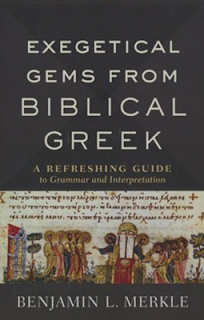
Benjamin L. Merkle is professor of New Testament and Greek at Southeastern Baptist Theological Seminary and Greek Editor of the Southeastern Theological Review.
Subscribe to:
Comments (Atom)