The material below comes from http://www.christianpost.com/news/john-piper-on-mans-sin-and-gods-sovereignty-80617/
I do not agree with Piper, but thought it would be interesting to see his articulation of predestination. I did not write the following:
_____________________________________________________________________________________
The 66-year-old preacher underlined that God has total control over everything, quoting verses from the Bible.
Ephesians 1: 11 says, "...Having been predestined according to the plan of him who works out everything in conformity with the purpose of his will." Daniel 4:35 states, "No one can hold back his hand or say to him: 'What have you done?'" Amos 3:6-7 says, "If a trumpet is blown in a city will not the people tremble? If a calamity occurs in a city has not the Lord done it?"
He went on to quote Proverbs 16:9: "The mind of man plans his way, but the Lord directs his steps." Proverbs 19:21: "Many are the plans in a man's heart, but it is the LORD's purpose that prevails. Proverbs 16:33: "The lot is cast into the lap, but its every decision is from the LORD."
"So every spin of the roulette wheel ... you know Las Vegas ... every roll of the dice in your family board game, every reaching of the hand for the scramble of the letter, is determined by God," Piper said.
He quoted Joseph as saying to his brothers after they had sold him into slavery, as recorded in Genesis 50:20: "As for you, you meant evil against me, but God meant it for good in order to bring about this present result, to preserve many people alive."
Piper said he had often heard this text misquoted. Some Christians think Joseph's brothers meant evil as they sold him into slavery to get rid of him, which was evil, a sin, but God used that incident for good. "That's not what it says, and there's a big difference," he said.
"God didn't watch it happen, and say, 'What am I going to do with this. Oh, I will make him vice president of Egypt; we'll turn it all around.' God never watches anything merely; He is always sustaining, acting. So He meant it," Piper said, quoting from Psalms 105, which says that God sent Joseph to Egypt to keep alive a people. "God had a plan to keep alive a people, and that is the way sin works."
Piper added that Acts 4:27-28 is perhaps the most crucial crux-like statement of God's sovereignty in the Bible "because what is being spoken about is the death of Christ." The two verses state: "Indeed Herod and Pontius Pilate met together with the Gentiles and the people of Israel in this city to conspire against your holy servant Jesus, whom you anointed. They did what your power and will had decided beforehand should happen."
Herod's mockery, Pilate's expediency, the Gentiles driving the nails, and the people of Israel shouting, "Crucify Him, crucify Him," is all sin, Piper said, adding it was all "predestined, designed by God, scripted in the Old Testament, including Judas [Iscariot]."
Piper also talked about the Fall in the Garden of Eden. He said God meant that to happen. Redemption, he explained, was planned by the death of the lamb before there was any sin to redeem from. "All who dwell on the earth will worship him, everyone whose name has not been written from the foundation of the world in the book of life of the Lamb who has been slain." (Revelation 13:8)
This is the kind of paradox that we must come to terms with to make sense of the Bible, he said. God's sovereignty ordains things to pass that from the human standpoint are willed as evil, and from God's standpoint willed as absolutely good for His final purposes, he added.
Tuesday, November 18, 2014

Saturday, November 15, 2014
M.A. Thesis on the Septuagint by Cara L. Murphy
It's entitled EXAMINING THE SEPTUAGINT: AN EXPLORATION OF THE GREEK OLD TESTAMENT'S
UNIQUE HERITAGE AND LASTING IMPACT ON THE NEW TESTAMENT
See http://digitalcommons.liberty.edu/masters/15/
Regards,
Edgar
UNIQUE HERITAGE AND LASTING IMPACT ON THE NEW TESTAMENT
See http://digitalcommons.liberty.edu/masters/15/
Regards,
Edgar
Roger E. Olson Critiques John Piper's Calvinist Views
All of the comments below are from Olson's blog:
John Piper has been at it again. But there's nothing new in the sermon reported on there. He has been saying this and writing it for decades. According to him, God foreordains sin. He "ordains and governs" it. He stops short of saying Godcauses is [SIC]. But the effect is the same: sin is God's will, even if it grieves him. And he's talking about about every specific sin, not just "sin in general."
Most Calvinists blush at such statements. And there's the line for me between "acceptable" and "unacceptable" Calvinism. I cannot accept, even with chagrin, Calvinism that says God foreordains and renders certain specific sins. That inexorably, ineluctably, inescapably makes God the author of sin and evil. That sullies God’s character OR makes sin not really sin. You have to choose. There’s no way around it.
Arminius was absolutely right when he addressed this Calvinist idea (which he associated especially with supralapsarianism but which is not held only by supras). He said that in that view, then, sin is not sin, or God sins and is really the only sinner.
Please see http://www.patheos.com/blogs/rogereolson/2012/08/john-piper-gods-sovereignty-and-sin/#disqus_thread
John Piper has been at it again. But there's nothing new in the sermon reported on there. He has been saying this and writing it for decades. According to him, God foreordains sin. He "ordains and governs" it. He stops short of saying Godcauses is [SIC]. But the effect is the same: sin is God's will, even if it grieves him. And he's talking about about every specific sin, not just "sin in general."
Most Calvinists blush at such statements. And there's the line for me between "acceptable" and "unacceptable" Calvinism. I cannot accept, even with chagrin, Calvinism that says God foreordains and renders certain specific sins. That inexorably, ineluctably, inescapably makes God the author of sin and evil. That sullies God’s character OR makes sin not really sin. You have to choose. There’s no way around it.
Arminius was absolutely right when he addressed this Calvinist idea (which he associated especially with supralapsarianism but which is not held only by supras). He said that in that view, then, sin is not sin, or God sins and is really the only sinner.
Please see http://www.patheos.com/blogs/rogereolson/2012/08/john-piper-gods-sovereignty-and-sin/#disqus_thread
Scripture and Chance
Someone with whom I once dialogued suggested that chance might just be our perception of things, and only our perception of reality. Initially, I feel compelled to question the suggestion that "chance" is our perception as opposed to being an objective feature of the world. In Eccl. 9:11, Qoheleth writes: "time and chance happeneth to them all" (ASV). This passage indicates that at least some events in our lives happen by "chance." This view also seems to be corroborated by Luke 10:31. That verse says in part: κατὰ συγκυρίαν δὲ ἱερεύς τις κατέβαινεν ἐν τῇ ὁδῷ ἐκείνῃ, καὶ ἰδὼν αὐτὸν ἀντιπαρῆλθεν. Again, "by chance," the priest happened to be traveling along the road. According to Vincent's Word Studies: "By chance (κατὰ συγκυρίαν) Only here in New Testament. The word means, literally, a coincidence. By coincidence of circumstances."
There is no indication in this Gospel account that God foreordained the priest's actions. In fact, I actually wonder what purpose would be served by God foreknowing or foreordaining everything. For example, let's say that one day I'm driving down the road imbibing a fifth of liquor (MH GENOITO!), then I lose control of my vehicle before hitting a bridge. Did God foreordain/will my actions? Were my actions known long before there was ever a human race? What would have happened if I had not been drinking and driving? Would I have been involved in a terrible accident? Maybe, but it would not have been as a result of driving while intoxicated. In either case, I would put the blame on my personal actions, which I had the power to perform or to refrain from committing.
Maybe God chose not to know whether I would do such a foolhardy thing. It's also possible that before I found myself in that situation, there was the objective possibility that I would imbibe alcohol, and the equal possibility that I would not drink while driving. Call this position libertarian free will if you like: Peter van Inwagen prefers to drop the "libertarian" tag.
My position about chance is not simply based on logical considerations. I've also referenced Luke which mentions "chance." On the other hand, there's an interesting passage in Ruth 2:3: "And she went, and came and gleaned in the fields after the reapers: and her hap was to light on the portion of the field belonging unto Boaz" (ASV).
καὶ ἐπορεύθη καὶ συνέλεξεν ἐν τῷ ἀγρῷ κατόπισθεν τῶν θεριζόντων· καὶ περιέπεσεν περιπτώματι τῇ μερίδι τοῦ ἀγροῦ Βοος τοῦ ἐκ συγγενείας Αβιμελεχ (OG/LXX).
"She just happened to end up in the portion of the field that belonged to Boaz"(NET Bible)
"The text is written from Ruth's limited perspective. As far as she was concerned, she randomly picked a spot in the field. But God was providentially at work and led her to the portion of the field belonging to Boaz, who, as a near relative of Elimelech, was a potential benefactor" (NET Note).
The writer of this particular OT account states that Ruth happened to "light on the portion of the field belonging unto Boaz." We are thus told that Ruth fortuitously began working in his field; but the rest of the narrative assures us that God's holy spirit is at work in the life of Ruth. Now it is quite possible that God could have
used Ruth if she happened to come upon a field belonging to someone else; however, the fact is that she happed upon the plot of land belonging to Boaz. Was this mere chance? Was it pure coincidence that Ruth began to work for Boaz? How should we understand this passage?
Benson's Commentary offers this view on Ruth 2:3: "Her hap was, &c. — It was a chance in appearance, and in reference to second causes, but ordered by God's providence. God wisely orders small events, even those that seem altogether contingent. Many a great affair is brought about by a little turn, fortuitous as to men, but designed by God."
Another theologian writes:
" . . . the author's real meaning in 2:3b is actually the opposite of what he says. The labelling [sic] of Ruth's meeting with Boaz as 'chance' is nothing more than the author's way of saying that no human intent was involved. For Ruth and Boaz it was an accident, but not for God. The tenor of the whole story makes it clear that the narrator sees God's hand throughout. In fact the very secularism of his expression here is his way of stressing that conviction. It is a kind of underplaying for effect. By calling this meeting an accident, the writer enables himself subtly to point out that even the'accidental' is directed by God" (Hals, Ronald. The Theology of the Book of Ruth. Philadelphia: Fortress Press, 1969).
It seems that some commentators also try to handle Luke 10:31 by attributing chance to the mind of God like the Cambridge Bible does:
"by chance] Rather, by coincidence, i.e. at the same time. The word 'chance' (τύχη) does not occur in Scripture. The nearest approach to it is the participle τυχὸν in 1 Corinthians 15:37 (if τυγχάνοντα be omitted in Luke 10:30). Chance, to the sacred writers, as to the most thoughtful of the Greeks, is 'the daughter of Forethought;' is 'God's unseen Providence, by men nicknamed Chance' (Fuller). 'Many good opportunities work under things which seem fortuitous.'"
Finally, at Rabbi Derek Leman's blog, we read:
"No, it is accepted that life's seemingly random events are actually, all or some of the time, influenced by the Divine purpose. So, Ruth's 'chance' doesn't randomly 'chance upon' the field of Boaz. Her unwitting steps were guided by an unseen hand, with invisible Providence bringing about a specific event. No argument about predestination vs. freewill is needed (freewill is simply assumed throughout the Bible). The mystery of unseen purpose is always with us."
However this account is to be understood, I don't believe that God foreordained this event before Ruth or Boaz existed. Similarly, I find it quite implausible that God foreordains every event that happens throughout the KOSMOS: reasons for this belief have been given in previous blog entries. A final thought pertains to free will. If our wills are truly capable of causing events, if they can bring it about that some action (A) occurs, then it's hard to correlate a strong deterministic view of the world with an agent causation (or libertarian) view of free will.
There is no indication in this Gospel account that God foreordained the priest's actions. In fact, I actually wonder what purpose would be served by God foreknowing or foreordaining everything. For example, let's say that one day I'm driving down the road imbibing a fifth of liquor (MH GENOITO!), then I lose control of my vehicle before hitting a bridge. Did God foreordain/will my actions? Were my actions known long before there was ever a human race? What would have happened if I had not been drinking and driving? Would I have been involved in a terrible accident? Maybe, but it would not have been as a result of driving while intoxicated. In either case, I would put the blame on my personal actions, which I had the power to perform or to refrain from committing.
Maybe God chose not to know whether I would do such a foolhardy thing. It's also possible that before I found myself in that situation, there was the objective possibility that I would imbibe alcohol, and the equal possibility that I would not drink while driving. Call this position libertarian free will if you like: Peter van Inwagen prefers to drop the "libertarian" tag.
My position about chance is not simply based on logical considerations. I've also referenced Luke which mentions "chance." On the other hand, there's an interesting passage in Ruth 2:3: "And she went, and came and gleaned in the fields after the reapers: and her hap was to light on the portion of the field belonging unto Boaz" (ASV).
καὶ ἐπορεύθη καὶ συνέλεξεν ἐν τῷ ἀγρῷ κατόπισθεν τῶν θεριζόντων· καὶ περιέπεσεν περιπτώματι τῇ μερίδι τοῦ ἀγροῦ Βοος τοῦ ἐκ συγγενείας Αβιμελεχ (OG/LXX).
"She just happened to end up in the portion of the field that belonged to Boaz"(NET Bible)
"The text is written from Ruth's limited perspective. As far as she was concerned, she randomly picked a spot in the field. But God was providentially at work and led her to the portion of the field belonging to Boaz, who, as a near relative of Elimelech, was a potential benefactor" (NET Note).
The writer of this particular OT account states that Ruth happened to "light on the portion of the field belonging unto Boaz." We are thus told that Ruth fortuitously began working in his field; but the rest of the narrative assures us that God's holy spirit is at work in the life of Ruth. Now it is quite possible that God could have
used Ruth if she happened to come upon a field belonging to someone else; however, the fact is that she happed upon the plot of land belonging to Boaz. Was this mere chance? Was it pure coincidence that Ruth began to work for Boaz? How should we understand this passage?
Benson's Commentary offers this view on Ruth 2:3: "Her hap was, &c. — It was a chance in appearance, and in reference to second causes, but ordered by God's providence. God wisely orders small events, even those that seem altogether contingent. Many a great affair is brought about by a little turn, fortuitous as to men, but designed by God."
Another theologian writes:
" . . . the author's real meaning in 2:3b is actually the opposite of what he says. The labelling [sic] of Ruth's meeting with Boaz as 'chance' is nothing more than the author's way of saying that no human intent was involved. For Ruth and Boaz it was an accident, but not for God. The tenor of the whole story makes it clear that the narrator sees God's hand throughout. In fact the very secularism of his expression here is his way of stressing that conviction. It is a kind of underplaying for effect. By calling this meeting an accident, the writer enables himself subtly to point out that even the'accidental' is directed by God" (Hals, Ronald. The Theology of the Book of Ruth. Philadelphia: Fortress Press, 1969).
It seems that some commentators also try to handle Luke 10:31 by attributing chance to the mind of God like the Cambridge Bible does:
"by chance] Rather, by coincidence, i.e. at the same time. The word 'chance' (τύχη) does not occur in Scripture. The nearest approach to it is the participle τυχὸν in 1 Corinthians 15:37 (if τυγχάνοντα be omitted in Luke 10:30). Chance, to the sacred writers, as to the most thoughtful of the Greeks, is 'the daughter of Forethought;' is 'God's unseen Providence, by men nicknamed Chance' (Fuller). 'Many good opportunities work under things which seem fortuitous.'"
Finally, at Rabbi Derek Leman's blog, we read:
"No, it is accepted that life's seemingly random events are actually, all or some of the time, influenced by the Divine purpose. So, Ruth's 'chance' doesn't randomly 'chance upon' the field of Boaz. Her unwitting steps were guided by an unseen hand, with invisible Providence bringing about a specific event. No argument about predestination vs. freewill is needed (freewill is simply assumed throughout the Bible). The mystery of unseen purpose is always with us."
However this account is to be understood, I don't believe that God foreordained this event before Ruth or Boaz existed. Similarly, I find it quite implausible that God foreordains every event that happens throughout the KOSMOS: reasons for this belief have been given in previous blog entries. A final thought pertains to free will. If our wills are truly capable of causing events, if they can bring it about that some action (A) occurs, then it's hard to correlate a strong deterministic view of the world with an agent causation (or libertarian) view of free will.
Wednesday, November 12, 2014
An Old Reply to Rob Bowman Concerning the Meaning of "Life"
ROB: The eternal state of the wicked is not properly called "life." To have life means to participate in a realm where relationships with others is possible. For example, to be physically alive means to participate in the physical realm where relationships with other physical beings, especially other human beings, is possible. The wicked will not have life; they will be cut off from everything and everyone.
EDGAR's REPLY: Come now, Rob. I cannot believe that you are concocting an arbitrary definition of life to explain how the wicked can exist forever and yet be devoid of life. Rudolf Bultmann writes that ζωὴ "denotes in Greek the physical vitality of organic beings, animals, men, and also plants. Life is understood, not as a thing, but as vitality, as the nature or manner which characterizes all living creatures as such" (TDNT 2:832).
BAGD says that βίος can have the sense of "life in its appearance and manifestations" (141). The Greek word is used to describe "earthly life in its functions and its duration"; "of manner of life"; "means of subsistence" (BAGD 141-142).
See Luke 8:14; 2 Tim. 2:4; 1 John 3:18; 5:20.
Based on the lexical and conceptual evidence we have at our disposal, I cannot accept your arbitrary definition of life, Rob. Even if a person is incapable of having relationships with anyone, it still doesn't mean that he or she is not alive. The same thing can be said for a solitary animal or tree in a wilderness, so your definition of life does not work. If the wicked are consciously separated from God for all eternity, then they would be alive for all eternity. Life is not limited to relationships or the capability thereof.
EDGAR's REPLY: Come now, Rob. I cannot believe that you are concocting an arbitrary definition of life to explain how the wicked can exist forever and yet be devoid of life. Rudolf Bultmann writes that ζωὴ "denotes in Greek the physical vitality of organic beings, animals, men, and also plants. Life is understood, not as a thing, but as vitality, as the nature or manner which characterizes all living creatures as such" (TDNT 2:832).
BAGD says that βίος can have the sense of "life in its appearance and manifestations" (141). The Greek word is used to describe "earthly life in its functions and its duration"; "of manner of life"; "means of subsistence" (BAGD 141-142).
See Luke 8:14; 2 Tim. 2:4; 1 John 3:18; 5:20.
Based on the lexical and conceptual evidence we have at our disposal, I cannot accept your arbitrary definition of life, Rob. Even if a person is incapable of having relationships with anyone, it still doesn't mean that he or she is not alive. The same thing can be said for a solitary animal or tree in a wilderness, so your definition of life does not work. If the wicked are consciously separated from God for all eternity, then they would be alive for all eternity. Life is not limited to relationships or the capability thereof.
Saturday, November 08, 2014
Justin Martyr and the Isaian Text
Justin was evidently born in Flavia Neapolis to pagan Greek parents. He wrote in Greek and no doubt understood the language very well. As Quasten observes:
"The most important of the Greek apologists of early Christian literature is Justin the Martyr" (Johannes Quasten, Patrology: The Beginnings of Patristic Literature, 1:196).
As far as analyzing words goes, Justin gives plenty of analysis in his writings. This can easily be seen by consulting the Greek text of Justin's Dialogue with Trypho, if you can locate one. An excellent study in this regard is Oskar Skarsaune's The Proof from Prophecy - A Study in Justin Martyr's Proof-Text Tradition: Text-Type, Provenance, Theological Profile (Leiden: Brill, 1987).
Skarsaune compares a number of texts from Justin's writings with the LXX. Admittedly, at times it appears that the Martyr is quoting the LXX from memory; at other times, it seems that he is relying on a testimonial source of some kind. But there are numerous places in Justin's works where there is no doubt that he is quoting from the LXX itself.
"Turning to Dial. 87.2, we find Is 11:1-3 quoted in a pretty good LXX text. The only significant variants are in vs. 1, where Justin's text is somewhat smoother in its parallelism than the LXX" (Skarsaune, 52).
Καὶ ἐξελεύσεται ῥάβδος ἐκ τῆς ῥίζης Ιεσσαι, καὶ ἄνθος ἐκ τῆς ῥίζης ἀναβήσεται. (Isaiah 11:1, LXX)
Καὶ ἐξελεύσεται ῥάβδος ἐκ τῆς ῥίζης Ιεσσαι καὶ ἄνθος ἀναβήσεται ἐκ τῆς ῥίζης Ιεσσαι (Dial 87.2)
I also recommend Moises Silva and Karen H. Jobes' Invitation to the Septuagint(Grand Rapids: Baker Academic, 2000).
Friday, November 07, 2014
Greek Pronouns and Antecedents (Ephesians 2:8)
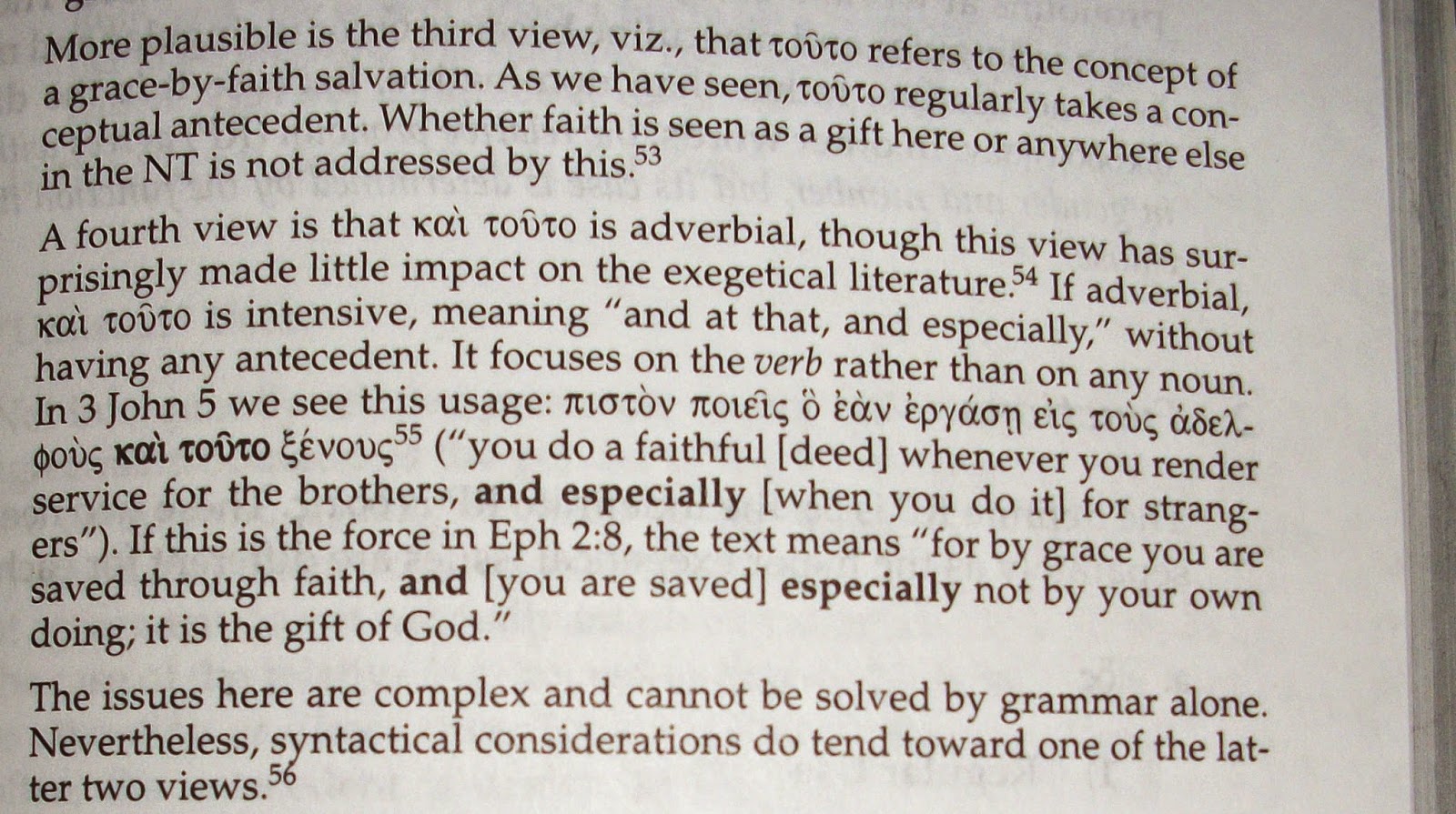
In his syntactical grammar (p. 334), Daniel B. Wallace has a pretty good discussion on Eph. 2:8 and its utilization of τοῦτο. The question: what is the antecedent of τοῦτο in Eph. 2:8? Wallace lists four standard interpretations: (1) χάριτί is the antecedent, (2) πίστεως could be the antecedent of τοῦτο, (3) the concept of "grace by faith" is the antecedent of the demonstrative pronoun τοῦτο, (4) καὶ τοῦτο has an adverbial force with no antecedent.
Wallace then discusses the shortcomings of options (1) and (2) because τοῦτο is neuter and χάριτί and πίστεως are feminine. He then refers to an article by R.H. Countess ("Thank God for the Genitive!") in which Countess argues that gender shift is common in Attic Greek, so there is no problem in construing a neuter demonstrative back to "a noun of a different gender" (Wallace 334). Needless to say, Wallace is critical of this approach because he thinks that Countess' examples from Attic literature are debatable and he thinks that they are best understood as referring "to a concept [rather] than a noun" (Wallace 334).
Wallace thus concludes that while "on rare occasions there is a gender shift between antecedent and pronoun, the pronoun is always caught between two nouns of a different gender," Eph. 2:8 is not an example of this phenomenon, however (Wallace 334-335). Wallace, therefore, goes on to discount options (1) and (2) as possible antecedents for τοῦτο and instead chooses option (3). That is, he argues that the antecedent of τοῦτο in Eph. 2:8 is "the concept of grace-by-faith salvation" (335). But I am skeptical about Wallace's proposal by virtue of the fact that he opts for a "concept" as the antecedent over against a substantive such as χάριτί or πίστεως. But there
are some reasons why I'm inclined to question Wallace's construal of τοῦτο as well (based on Attic and NT literature). Yet one thorough commentary written by Harold Hoehner also takes the position that the demonstrative pronoun refers to the entire preceding section, as opposed to just one noun or participle. He writes that it refers to "the concept of salvation by grace through faith" (Ephesians, page 343).
I conclude by saying that Wallace's decision regarding the antecedent of τοῦτο in Eph. 2:8 is based on grammatical parallelism (not attraction). The professor even writes that the issues surrounding Eph. 2:8 "are complex and cannot be solved by grammar alone. Nevertheless, syntactical considerations do tend toward" choices (3) or (4).

Wallace then discusses the shortcomings of options (1) and (2) because τοῦτο is neuter and χάριτί and πίστεως are feminine. He then refers to an article by R.H. Countess ("Thank God for the Genitive!") in which Countess argues that gender shift is common in Attic Greek, so there is no problem in construing a neuter demonstrative back to "a noun of a different gender" (Wallace 334). Needless to say, Wallace is critical of this approach because he thinks that Countess' examples from Attic literature are debatable and he thinks that they are best understood as referring "to a concept [rather] than a noun" (Wallace 334).
Wallace thus concludes that while "on rare occasions there is a gender shift between antecedent and pronoun, the pronoun is always caught between two nouns of a different gender," Eph. 2:8 is not an example of this phenomenon, however (Wallace 334-335). Wallace, therefore, goes on to discount options (1) and (2) as possible antecedents for τοῦτο and instead chooses option (3). That is, he argues that the antecedent of τοῦτο in Eph. 2:8 is "the concept of grace-by-faith salvation" (335). But I am skeptical about Wallace's proposal by virtue of the fact that he opts for a "concept" as the antecedent over against a substantive such as χάριτί or πίστεως. But there
are some reasons why I'm inclined to question Wallace's construal of τοῦτο as well (based on Attic and NT literature). Yet one thorough commentary written by Harold Hoehner also takes the position that the demonstrative pronoun refers to the entire preceding section, as opposed to just one noun or participle. He writes that it refers to "the concept of salvation by grace through faith" (Ephesians, page 343).
I conclude by saying that Wallace's decision regarding the antecedent of τοῦτο in Eph. 2:8 is based on grammatical parallelism (not attraction). The professor even writes that the issues surrounding Eph. 2:8 "are complex and cannot be solved by grammar alone. Nevertheless, syntactical considerations do tend toward" choices (3) or (4).
Saturday, November 01, 2014
Trinity and Identity (Tuggy v. Brandon)
Dale Tuggy floats an argument in his debate with Rob Bowman which has been criticized by a Trinitarian philosophical blogger named "Brandon." It goes thus:
1) The Father and the Son are the same God.
2) For any x and y, and for any kind F, if x and y are the same F, then x is an F, y is an F, and x = y. (x and y are numerically one)
3) The Father = the Son. (1, 2)
However, Brandon says 2) is "false" or begs the question (a logical fallacy) since it possibly contains an "equivocal" middle term or makes (unwarranted) assumptions. A middle term appears in the major and minor premise of an argument/syllogism, but does not appear in the conclusion of the argument.
He then provides a complicated "rebuttal" which amounts to (IMO) "we can't refute the Trinity doctrine by reasoning Dale Tuggy's way."
I'm not sure if Tuggy's argument goes through as it stands, but I've tried to construct a parallel version that is not susceptible to Brandon's criticism. Maybe:
1) Brahma and Vishnu are the same God.
2) For any x and y, and for any kind F, if x and y are the same F, then x is an F, y is an F, and x = y. (x and y are numerically one).
3) Brahma = Vishnu.
1) The Father and the Son are the same God.
2) For any x and y, and for any kind F, if x and y are the same F, then x is an F, y is an F, and x = y. (x and y are numerically one)
3) The Father = the Son. (1, 2)
However, Brandon says 2) is "false" or begs the question (a logical fallacy) since it possibly contains an "equivocal" middle term or makes (unwarranted) assumptions. A middle term appears in the major and minor premise of an argument/syllogism, but does not appear in the conclusion of the argument.
He then provides a complicated "rebuttal" which amounts to (IMO) "we can't refute the Trinity doctrine by reasoning Dale Tuggy's way."
I'm not sure if Tuggy's argument goes through as it stands, but I've tried to construct a parallel version that is not susceptible to Brandon's criticism. Maybe:
1) Brahma and Vishnu are the same God.
2) For any x and y, and for any kind F, if x and y are the same F, then x is an F, y is an F, and x = y. (x and y are numerically one).
3) Brahma = Vishnu.
2 Samuel 12:14 (Showing Contempt for YHWH?)
"Howbeit, because by this deed thou hast given great occasion to the enemies of Jehovah to blaspheme, even the child that is born to thee shall certainly die" (2 Samuel 12:14, Darby Bible).
Other translations say that David showed great contempt for YHWH (Jehovah) himself:
"But because by doing this you have shown utter contempt for the LORD, the son born to you will die" (NIV).
Either way, the divine reprimand given to David is strong.
NET Bible note on this verse:
The MT has here "because you have caused the enemies of the Lord to treat the Lord with such contempt." This is one of the so-called tiqqune sopherim, or "emendations of the scribes." According to this ancient tradition, the scribes changed the text in order to soften somewhat the negative light in which David was presented. If that is the case, the MT reflects the altered text. The present translation departs from the MT here. Elsewhere the Piel stem of this verb means "treat with contempt," but never "cause someone to treat with contempt."
NET thus renders 12:14: "Nonetheless, because you have treated the Lord with such contempt in this matter, the son who has been born to you will certainly die."
"Nevertheless, because you have treated Jehovah with utter disrespect in this matter, the son just born to you will certainly die" (NWT 2013).
Other translations say that David showed great contempt for YHWH (Jehovah) himself:
"But because by doing this you have shown utter contempt for the LORD, the son born to you will die" (NIV).
Either way, the divine reprimand given to David is strong.
NET Bible note on this verse:
The MT has here "because you have caused the enemies of the Lord to treat the Lord with such contempt." This is one of the so-called tiqqune sopherim, or "emendations of the scribes." According to this ancient tradition, the scribes changed the text in order to soften somewhat the negative light in which David was presented. If that is the case, the MT reflects the altered text. The present translation departs from the MT here. Elsewhere the Piel stem of this verb means "treat with contempt," but never "cause someone to treat with contempt."
NET thus renders 12:14: "Nonetheless, because you have treated the Lord with such contempt in this matter, the son who has been born to you will certainly die."
"Nevertheless, because you have treated Jehovah with utter disrespect in this matter, the son just born to you will certainly die" (NWT 2013).
Friday, October 31, 2014
Isaiah 63:9: Qere and Kethib
In a world that is filled with pain and suffering, only an existent God who is capable of suffering/who has suffered makes sense to me:
"Through all that they suffered, he suffered too. The messenger sent from his very presence delivered them. In his love and mercy he protected them; he lifted them up and carried them throughout ancient times" (Isaiah 63:9, NET Bible).
tn Heb "in all their distress, there was distress to him" (reading לוֹ [lo] with the margin/Qere).-Footnote for Isa 63:9, NET Bible.
"In all their affliction he was afflicted] (lit. 'there was affliction to Him'). This is the sense of the Qĕrê, which substitutes lô (to him) for the lô’ (not) of the Kĕthîb (see on ch. Isaiah 9:3). It is impossible to obtain a good sense from the consonantal text; and it is accordingly rejected in favour of the Qĕrê by nearly all commentators" (Cambridge Bible for Schools and Colleges).
"Through all that they suffered, he suffered too. The messenger sent from his very presence delivered them. In his love and mercy he protected them; he lifted them up and carried them throughout ancient times" (Isaiah 63:9, NET Bible).
tn Heb "in all their distress, there was distress to him" (reading לוֹ [lo] with the margin/Qere).-Footnote for Isa 63:9, NET Bible.
"In all their affliction he was afflicted] (lit. 'there was affliction to Him'). This is the sense of the Qĕrê, which substitutes lô (to him) for the lô’ (not) of the Kĕthîb (see on ch. Isaiah 9:3). It is impossible to obtain a good sense from the consonantal text; and it is accordingly rejected in favour of the Qĕrê by nearly all commentators" (Cambridge Bible for Schools and Colleges).
Tuesday, October 28, 2014
Pronunciation of Attic or Koine Greek
A friend once wrote:
My [edited] answer:
I would not say that thay-ahs is wrong: it is maybe one way to pronounce the Greek morpheme θεός; but epsilon is short, so that is one reason why I do not pronounce θε as "thay." Biblehub.com has "theh'-os" for the Greek θεός.
Όμικρον (ο) has an interesting phonological history. At one time, it was enunciated differently than Ωμέγα. Donald Mastronarde describes Ωμέγα (ω) as "a long open central-back vowel" which was pronounced like the English "saw." On the other hand, Όμικρον is "a short back mid vowel," vocalized like the 'o' in the German "Gott." But, historically, there evidently came a time when ω was no longer phonemically distinguishable from ο in Greek: that is why the Byzantines made a morphemic/graphemic distinction between Ωμέγα and Όμικρον. And, if you will notice today, some say λόγος with a short 'o" and others treat Όμικρον in the word as a long vowel. Again, either way is acceptable except to the most persnickety purist.
For what it is worth, I purchased a copy of Randall Buth's proto-CD for "Emic Koine." Buth says that ω = ο in Modern Greek--ο is lower than ω in the Erasmian system and in the Allen-Daitz "restored Attic" system, ω is longer and lower than ο. The page found here is also quite helpful:
http://www.biblicalgreek.org/links/pronunciation.html
Lastly, the ϱ (r) was likely trilled, but I haven't traced its history to see if that practice stopped at some point.
In the White-Stafford debate, QEOS is pronounced as thay-ahs. Interesting point on W. In English, hO WN might be uttered as "ho ahn", and this might work for casual, non-scholastic conversation. But, how is the omicron pronounced here? For ANTILUTRON, I've been uttering antee-lootron (without rolling the r, but I've gotten better at that). The rho was rolled too, right?
My [edited] answer:
I would not say that thay-ahs is wrong: it is maybe one way to pronounce the Greek morpheme θεός; but epsilon is short, so that is one reason why I do not pronounce θε as "thay." Biblehub.com has "theh'-os" for the Greek θεός.
Όμικρον (ο) has an interesting phonological history. At one time, it was enunciated differently than Ωμέγα. Donald Mastronarde describes Ωμέγα (ω) as "a long open central-back vowel" which was pronounced like the English "saw." On the other hand, Όμικρον is "a short back mid vowel," vocalized like the 'o' in the German "Gott." But, historically, there evidently came a time when ω was no longer phonemically distinguishable from ο in Greek: that is why the Byzantines made a morphemic/graphemic distinction between Ωμέγα and Όμικρον. And, if you will notice today, some say λόγος with a short 'o" and others treat Όμικρον in the word as a long vowel. Again, either way is acceptable except to the most persnickety purist.
For what it is worth, I purchased a copy of Randall Buth's proto-CD for "Emic Koine." Buth says that ω = ο in Modern Greek--ο is lower than ω in the Erasmian system and in the Allen-Daitz "restored Attic" system, ω is longer and lower than ο. The page found here is also quite helpful:
http://www.biblicalgreek.org/links/pronunciation.html
Lastly, the ϱ (r) was likely trilled, but I haven't traced its history to see if that practice stopped at some point.
Jean Calvin and Zechariah 10:5 (Question)
"Et erunt quasi fortes, (aut, gigantes,) calcantes in luto platearum in proelio; et proeliabuntur, quia Iehova cum ipsis; et pudefient ascensores equorum" (Zechariah 10:5, Jean Calvin's Commentary on Zechariah and Malachi).
"et erunt quasi fortes conculcantes lutum viarum in proelio et bellabunt quia Dominus cum eis et confundentur ascensores equorum" (Biblia Sacra Vulgata at www.academic-bible.com).
I don't have a critical text of the Vulgate at the moment, so I'm wondering why Calvin uses "pudefient" rather than "confudentur" in his commentary on Zech 10:5. Any help would be appreciated.
"et erunt quasi fortes conculcantes lutum viarum in proelio et bellabunt quia Dominus cum eis et confundentur ascensores equorum" (Biblia Sacra Vulgata at www.academic-bible.com).
I don't have a critical text of the Vulgate at the moment, so I'm wondering why Calvin uses "pudefient" rather than "confudentur" in his commentary on Zech 10:5. Any help would be appreciated.
Friday, October 17, 2014
More Lines of Evidence for the New Testament/LXX Equaling Koine Greek
I am aware that certain scholars either do not take a decided stand on this issue or they suggest that the Greek of the LXX is not (strictly speaking) Koine. The 1905 work by F.C. Conybeare and St. George Stock entitled Grammar of Septuagint Greek states:
"The New Testament, having itself been written in Greek, is not so saturated with Hebrew as the Septuagint: still the resemblance in this respect is close enough to warrant the two being classed together under the title of Biblical Greek" (page 22).
However, A. T. Robertson argues more fervently that the Greek of the LXX is the ancient vernacular of Alexandria. The papyrological corpus seems to favor Robertson's thesis: there is no such animal as "Biblical Greek" (sensu stricto)
This point really should not surprise us since the Koine period evidently lasted ca. 330 BCE-330 CE. During his brief but glorious life, we know that Alexander the Great sought to make Koine a Weltsprache or lingua franca of the ancient world and his desire came to fruition. Why would the LXX have been an exception to this rule? One of the best ways to decide the issue is to compare the LXX with the Greek papyri. One can then see similarities and differences between the two.
Robertson (A Grammar of the GNT) quotes Deissmann concerning the issue of the NT and Koine Greek as follows:
"If we are ever in this matter to reach certainty at all, then it is the inscriptions and papyri which will give us the nearest approximation to the truth" (Deissmann qt. in Robertson, p. 79).
Deissmann continues to build his case by noting that both the LXX and the NT, based on a study of Greek papyri and inscriptions, were translated using "the Greek of ordinary intercourse as spoken in countries bordering on the Mediterranean" and he also observes that this developing common tongue of the Meditteranean people differed in "many respects" from the classical Attic of antiquity (See ibid., pp. 79-80).
As J.H. Moulton concludes in his NT Greek grammar:
"The papyri exhibit in their writers a variety of literary education even wider than that observable in the NT, and we can match each sacred author with documents that in respect of Greek stand on about the same plane. The conclusion is that 'Biblical' Greek, except where it is translation Greek, was simply the vernacular of daily life . . . The NT writers had little idea that they were writing literature. The Holy Ghost spoke absolutely in the language of the people as we might surely have expected He would" (p. 5).
"The New Testament, having itself been written in Greek, is not so saturated with Hebrew as the Septuagint: still the resemblance in this respect is close enough to warrant the two being classed together under the title of Biblical Greek" (page 22).
However, A. T. Robertson argues more fervently that the Greek of the LXX is the ancient vernacular of Alexandria. The papyrological corpus seems to favor Robertson's thesis: there is no such animal as "Biblical Greek" (sensu stricto)
This point really should not surprise us since the Koine period evidently lasted ca. 330 BCE-330 CE. During his brief but glorious life, we know that Alexander the Great sought to make Koine a Weltsprache or lingua franca of the ancient world and his desire came to fruition. Why would the LXX have been an exception to this rule? One of the best ways to decide the issue is to compare the LXX with the Greek papyri. One can then see similarities and differences between the two.
Robertson (A Grammar of the GNT) quotes Deissmann concerning the issue of the NT and Koine Greek as follows:
"If we are ever in this matter to reach certainty at all, then it is the inscriptions and papyri which will give us the nearest approximation to the truth" (Deissmann qt. in Robertson, p. 79).
Deissmann continues to build his case by noting that both the LXX and the NT, based on a study of Greek papyri and inscriptions, were translated using "the Greek of ordinary intercourse as spoken in countries bordering on the Mediterranean" and he also observes that this developing common tongue of the Meditteranean people differed in "many respects" from the classical Attic of antiquity (See ibid., pp. 79-80).
As J.H. Moulton concludes in his NT Greek grammar:
"The papyri exhibit in their writers a variety of literary education even wider than that observable in the NT, and we can match each sacred author with documents that in respect of Greek stand on about the same plane. The conclusion is that 'Biblical' Greek, except where it is translation Greek, was simply the vernacular of daily life . . . The NT writers had little idea that they were writing literature. The Holy Ghost spoke absolutely in the language of the people as we might surely have expected He would" (p. 5).
Thursday, October 16, 2014
Koine Greek: Quid Est? (With a Note on CASUS PENDENS)
Recent questions have arisen about the nature of the original NT texts and what counts as Koine Greek. To be honest, I have not devoted much time to this question in some time. But I've found old dialogues that might be helpful or that possibly show my progression of thought regarding the question. Here is one of those old discussions:
Dear [Fred],
You have asked for a definition of Koine. As I mentioned, I do not feel comfortable defining it, but would much rather describe it. A number of phenomena are akin to Koine, in this respect. Try to define "justice" or "beauty" in a non-circular way that attracts nearly universal consensus and see what happens. I submit that we face the same challenge when we try to define Koine Greek.
First, however, I will say that Greek was definitely undergoing a change from Attic to "Koine" prior to Alexander's attempt to Hellenize non-Greek peoples and impose a Weltsprache on them. History shows that from the fourth century BCE-fourth century CE, a type of Greek was introduced which differed from the Greek found in Plato, Aristotle, Isocrates or even in Xenophon. Yet, this developing form of Greek was used in different media, like any other language. Thus, one finds a higher register of Koine in Josephus, Philo and Epictetus than might be found in the Greek papyri; but the dialect is the same. It is still Koine Greek, identified by its syntax, morphology, phonology, and idiomatic use. Whatever one may think concerning the grammatical features of what I am calling Koine Greek, it seems hard to dispute Alexander's influence on Greek and how it began to change as Alexander and his successors sought to bring about a common Weltsprache.
At any rate, I offer two examples for starters to show the nature of Koine Greek. My initial examples will come from Colwell's work The Greek of the Fourth Gospel.
Some (e.g., Burney, et al) who believe that John was originally writen in Aramaic think that the construction classified as CASUS PENDENS evidently found in 27 Johannine passages (Jn 1:12; 1:18; 3:26, etc) is a "Semitic" construction (See Colwell, 37). However, the construction is found in Classical Greek (cf. Xen. Cyr II.3.5; Ec. I.14. See also Gildersleeve's Greek Grammar for examples from Plato,
Isocrates, Herodotus, Euripides and Homer) and it regularly occurs in the Greek papyri. Some examples that Colwell gives are:
1) BGU I, 19 (a lawsuit record dated 135 CE), col. II, lines 4f:
"hOSA PROSHNANTO PA[TRI?] KWN PERI TON PROKEIMENON APO THS EU [D] AIMONIDOS DIAQHKHS . . . TAUTA METEINAI TOIS EKEINOU TEKNOIS. Compare Jn 1:12 with BGU II, 372 (official decree, dated 154 CE), col II, lines 19f "where EAN TIS occurs in the same construction" (Colwell, 38).
Other Greek papyri containing the CASUS PENDENS construction are BGU II, 523 (a letter), P.Oxy. II, 299 (a letter dated 1 CE) and P.Oxy.II, 268, line 2 (a repayment of a dowry, dated 58 CE).
I also recommend Light from Ancient Letters (Philadelphia: Fortress Press, 1986) by John L. White.
Dear [Fred],
You have asked for a definition of Koine. As I mentioned, I do not feel comfortable defining it, but would much rather describe it. A number of phenomena are akin to Koine, in this respect. Try to define "justice" or "beauty" in a non-circular way that attracts nearly universal consensus and see what happens. I submit that we face the same challenge when we try to define Koine Greek.
First, however, I will say that Greek was definitely undergoing a change from Attic to "Koine" prior to Alexander's attempt to Hellenize non-Greek peoples and impose a Weltsprache on them. History shows that from the fourth century BCE-fourth century CE, a type of Greek was introduced which differed from the Greek found in Plato, Aristotle, Isocrates or even in Xenophon. Yet, this developing form of Greek was used in different media, like any other language. Thus, one finds a higher register of Koine in Josephus, Philo and Epictetus than might be found in the Greek papyri; but the dialect is the same. It is still Koine Greek, identified by its syntax, morphology, phonology, and idiomatic use. Whatever one may think concerning the grammatical features of what I am calling Koine Greek, it seems hard to dispute Alexander's influence on Greek and how it began to change as Alexander and his successors sought to bring about a common Weltsprache.
At any rate, I offer two examples for starters to show the nature of Koine Greek. My initial examples will come from Colwell's work The Greek of the Fourth Gospel.
Some (e.g., Burney, et al) who believe that John was originally writen in Aramaic think that the construction classified as CASUS PENDENS evidently found in 27 Johannine passages (Jn 1:12; 1:18; 3:26, etc) is a "Semitic" construction (See Colwell, 37). However, the construction is found in Classical Greek (cf. Xen. Cyr II.3.5; Ec. I.14. See also Gildersleeve's Greek Grammar for examples from Plato,
Isocrates, Herodotus, Euripides and Homer) and it regularly occurs in the Greek papyri. Some examples that Colwell gives are:
1) BGU I, 19 (a lawsuit record dated 135 CE), col. II, lines 4f:
"hOSA PROSHNANTO PA[TRI?] KWN PERI TON PROKEIMENON APO THS EU [D] AIMONIDOS DIAQHKHS . . . TAUTA METEINAI TOIS EKEINOU TEKNOIS. Compare Jn 1:12 with BGU II, 372 (official decree, dated 154 CE), col II, lines 19f "where EAN TIS occurs in the same construction" (Colwell, 38).
Other Greek papyri containing the CASUS PENDENS construction are BGU II, 523 (a letter), P.Oxy. II, 299 (a letter dated 1 CE) and P.Oxy.II, 268, line 2 (a repayment of a dowry, dated 58 CE).
I also recommend Light from Ancient Letters (Philadelphia: Fortress Press, 1986) by John L. White.
Wednesday, October 15, 2014
The Septuagint (LXX): In Which Greek Dialect Was It Written?
[Fred]
No one's ever been able to find a writing that we know was written in Greek that matches the NT style or the things that the LXX and NT have in common that are clearly Semitic in style.
[Edgar's Reply]
Current research seems to place your thesis in some doubt. A work on Greek aspect entitled Verbal Syntax in the Greek Pentateuch states:
"Over the last century it has become possible, in the light of the newly discovered evidence of Greek papyri coupled with methodological advances, to demonstrate more and more clearly in various respects the affinities of LXX Greek with the contemporary Koine vernacular of Egypt. This has led in large measure to a resolution of the old dispute.
The method of translation adequately explains the Hebraistic cast of the LXX. It is unnecessary to propose the existence of a special Jewish Greek dialect to explain the abnormalities. Nevertheless, the notion of Jewish Greek continues to find its advocates, especially in the broader sphere of biblical Greek studies. The present work will supply further clear evidence of ordinary Koine characteristics in the translation Greek of the LXX"(T.V. Evans, Verbal Syntax in the Greek Pentateuch: Natural Greek Usage and Hebrew Interference. Oxford: Oxford University Press, 2001, page 4).
Evans stresses what other scholars working with the ancient papyri have highlighted and emphasized for years, namely, that the LXX was evidently translated in Koine Greek and it bears many literary marks that inexorably link it with the Greek papyri of Egypt.
No one's ever been able to find a writing that we know was written in Greek that matches the NT style or the things that the LXX and NT have in common that are clearly Semitic in style.
[Edgar's Reply]
Current research seems to place your thesis in some doubt. A work on Greek aspect entitled Verbal Syntax in the Greek Pentateuch states:
"Over the last century it has become possible, in the light of the newly discovered evidence of Greek papyri coupled with methodological advances, to demonstrate more and more clearly in various respects the affinities of LXX Greek with the contemporary Koine vernacular of Egypt. This has led in large measure to a resolution of the old dispute.
The method of translation adequately explains the Hebraistic cast of the LXX. It is unnecessary to propose the existence of a special Jewish Greek dialect to explain the abnormalities. Nevertheless, the notion of Jewish Greek continues to find its advocates, especially in the broader sphere of biblical Greek studies. The present work will supply further clear evidence of ordinary Koine characteristics in the translation Greek of the LXX"(T.V. Evans, Verbal Syntax in the Greek Pentateuch: Natural Greek Usage and Hebrew Interference. Oxford: Oxford University Press, 2001, page 4).
Evans stresses what other scholars working with the ancient papyri have highlighted and emphasized for years, namely, that the LXX was evidently translated in Koine Greek and it bears many literary marks that inexorably link it with the Greek papyri of Egypt.
Sunday, October 12, 2014
Two Journal Articles on Earthquakes (SEISMOI)
Doing a little more research on the Greek word SEISMOS within a biblical context, I've found Moulton and Milligan's study of the ancient papyri to be helpful. Furthermore, James S. Murray reviews literary, epigraphical, and numismatic evidence for urban earthquakes (particularly in Asia Minor and related areas) in "The Urban Earthquake Imagery and Divine Judgement in John's Apocalypse," Novum Testamentum, Vol. 47, Fasc. 2 (Apr. 2005), pp. 142-161.
But one of the most important articles on this subject has to be Richard Bauckham, "The Eschatological Earthquake in the Apocalypse of John," Novum Testamentum, Vol. 19, Fasc. 3 (Jul. 1977), pp. 224-233.
The latter also provides some context to the biblical use of SEISMOS.
But one of the most important articles on this subject has to be Richard Bauckham, "The Eschatological Earthquake in the Apocalypse of John," Novum Testamentum, Vol. 19, Fasc. 3 (Jul. 1977), pp. 224-233.
The latter also provides some context to the biblical use of SEISMOS.
Friday, October 10, 2014
Aquinas--Gospel of John 1:14
Taken from COMMENTARY ON THE GOSPEL OF ST. JOHN (Aquinas)
Part I: Chapters 1-7 translated by James A. Weisheipl, O.P.
Magi Books, Inc., Albany, N.Y.
Lectio 7: καὶ ὁ λόγος σὰρξ ἐγένετο καὶ ἐσκήνωσεν ἐν ἡμῖν
"But if this were so, it would mean that God did not become man, for one particular suppositum cannot be predicated of another. Accordingly, if the person or suppositum of the Word is different than the person or suppositum of the man, in Christ, then what the Evangelist says is not true, namely, the Word was made flesh. For a thing is made or becomes something in order to be it; if, then, the Word is not man, it could not be said that the Word became man. And so the Evangelist expressly said was made, and not 'assumed,' to show that the union of the Word to flesh is not such as was the 'lifting up' of the prophets, who were not 'taken up' into a unity of person, but for the prophetic act. This union is such as would truly make God man and man God, i.e., that God would be man" (170).
(Sed secundum hoc Deus non esset factus homo; quia impossibile est quod duorum singularium, quae diversa sunt secundum suppositum, unum praedicetur de alio. Unde si alia est persona verbi, seu suppositum, et alia persona hominis, seu suppositum in Christo, tunc non erit verum quod dicit Evangelista verbum caro factum est. Ad hoc enim fit aliquid, ut sit; si ergo verbum non esset homo, non posset dici quod verbum sit factum homo. Et ideo signanter Evangelista dixit factum est, et non dixit assumpsit, ut ostendat quod unio verbi ad carnem non est talis qualis est assumptio prophetarum, qui non assumebantur in unitatem suppositi, sed ad actum propheticum: sed est talis quod Deum vere faceret hominem, et hominem Deum, idest quod Deus esset homo.)
"If you ask how the Word is man, it must be said that he is man in the way that anyone is, man, namely, as having human nature. Not that the Word is human nature itself, but he is a divine suppositum united to a human nature. The statement, the Word was made flesh, does not indicate any change in the Word, but only in the nature newly assumed into the oneness of a divine person. And the Word was made flesh through a union to flesh. Now a union is a relation. And relations newly said of God with respect to creatures do not imply a change on the side of God, but on the side of the creature relating in a new way to God" (172).
(Si vero quaeris quomodo verbum est homo, dicendum quod eo modo est homo quo quicumque alius est homo, scilicet habens humanam naturam. Non quod verbum sit ipsa humana natura, sed est divinum suppositum unitum humanae naturae. Hoc autem quod dicitur verbum caro factum est, non aliquam mutationem in verbo, sed solum in natura assumpta de novo in unitatem personae divinae dicit. Et verbum caro factum est, per unionem ad carnem. Unio autem relatio quaedam est. Relationes autem de novo dictae de Deo in respectu ad creaturas, non important mutationem ex parte Dei, sed ex parte creaturae novo modo se habentis ad Deum.)
Part I: Chapters 1-7 translated by James A. Weisheipl, O.P.
Magi Books, Inc., Albany, N.Y.
Lectio 7: καὶ ὁ λόγος σὰρξ ἐγένετο καὶ ἐσκήνωσεν ἐν ἡμῖν
"But if this were so, it would mean that God did not become man, for one particular suppositum cannot be predicated of another. Accordingly, if the person or suppositum of the Word is different than the person or suppositum of the man, in Christ, then what the Evangelist says is not true, namely, the Word was made flesh. For a thing is made or becomes something in order to be it; if, then, the Word is not man, it could not be said that the Word became man. And so the Evangelist expressly said was made, and not 'assumed,' to show that the union of the Word to flesh is not such as was the 'lifting up' of the prophets, who were not 'taken up' into a unity of person, but for the prophetic act. This union is such as would truly make God man and man God, i.e., that God would be man" (170).
(Sed secundum hoc Deus non esset factus homo; quia impossibile est quod duorum singularium, quae diversa sunt secundum suppositum, unum praedicetur de alio. Unde si alia est persona verbi, seu suppositum, et alia persona hominis, seu suppositum in Christo, tunc non erit verum quod dicit Evangelista verbum caro factum est. Ad hoc enim fit aliquid, ut sit; si ergo verbum non esset homo, non posset dici quod verbum sit factum homo. Et ideo signanter Evangelista dixit factum est, et non dixit assumpsit, ut ostendat quod unio verbi ad carnem non est talis qualis est assumptio prophetarum, qui non assumebantur in unitatem suppositi, sed ad actum propheticum: sed est talis quod Deum vere faceret hominem, et hominem Deum, idest quod Deus esset homo.)
"If you ask how the Word is man, it must be said that he is man in the way that anyone is, man, namely, as having human nature. Not that the Word is human nature itself, but he is a divine suppositum united to a human nature. The statement, the Word was made flesh, does not indicate any change in the Word, but only in the nature newly assumed into the oneness of a divine person. And the Word was made flesh through a union to flesh. Now a union is a relation. And relations newly said of God with respect to creatures do not imply a change on the side of God, but on the side of the creature relating in a new way to God" (172).
(Si vero quaeris quomodo verbum est homo, dicendum quod eo modo est homo quo quicumque alius est homo, scilicet habens humanam naturam. Non quod verbum sit ipsa humana natura, sed est divinum suppositum unitum humanae naturae. Hoc autem quod dicitur verbum caro factum est, non aliquam mutationem in verbo, sed solum in natura assumpta de novo in unitatem personae divinae dicit. Et verbum caro factum est, per unionem ad carnem. Unio autem relatio quaedam est. Relationes autem de novo dictae de Deo in respectu ad creaturas, non important mutationem ex parte Dei, sed ex parte creaturae novo modo se habentis ad Deum.)
Tuesday, October 07, 2014


Sunday, October 05, 2014
Did the Incarnate Son Undergo Change? (Thomas Torrance's Answer)
I sent this discussion to a former professor of mine concerning T.F. Torrance's view of God, time and immutability as well as the Trinity doctrine. Wanted to share it with some of you also, who might benefit from a general knowledge of Torrance's Incarnation
views.
______________________________________________________
Hi xxxx,
I'll try to provide a brief summary of Torrance's book entitled The Christian Doctrine of God: One Being Three Persons (Edinburgh: T & T Clark, 1996). All subsequent references (page numbers) will be taken from his monograph.
Torrance writes that God's being is dynamic (non-static) and thus "unique divine becoming" (237). But how is it possible for God to be "dynamic unchangeableness"?
The author contends that God forever has been Father, Son and Holy Spirit "but not always Creator" (ibid). The Supreme Being produced the cosmos EX NIHILO "in the unlimited freedom of his love" ungrudgingly, uncoerced, that is, by virtue of the fact that He is A SE ESSE (ibid).
Yet when God brought the universe into being through His own Word or Utterance (FIAT LUX), He did not undergo any change at this point (Torrance argues). The cosmos is, in fact, a demonstration of God's immutable and unchangeable nature--although it is not an after-thought, the universe emanates from His "divine life and love" (ibid).
But the "absolutely new [divine] event" (says Torrance) is the Incarnation (238). For while God has always been Father, Son and Holy Spirit and the creation is putatively awe-inspiring evidence of His immutable nature, the living deity of the Bible has not always been incarnate. The LOGOS (the second Person of the Trinity) "became" flesh (hO LOGOS SARX EGENETO) and we beheld his glory: the Son of God possessed the DOXA of an only-begotten son (MONOGENHS hUIOS) and this glory (DOXA) was manifested many times throughout the course of his earthly ministry.
Yet there is a sense in which the Incarnation is also a symbol of God's unchanging nature or essence. Despite God the Son's "crucifixion" and subsequent resurrection to life again--despite the outpouring of the Holy Spirit on those 120 persons gathered at Pentecost in 33 CE--God remains invariant. With Him, the disciple James declares, there is not a variation of the turning of the shadow (James 1:17 NWT). On the other hand, Pentecost might represent a change with respect to the divine life. Torrance notes:
"The transcendent Spirit of God had always been actively present in the world immanently sustaining its continuing relation to God the Creator, but what happened at Pentecost manifested a change not only in the form of his activity but in the mode of his immanence which it is difficult for us to conceive or express. It certainly illuminates for us the changed situation between God and man brought about by the incarnation, but at the same time it brings home to us the fact that what happened at Pentecost was not only quite new in the experience of mankind, but something incomprehensibly new in the life and activity of the eternal God and the mode of his presence to all flesh"(ibid).
To conclude, the upshot of Torrance's analysis of the creative activity of God and the INCARNATIO CHRISTI is that he believes the Triune God is neither the "Unmoved Mover" (Aristotle) nor the "Moved Unmover" (Whitehead) [1] or, I might add, the "Most Moved Mover" (Pinnock). No, YHWH (according to Torrance) is the Self-moved God, who is immutable with respect to His nature but infinitely mobile, absolutely free, and inexhaustibly new vis-à-vis His divine activity (239).
I now close with this quote from Torrance, who also seems to argue that God is somehow in time as well as eternal. Torrance writes of the living God:
"He is the Self-moved God who is transcendently and majestically free to become one with us in our creaturely existence and even to enter into the depths of our misery and alienation, while remaining he who he always is as the mighty living God, and who is therefore perfectly free and able to redeem and save us from our bondage and degradation" (ibid).
[1] Colin Gunton describes Whitehead's God as the "Moved Unmover." Torrance also appears to prefer this terminology.
views.
______________________________________________________
Hi xxxx,
I'll try to provide a brief summary of Torrance's book entitled The Christian Doctrine of God: One Being Three Persons (Edinburgh: T & T Clark, 1996). All subsequent references (page numbers) will be taken from his monograph.
Torrance writes that God's being is dynamic (non-static) and thus "unique divine becoming" (237). But how is it possible for God to be "dynamic unchangeableness"?
The author contends that God forever has been Father, Son and Holy Spirit "but not always Creator" (ibid). The Supreme Being produced the cosmos EX NIHILO "in the unlimited freedom of his love" ungrudgingly, uncoerced, that is, by virtue of the fact that He is A SE ESSE (ibid).
Yet when God brought the universe into being through His own Word or Utterance (FIAT LUX), He did not undergo any change at this point (Torrance argues). The cosmos is, in fact, a demonstration of God's immutable and unchangeable nature--although it is not an after-thought, the universe emanates from His "divine life and love" (ibid).
But the "absolutely new [divine] event" (says Torrance) is the Incarnation (238). For while God has always been Father, Son and Holy Spirit and the creation is putatively awe-inspiring evidence of His immutable nature, the living deity of the Bible has not always been incarnate. The LOGOS (the second Person of the Trinity) "became" flesh (hO LOGOS SARX EGENETO) and we beheld his glory: the Son of God possessed the DOXA of an only-begotten son (MONOGENHS hUIOS) and this glory (DOXA) was manifested many times throughout the course of his earthly ministry.
Yet there is a sense in which the Incarnation is also a symbol of God's unchanging nature or essence. Despite God the Son's "crucifixion" and subsequent resurrection to life again--despite the outpouring of the Holy Spirit on those 120 persons gathered at Pentecost in 33 CE--God remains invariant. With Him, the disciple James declares, there is not a variation of the turning of the shadow (James 1:17 NWT). On the other hand, Pentecost might represent a change with respect to the divine life. Torrance notes:
"The transcendent Spirit of God had always been actively present in the world immanently sustaining its continuing relation to God the Creator, but what happened at Pentecost manifested a change not only in the form of his activity but in the mode of his immanence which it is difficult for us to conceive or express. It certainly illuminates for us the changed situation between God and man brought about by the incarnation, but at the same time it brings home to us the fact that what happened at Pentecost was not only quite new in the experience of mankind, but something incomprehensibly new in the life and activity of the eternal God and the mode of his presence to all flesh"(ibid).
To conclude, the upshot of Torrance's analysis of the creative activity of God and the INCARNATIO CHRISTI is that he believes the Triune God is neither the "Unmoved Mover" (Aristotle) nor the "Moved Unmover" (Whitehead) [1] or, I might add, the "Most Moved Mover" (Pinnock). No, YHWH (according to Torrance) is the Self-moved God, who is immutable with respect to His nature but infinitely mobile, absolutely free, and inexhaustibly new vis-à-vis His divine activity (239).
I now close with this quote from Torrance, who also seems to argue that God is somehow in time as well as eternal. Torrance writes of the living God:
"He is the Self-moved God who is transcendently and majestically free to become one with us in our creaturely existence and even to enter into the depths of our misery and alienation, while remaining he who he always is as the mighty living God, and who is therefore perfectly free and able to redeem and save us from our bondage and degradation" (ibid).
[1] Colin Gunton describes Whitehead's God as the "Moved Unmover." Torrance also appears to prefer this terminology.
Monday, September 29, 2014


Wednesday, September 24, 2014
Kevin Giles Discusses Moltmann, Pannenberg and Catholic Views of the Trinity
The following paper outlines what Kevin Giles writes about subordinationism in the thought of Moltmann, Pannenberg and Roman Catholic theologians. I will discuss pp. 94-97 of Giles' work The Trinity and Subordinationism. All references are to his book.
I. Jurgen Moltmann and the Trinity
Jurgen Moltmann is one 20th century theologian and writer, who has intensely focused on the Trinity doctrine. Karl Barth has apparently exerted a great influence on Moltmann, especially with regard to the latter's stress on relationality. The community of the Three Persons within Moltmann's social Trinitarian thought is grounded in the Eastern notion of perichoresis (i.e. intermutuality, interpenetration
or mutual indwelling). The Three are considered to be divine subjects (centers of activity), Moltmann argues, who are coequal, live in one another, manifest themselves in one another, as they eternally work through one another (see Giles 94-95).
Giles concludes that Moltmann categorically repudiates "all subordinationism" (95). The Three Persons supposedly relate to the world and to one another in love. The argument is thus made that God is not a monarch to whom humans subject themselves. Rather, he is supposed to be "one who seeks a loving fellowship with those with whom he identifies himself" (ibid). Moltmann thinks God is our heavenly partner, it seems, suffering with and for us. Undoubtedly his form of social Trinitarianism is a result of his theological starting-point. He begins with God's activity in Heilsgeschichte (salvation history) rather than with God's immanence (divine existence in se).
II. Pannenberg, the Trinity and Subordinationism
Another significant Protestant theologian is Wolfhart Pannenberg. His thought has been described as "speculative" since he putatively has the tendency (Tendenz) to navigate theologically where other Trinitarian discussions are "currently cresting" (Giles quoting Ted Peters in Giles 95). Giles chooses Pannenberg because other Protestant theologians have stated that the German thinker espouses the eternal subordination of the Son. But while Pannenberg does write that the Son is "dependent" on the Father and he is evidently "differentiated" from the Father, Pannenberg's thought as a whole apparently does not support the claim made by certain Protestant theologians. Granted, he seems to believe that the Son and the Spirit are dependent on the Father; however, the Father is evidently also dependent on the Son in his post-resurrection existence according to Pannenberg:
"The Father's dependence on the Son takes place, Pannenberg argues, after Christ's resurrection, when he is given all power and authority, being made head over all things . . ." (Giles 96).
In nuce, it appears that Pannenberg believes the Son's dependence on the Father is balanced by the Father's mutual dependence on the Son. Giles thus concludes that a holistic reading of Pannenberg does not support the claim that he teaches the eternal subordination of the Son. To the contrary, a "mutuality in their relationship" obtains, is the view of Pannenberg.
III. Roman Catholicism and Subordinationism
Giles states that Roman Catholic treatments of the Trinity doctrine are examples of high-level scholarship: they are "impressive," and these Catholic studies apparently do not differ in substance from their Protestant counterparts. Giles summarizes these Roman Catholic works in the following way: "The Trinity is a communion of three distinct divine persons who interpenetrate one another and work as one, none being set over or under the others" (97).
Nevertheless, he reports that he was surprised when he researched Catholic books while writing his study, for he found that none of the Catholic works he consulted actually talked about subordinationism in any detail. He relates that Catholics think the pre-Nicenes "naively" subordinated the Son and Spirit to the Father (Bernard Lonergan). Furthermore, "Subordinationism is not given a hearing by Roman Catholic theologians because their doctrine of the Trinity is emphatically 'Western' "(ibid).
The Roman Catholic version of the Trinity doctrine supposedly begins with the unity of the persons. Ergo, "Whenever the divine unity is to the fore, subordinationism is excluded" (ibid). The Western Filioque clause also seems to preclude any suggestion that the Son is, in any way, subordinate to the Father. In ftn. 51 on page 97, Giles refers to Catholic books on the Trinity that he consulted in preparation for his study. He closes the section on Roman Catholic theologians by referring to Karl Rahner's rule, even though he denies that this notable axiom supports the eternal subordination of the Son concept. The famed rule says: "the economic Trinity is the immanent Trinity and the immanent Trinity is the economic Trinity."
So whether drawing from Protestant or Roman Catholic thinkers, Giles insists that neither type of theologia upholds subordinationism.
I. Jurgen Moltmann and the Trinity
Jurgen Moltmann is one 20th century theologian and writer, who has intensely focused on the Trinity doctrine. Karl Barth has apparently exerted a great influence on Moltmann, especially with regard to the latter's stress on relationality. The community of the Three Persons within Moltmann's social Trinitarian thought is grounded in the Eastern notion of perichoresis (i.e. intermutuality, interpenetration
or mutual indwelling). The Three are considered to be divine subjects (centers of activity), Moltmann argues, who are coequal, live in one another, manifest themselves in one another, as they eternally work through one another (see Giles 94-95).
Giles concludes that Moltmann categorically repudiates "all subordinationism" (95). The Three Persons supposedly relate to the world and to one another in love. The argument is thus made that God is not a monarch to whom humans subject themselves. Rather, he is supposed to be "one who seeks a loving fellowship with those with whom he identifies himself" (ibid). Moltmann thinks God is our heavenly partner, it seems, suffering with and for us. Undoubtedly his form of social Trinitarianism is a result of his theological starting-point. He begins with God's activity in Heilsgeschichte (salvation history) rather than with God's immanence (divine existence in se).
II. Pannenberg, the Trinity and Subordinationism
Another significant Protestant theologian is Wolfhart Pannenberg. His thought has been described as "speculative" since he putatively has the tendency (Tendenz) to navigate theologically where other Trinitarian discussions are "currently cresting" (Giles quoting Ted Peters in Giles 95). Giles chooses Pannenberg because other Protestant theologians have stated that the German thinker espouses the eternal subordination of the Son. But while Pannenberg does write that the Son is "dependent" on the Father and he is evidently "differentiated" from the Father, Pannenberg's thought as a whole apparently does not support the claim made by certain Protestant theologians. Granted, he seems to believe that the Son and the Spirit are dependent on the Father; however, the Father is evidently also dependent on the Son in his post-resurrection existence according to Pannenberg:
"The Father's dependence on the Son takes place, Pannenberg argues, after Christ's resurrection, when he is given all power and authority, being made head over all things . . ." (Giles 96).
In nuce, it appears that Pannenberg believes the Son's dependence on the Father is balanced by the Father's mutual dependence on the Son. Giles thus concludes that a holistic reading of Pannenberg does not support the claim that he teaches the eternal subordination of the Son. To the contrary, a "mutuality in their relationship" obtains, is the view of Pannenberg.
III. Roman Catholicism and Subordinationism
Giles states that Roman Catholic treatments of the Trinity doctrine are examples of high-level scholarship: they are "impressive," and these Catholic studies apparently do not differ in substance from their Protestant counterparts. Giles summarizes these Roman Catholic works in the following way: "The Trinity is a communion of three distinct divine persons who interpenetrate one another and work as one, none being set over or under the others" (97).
Nevertheless, he reports that he was surprised when he researched Catholic books while writing his study, for he found that none of the Catholic works he consulted actually talked about subordinationism in any detail. He relates that Catholics think the pre-Nicenes "naively" subordinated the Son and Spirit to the Father (Bernard Lonergan). Furthermore, "Subordinationism is not given a hearing by Roman Catholic theologians because their doctrine of the Trinity is emphatically 'Western' "(ibid).
The Roman Catholic version of the Trinity doctrine supposedly begins with the unity of the persons. Ergo, "Whenever the divine unity is to the fore, subordinationism is excluded" (ibid). The Western Filioque clause also seems to preclude any suggestion that the Son is, in any way, subordinate to the Father. In ftn. 51 on page 97, Giles refers to Catholic books on the Trinity that he consulted in preparation for his study. He closes the section on Roman Catholic theologians by referring to Karl Rahner's rule, even though he denies that this notable axiom supports the eternal subordination of the Son concept. The famed rule says: "the economic Trinity is the immanent Trinity and the immanent Trinity is the economic Trinity."
So whether drawing from Protestant or Roman Catholic thinkers, Giles insists that neither type of theologia upholds subordinationism.
Tuesday, September 23, 2014
Spirit of God and of Christ
A number of points in the NT and Phil. 1:19 make me think that Paul is speaking of the holy spirit when he talks about "the spirit of Jesus Christ."
(1) Paul says that both the prayers of the brothers and sisters as well as the spirit of Jesus will "result in his deliverance" (Emphatic Diaglott) or his "salvation" (NWT). Scholars are not sure whether the SWTHRIAN mentioned refers to eternal salvation, deliverance from prison, or vindication in a legal sense. But regardless of what "salvation" Paul is talking about, he most certainly has in mind his eternal destiny as well as a possible release from prison (this may be an example of deliberate ambiguity). But how would this "release" come about? Would it happen through the mental disposition of Christ manifested by Paul or through the holy spirit that God vouchsafed to Christ? In answer to this question, notice that Paul associates the spirit of Jesus with the prayers of the first century brothers and sisters in Philippi(Cf. Acts 4:23-31).
But why didn't Paul call the "spirit of Jesus Christ" God's spirit if they are in fact one and the same? Well, it is interesting that Paul entreated the Lord three times, begging God to remove a thorn that apparently plagued Paul for quite some time (2 Cor. 12:8). What was the result of this prayer? Jehovah told Paul that his power was perfected in Paul's weakness. Consequently, the Apostle said that he would boast in his weakness, "so that the POWER of the Anointed" would abide upon him (2 Cor. 12:9 Emphatic Diaglott).
Notice that DUNAMIS is first described as God's power, then it is called "the POWER of the Anointed" (Christ). But how would Paul be infused with the Anointed One's power? Acts 1:8; 10:38; Eph. 3:16ff all indicate that the power of God is communicated via His holy spirit. I therefore conclude Paul believed that God and Christ work so closely together as they imbue believers with the holy spirit that to desire the spirit of Jesus Christ is to desire the spirit of God.
Furthermore, it seems that Paul most certainly refers to God's spirit as the spirit of Christ in Rom. 8:9-11. Those verses dovetail with Titus 3:5-6.
But notice closely what Gal. 4:6-7 also teaches us. It is not God's sons who cry out in 4:6, but the spirit of God's Son (cf. Romans 8:14-17). And note that it cries out, "Abba, Father!" I would submit that the spirit of 4:6 is thus the holy spirit that engenders a conviction of sonship in God's children. Thus, while all Christians have (or are supposed to have) the dominant mental attitude of Christ, not all Christians have the conviction of sonship. So that makes me wonder: since the spirit in 4:6 cries "Abba," how could it refer to Christ's mental disposition? Why would Christ's mental disposition cry Abba in a worshiper of Jehovah? Surely it is not Christ's "mind" that produces God's sons, is it?
(1) Paul says that both the prayers of the brothers and sisters as well as the spirit of Jesus will "result in his deliverance" (Emphatic Diaglott) or his "salvation" (NWT). Scholars are not sure whether the SWTHRIAN mentioned refers to eternal salvation, deliverance from prison, or vindication in a legal sense. But regardless of what "salvation" Paul is talking about, he most certainly has in mind his eternal destiny as well as a possible release from prison (this may be an example of deliberate ambiguity). But how would this "release" come about? Would it happen through the mental disposition of Christ manifested by Paul or through the holy spirit that God vouchsafed to Christ? In answer to this question, notice that Paul associates the spirit of Jesus with the prayers of the first century brothers and sisters in Philippi(Cf. Acts 4:23-31).
But why didn't Paul call the "spirit of Jesus Christ" God's spirit if they are in fact one and the same? Well, it is interesting that Paul entreated the Lord three times, begging God to remove a thorn that apparently plagued Paul for quite some time (2 Cor. 12:8). What was the result of this prayer? Jehovah told Paul that his power was perfected in Paul's weakness. Consequently, the Apostle said that he would boast in his weakness, "so that the POWER of the Anointed" would abide upon him (2 Cor. 12:9 Emphatic Diaglott).
Notice that DUNAMIS is first described as God's power, then it is called "the POWER of the Anointed" (Christ). But how would Paul be infused with the Anointed One's power? Acts 1:8; 10:38; Eph. 3:16ff all indicate that the power of God is communicated via His holy spirit. I therefore conclude Paul believed that God and Christ work so closely together as they imbue believers with the holy spirit that to desire the spirit of Jesus Christ is to desire the spirit of God.
Furthermore, it seems that Paul most certainly refers to God's spirit as the spirit of Christ in Rom. 8:9-11. Those verses dovetail with Titus 3:5-6.
But notice closely what Gal. 4:6-7 also teaches us. It is not God's sons who cry out in 4:6, but the spirit of God's Son (cf. Romans 8:14-17). And note that it cries out, "Abba, Father!" I would submit that the spirit of 4:6 is thus the holy spirit that engenders a conviction of sonship in God's children. Thus, while all Christians have (or are supposed to have) the dominant mental attitude of Christ, not all Christians have the conviction of sonship. So that makes me wonder: since the spirit in 4:6 cries "Abba," how could it refer to Christ's mental disposition? Why would Christ's mental disposition cry Abba in a worshiper of Jehovah? Surely it is not Christ's "mind" that produces God's sons, is it?
Saturday, September 20, 2014
The Use of "Father" for God in Ancient Judaism
Taken from my dissertation "Metaphor and Divine Paternity" which will be published (hopefully) within the next year or two:
[Walter] Kasper states that ancient Israel believed God has “the attitude of a father.” Marsh similarly affirms that the use of “Father” as a divine appellation in the Tanakh “is clearly a metaphor, an image employed to express some aspect or aspects of God’s relationship with God’s people.” Moreover, Jeremiah the prophet indicates that God’s paternity with respect to Israel is symbolic or metaphorical when he speaks of YHWH “becoming” a Father to Israel (Jeremiah 31:9 NRSV). Therefore, it seems that the paternal title for deity is a well-established metaphor in ancient Judaism: the expression appears to form part of a metasememe that communicates the notion of God electing and providentially guiding Israel, the historical seed of Abraham (2 Chronicles 20:7; Isaiah 41:8). Hence, although the communal address “our Father” is “relatively late,” (according to Vermes) the metaphor of God as Father (ab) to the Israelite nation appears to have been a prominent motif in the sacred documents of early Judaism (Prayer for Intercession 3:5-8).
[Walter] Kasper states that ancient Israel believed God has “the attitude of a father.” Marsh similarly affirms that the use of “Father” as a divine appellation in the Tanakh “is clearly a metaphor, an image employed to express some aspect or aspects of God’s relationship with God’s people.” Moreover, Jeremiah the prophet indicates that God’s paternity with respect to Israel is symbolic or metaphorical when he speaks of YHWH “becoming” a Father to Israel (Jeremiah 31:9 NRSV). Therefore, it seems that the paternal title for deity is a well-established metaphor in ancient Judaism: the expression appears to form part of a metasememe that communicates the notion of God electing and providentially guiding Israel, the historical seed of Abraham (2 Chronicles 20:7; Isaiah 41:8). Hence, although the communal address “our Father” is “relatively late,” (according to Vermes) the metaphor of God as Father (ab) to the Israelite nation appears to have been a prominent motif in the sacred documents of early Judaism (Prayer for Intercession 3:5-8).
Friday, September 19, 2014
Is There An Actual Difference in God Between Essence and Person (Aquinas' Answer)
"I answer that, The truth of this question is quite clear if we consider the divine simplicity. For it was shown above (Question 3, Article 3) that the divine simplicity requires that in God essence is the same as 'suppositum,' which in intellectual substances is nothing else than person. But a difficulty seems to arise from the fact that while the divine persons are multiplied, the essence nevertheless retains its unity. And because, as Boethius says (De Trin. i), 'relation multiplies the Trinity of persons,' some have thought that in God essence and person differ, forasmuch as they held the relations to be 'adjacent'; considering only in the relations the idea of 'reference to another,' and not the relations as realities. But as it was shown above (Question 28, Article 2) in creatures relations are accidental, whereas in God they are the divine essence itself. Thence it follows that in God essence is not really distinct from person; and yet that the persons are really distinguished from each other. For person, as above stated (29, 4), signifies relation as subsisting in the divine nature. But relation as referred to the essence does not differ therefrom really, but only in our way of thinking; while as referred to an opposite relation, it has a real distinction by virtue of that opposition. Thus there are one essence and three persons."
Summa Theologica (Prima Pars, Quaestio 39, Article 1)
Summa Theologica (Prima Pars, Quaestio 39, Article 1)
The Summa Theologica of St. Thomas Aquinas
Second and Revised Edition, 1920
Literally translated by Fathers of the English Dominican Province
Online Edition Copyright © 2008 by Kevin Knight
Monday, September 15, 2014
Secular/Sacred Music and the Early Church Fathers
This bit of information is taken from a book entitled Theology and the Arts: Encountering God through Music, Art and Rhetoric(New York/Mahmah, N.J.: Paulist Press, 2000) by Richard Viladesau. The quote is found on page 16 of the aforementioned work:
"It was of course recognized that the Old Testament not only spoke approvingly of the use of music (including instruments) in worship, but even commanded it. However, in the Hellenistic church, derived principally from Gentile roots, the music prescribed by the Torah for Jewish ritual was thought to be an accommodation by God to the weaknesses of the covenanted people--much like the permission of divorce in the Law of Moses. The fathers supported their position by quoting out of context such passages as Amos 5:23--'Away from me with the noise of your songs; the playing of your harps I do not wish to hear'--and Isaiah 5:12--'they have lyre and harp, timbrel and flute and wine at their feasts; but they do not regard the deeds of the Lord.' As far as Christian worship is concerned, they interpreted the instruments allegorically as representing powers of the soul and mind. Thus, for example, Pseudo-Origen writes that when the psalm says, 'Praise him in the sound of the trumpet,' the 'trumpet' is to be understood as the contemplative mind."
My point in citing this passage is to show that the early church Fathers perhaps took some biblical passages out of context and also let their everyday assumptions (preapprehensions) or philosophical views govern their interpretation of both the Old and New Testament.
Generally, from what I've read, the pre-Nicenes totally disapproved of secular love music; but maybe they qualify these sentiments somewhere. In any event, here are some examples of their overall attitude toward love/secular and instrumental music:
Also:
"It was of course recognized that the Old Testament not only spoke approvingly of the use of music (including instruments) in worship, but even commanded it. However, in the Hellenistic church, derived principally from Gentile roots, the music prescribed by the Torah for Jewish ritual was thought to be an accommodation by God to the weaknesses of the covenanted people--much like the permission of divorce in the Law of Moses. The fathers supported their position by quoting out of context such passages as Amos 5:23--'Away from me with the noise of your songs; the playing of your harps I do not wish to hear'--and Isaiah 5:12--'they have lyre and harp, timbrel and flute and wine at their feasts; but they do not regard the deeds of the Lord.' As far as Christian worship is concerned, they interpreted the instruments allegorically as representing powers of the soul and mind. Thus, for example, Pseudo-Origen writes that when the psalm says, 'Praise him in the sound of the trumpet,' the 'trumpet' is to be understood as the contemplative mind."
My point in citing this passage is to show that the early church Fathers perhaps took some biblical passages out of context and also let their everyday assumptions (preapprehensions) or philosophical views govern their interpretation of both the Old and New Testament.
Generally, from what I've read, the pre-Nicenes totally disapproved of secular love music; but maybe they qualify these sentiments somewhere. In any event, here are some examples of their overall attitude toward love/secular and instrumental music:
"In W. Riedel we read among the Commandments of the Fathers, Superiors and Masters that:
Christians are not allowed to teach their daughters singing, the playing of instruments or similar things because, according to their religion, it is neither good nor becoming.
All these passages, it is true, are concerned with worldly song and worldly music, to the practice of which pagan women attached excessive importance . . . In contrast to this the singing of psalms was recommended again and again to Christian virgins precisely as a substitute for prohibited secular music. Tertullian writes:
Let the two [spouses] sing psalms and hymns and incite each other to see who can sing better to his God" (information taken from J. Quasten's Music and Worship in Pagan and Christian Antiquity, pages 83-84).
Also:
"The reasons for which Christians passed their sharp judgment were other than those of the pagans. It is true that Christians also held music in contempt because it promoted moral decay. Thus Clement of Alexandria condemned flute music because it was 'a chain in a bridge of sensual love and idle impulses,' and he rejected the noise of cymbal and tambourine because it made one forget propriety and morality. But the most important reason for Clement's condemnation of profane music in private life, which all other Christian writers shared with him, was the close relationship between music and the pagan cult of the idols. Therefore all the music of that time, as far as Christians were concerned, constituted one great worship of idols" (ibid. 126).
"God also gave man a voice. Yet, love songs and indecent things are not to be sung merely on that account" (Cyprian, ANF 5.433).
Saturday, September 13, 2014
Geza Vermes' Statement on DSS and the Hebrew Bible
I'm addressing issues of Old Testament (Hebrew Bible) reliability.


See https://search.yahoo.com/search;_ylt=ApJrWQr.0ocofKXN4MBnDCWbvZx4?p=geza+vermes+dead+sea+scrolls&toggle=1&cop=mss&ei=UTF-8&fr=yfp-t-442&fp=1


See https://search.yahoo.com/search;_ylt=ApJrWQr.0ocofKXN4MBnDCWbvZx4?p=geza+vermes+dead+sea+scrolls&toggle=1&cop=mss&ei=UTF-8&fr=yfp-t-442&fp=1
Saturday, September 06, 2014
Keeping Comments Relevant
I love to interact with comments on my blog entries, but they need to relate to the original posts. There have been recent comments which I've had to reject because they strayed from the original posts or tried to link to some anti-Witness website. Sorry, but I will not promote such links or take off-topic remarks.
Thanks,
Edgar
Thanks,
Edgar
Wednesday, September 03, 2014
Archer Demonstrates That the Old Testament Is Reliable
Taken from Gleason L. Archer, A Survey of Old Testament Introduction (Chicago: Moody Press, 1994 ed), p. 32.
"Even though the two copies of Isaiah discovered in Qumran Cave 1 near the Dead Sea in 1947 were a thousand years earlier than the oldest dated manuscript previously known (A.D. 980), they proved to be word for word identical with our standard Hebrew Bible in more than 95 percent of the text, but in 1QIsb, (ca. 75 B.C.) the preserved text is almost letter for letter identical with the Leningrad Manuscript. The five percent of variation consisted chiefly of obvious slips of the pen and variations in spelling. Even those Dead Sea fragments of Deuteronomy and Samuel which point to a different manuscript family from that which underlies our received Hebrew text do not indicate any differences in doctrine or teaching. They do not affect the message of revelation in the slightest."
You can find much more evidence in this work.
"Even though the two copies of Isaiah discovered in Qumran Cave 1 near the Dead Sea in 1947 were a thousand years earlier than the oldest dated manuscript previously known (A.D. 980), they proved to be word for word identical with our standard Hebrew Bible in more than 95 percent of the text, but in 1QIsb, (ca. 75 B.C.) the preserved text is almost letter for letter identical with the Leningrad Manuscript. The five percent of variation consisted chiefly of obvious slips of the pen and variations in spelling. Even those Dead Sea fragments of Deuteronomy and Samuel which point to a different manuscript family from that which underlies our received Hebrew text do not indicate any differences in doctrine or teaching. They do not affect the message of revelation in the slightest."
You can find much more evidence in this work.
How Should We Understand 2 Corinthians 5:1-5?
A gentleman once wrote concerning 2 Cor 5:1-5:
"This seems to me to be indicating that Paul's mortal body would not be abandoned, but rather improved. That he [sic] "house" is referring to enhancement to his mortal condition which *descends* from God."
MY RESPONSE to Him:
Notice that Paul actually indicates that his earthly tent WILL be dissolved. The NASB rightly translates this verse as follows:
"For we know that if the earthly tent which is our house is torn down, we have a building from God, a house not made with hands,
eternal in the heavens."
Compare this thought with 2 Cor 5:4-5 (NASB)
4 For indeed while we are in this tent, we groan, being burdened, because we do not want to be unclothed but to be clothed, so that what is mortal will be swallowed up by life.
5 Now He who prepared us for this very purpose is God, who gave to us the Spirit as a pledge.
So we are not simply talking about "improving" a mortal body here. The apostle suggests that his earthly tent will undergo dissolution
and it will be replaced by a sturdy house, "eternal in the heavens." Additionally the verse says nothing about a body "descending" from God, but it simply shows that God is the source of the new body:
"Thus, the heavenly dwelling of 2 Cor 5:1, no less than the heavenly commonwealth of Phil 3:19, would be an image for that new age. Not
even death, the final proof of mortality, need cause the apostles to shrink back (4:16a), for they, like all believers, know that their
true home is in heaven" (Furnish, VP. II Corinthians; translated with introduction, notes and commentary. Garden City, N.Y.: Doubleday,
1984).
"This seems to me to be indicating that Paul's mortal body would not be abandoned, but rather improved. That he [sic] "house" is referring to enhancement to his mortal condition which *descends* from God."
MY RESPONSE to Him:
Notice that Paul actually indicates that his earthly tent WILL be dissolved. The NASB rightly translates this verse as follows:
"For we know that if the earthly tent which is our house is torn down, we have a building from God, a house not made with hands,
eternal in the heavens."
Compare this thought with 2 Cor 5:4-5 (NASB)
4 For indeed while we are in this tent, we groan, being burdened, because we do not want to be unclothed but to be clothed, so that what is mortal will be swallowed up by life.
5 Now He who prepared us for this very purpose is God, who gave to us the Spirit as a pledge.
So we are not simply talking about "improving" a mortal body here. The apostle suggests that his earthly tent will undergo dissolution
and it will be replaced by a sturdy house, "eternal in the heavens." Additionally the verse says nothing about a body "descending" from God, but it simply shows that God is the source of the new body:
"Thus, the heavenly dwelling of 2 Cor 5:1, no less than the heavenly commonwealth of Phil 3:19, would be an image for that new age. Not
even death, the final proof of mortality, need cause the apostles to shrink back (4:16a), for they, like all believers, know that their
true home is in heaven" (Furnish, VP. II Corinthians; translated with introduction, notes and commentary. Garden City, N.Y.: Doubleday,
1984).
Monday, September 01, 2014
2 Corinthians 5:8 and the Resurrection
Here are some points I have read about 2 Cor. 5:1-8:
See Marvin C. Pate's Adam Christology as the Exegetical and Theological Structure of 2 Corinthians 4:7-5:21. He contends that the word "naked" in 2 Cor. 5:3 should be interpreted in the light of the Genesis account and 3 Bar. 4:16; 2 En 22:8; 30:12. Pate thinks that Paul is referring to shamefulness and a "loss of glory" in 2 Cor. 5:3.
I would also suggest David Aune's discussion on GUMNOS in Revelation commentary (Word series). Note how "nakedness" is associated with shamefulness in Rev. 16:15. There are a number of parallels for this usage in non-canonical literature and the OT (Gen. 3:10; 9:24; Isa 20:4; 47:3; Hosea 2:10; 1 Cor. 12:23; Apoc. Moses 20). See also Jub. 3:30.
"But what does Paul mean in his desire not to be found naked? While most commentators interpret 'naked' either as 'disembodied' or as 'moral nakedness' or 'shame,' there is another possibility if the allusion is to Ecclesiastes 5:14-15 LXX: 'As he [sc. the rich man] came forth naked from his mother's womb, he shall return back as he came, and he shall receive nothing for his labor, in order that it might go with him in his hand.' Seen in the light of this passage, Paul does not want to be found 'naked' in the sense of being physically buried without receiving a reward for his apostolic suffering and labor . . . If this interpretation is correct, then 2 Corinthians 5:3 is not as tautological as it may at first seem. Paul is saying that he wants to receive his resurrection body so that he will not be found naked in the grave, having lived and died in vain, without recompense"(James M. Scott, 2 Corinthians, 113).
See Marvin C. Pate's Adam Christology as the Exegetical and Theological Structure of 2 Corinthians 4:7-5:21. He contends that the word "naked" in 2 Cor. 5:3 should be interpreted in the light of the Genesis account and 3 Bar. 4:16; 2 En 22:8; 30:12. Pate thinks that Paul is referring to shamefulness and a "loss of glory" in 2 Cor. 5:3.
I would also suggest David Aune's discussion on GUMNOS in Revelation commentary (Word series). Note how "nakedness" is associated with shamefulness in Rev. 16:15. There are a number of parallels for this usage in non-canonical literature and the OT (Gen. 3:10; 9:24; Isa 20:4; 47:3; Hosea 2:10; 1 Cor. 12:23; Apoc. Moses 20). See also Jub. 3:30.
Sunday, August 31, 2014
Spirit of God and the Spirit of Christ (Philippians 1:19)
οἶδα γὰρ ὅτι τοῦτό μοι ἀποβήσεται εἰς σωτηρίαν διὰ τῆς ὑμῶν δεήσεως καὶ ἐπιχορηγίας τοῦ πνεύματος Ἰησοῦ Χριστοῦ (Philippians 1:19)
I would submit that Philippians 2:1 and 3:3 are helpful in understanding Philippians 1:19. In 2:1, it's possible to understand πνεύματος as referring to a "spirit" other than God's holy spirit--but its interesting to note that C.B. Williams translates 2:1 as follows: "any common share in the Spirit." Cf. Weymouth's "any common sharing of the Spirit" and Ralph Earle's Word Meanings in the NT (page 335). Additionally, Philippians 2:1 reminds me of a similar Pauline expression in 2 Corinthians 13:14: ἡ κοινωνία τοῦ ἁγίου πνεύματος μετὰ πάντων ὑμῶν.
2 Corinthians 13:14 contains an articular use of πνεύματος whereas Philippians 2:1 is anarthrous. However, the omission of the article in 2:1 does not mean that πνεύματος there lacks definiteness. Cf. the anarthrous use of πνεύματος in Hebrew 9:14 which could be translated: "how much more will the blood of Christ, who through the eternal Spirit offered himself without blemish to God" (ESV) Moreover, Philippians 3:3 seems to be a clear reference to the spirit of God(πνεύματι θεοῦ) although the construction there is similarly anarthrous.
I would submit that Philippians 2:1 and 3:3 are helpful in understanding Philippians 1:19. In 2:1, it's possible to understand πνεύματος as referring to a "spirit" other than God's holy spirit--but its interesting to note that C.B. Williams translates 2:1 as follows: "any common share in the Spirit." Cf. Weymouth's "any common sharing of the Spirit" and Ralph Earle's Word Meanings in the NT (page 335). Additionally, Philippians 2:1 reminds me of a similar Pauline expression in 2 Corinthians 13:14: ἡ κοινωνία τοῦ ἁγίου πνεύματος μετὰ πάντων ὑμῶν.
2 Corinthians 13:14 contains an articular use of πνεύματος whereas Philippians 2:1 is anarthrous. However, the omission of the article in 2:1 does not mean that πνεύματος there lacks definiteness. Cf. the anarthrous use of πνεύματος in Hebrew 9:14 which could be translated: "how much more will the blood of Christ, who through the eternal Spirit offered himself without blemish to God" (ESV) Moreover, Philippians 3:3 seems to be a clear reference to the spirit of God(πνεύματι θεοῦ) although the construction there is similarly anarthrous.
Saturday, August 30, 2014
Geza Vermes Discusses the Ancient Use of Abba
The following post is based on Jesus in His Jewish Context written by Geza Vermes. Here is what he has to say about Jesus' use of the Aramaic word Abba:
Vermes also notes that Jeremias' thesis that no Jew
ever called God abba in prayer is "also open to
question" (page 38). No evidence seems to buttress the notion that
individual prayers in Aramaic failed to contain the
vocative abba. Furthermore, Vermes points out that
there may be "at least one indirect attestation" to
abba used in Jewish prayer with the so-called
rain-maker Hanan (first century B.C.E.). See bTann.
23b.
Vermes' conclusion is that the portrait of the Father
communicated in the Gospels satisfies the
form-critical criteria of multiple attestation and
consistence since Jesus' teaching concerning God the
Father is echoed in other sources, whether they
explicitly mention the word Father or not (ibid).
"Much has been written about the significance of the
use by Jesus of the title abba, especially by Jeremias
and his followers. In the opinion of the late
professor from Gottingen, this ipsissima vox Jesu is
unparalleled in Jewish prayer. Compared with that of the
ancient Jews, who, as one of Jeremias' pupils
explains, 'maintained the dignity of God, in so far as
they addressed him as Father at all, by scrupulously
avoiding the particular form of the word used by
children', it is the 'chatter of a small child'.
Jeremias, that is to say, understood Jesus to have
addressed God as 'Dad' or 'Daddy', but apart from the
A PRIORI improbability and incongruousness of the
theory, there seems to be no linguistic support for
it. Young children speaking Aramaic addressed their
parents as abba or imma but it was not the only
context in which abba would be employed. By the time
of Jesus, the determined form of the noun, abba ([=]
'the father'), signified also 'my father'; 'MY
father', though still attested in Qumran and biblical
Aramaic, had largely disappeared as an idiom from the
Galilean dialect. Again, abba could be used in solemn,
far from childish, situations such as the fictional
altercation between the patriarchs Judah and Joseph
reported in the Palestinian Targum, when the furious
Judah threatens the governor of Egypt (his
unrecognized brother) saying: 'I swear by the life of
the head of abba ([=] my father) as you swear by the
life of the head of Pharaoh, your master, that if I
draw my sword from the scabbard, I will not return it
there until the land of Egypt is filled with the
slain'" (pages 37-38).
Vermes also notes that Jeremias' thesis that no Jew
ever called God abba in prayer is "also open to
question" (page 38). No evidence seems to buttress the notion that
individual prayers in Aramaic failed to contain the
vocative abba. Furthermore, Vermes points out that
there may be "at least one indirect attestation" to
abba used in Jewish prayer with the so-called
rain-maker Hanan (first century B.C.E.). See bTann.
23b.
Vermes' conclusion is that the portrait of the Father
communicated in the Gospels satisfies the
form-critical criteria of multiple attestation and
consistence since Jesus' teaching concerning God the
Father is echoed in other sources, whether they
explicitly mention the word Father or not (ibid).
Friday, August 29, 2014
The Grammar of Hebrews 11:11
W-H has: Πίστει καὶ αὐτὴ Σάρρα δύναμιν εἰς καταβολὴν σπέρματος ἔλαβεν καὶ παρὰ καιρὸν ἡλικίας, ἐπεὶ πιστὸν ἡγήσατο τὸν ἐπαγγειλάμενον· for Hebrews 11:11.
Ralph Earle's Word Meanings in the NT contains a fine discussion on this verse. Earle informs us that most translations consider Sarah to be the subject of Heb 11:11, but the NIV regards Abraham as the subject: "And by faith even Sarah, who was past childbearing age, was enabled to bear children because she considered him faithful who had made the promise" (NIV).
Earle refers to F.F. Bruce's commentary on Hebrews (NICNT) which suggests that αὐτὴ Σάρρα be construed as a dative of accompaniment rather than a subject nominative. That is, instead of αὐτὴ Σάρρα, we should read αὐτῇ Σάρρᾳ (Nestle GNT).
Bruce Metzger lists two possibilities for this portion of Heb 11:11. Either Abraham can be taken as the subject of the passage or αὐτὴ Σάρρα στεῖρα should be understood as a dative of accompaniment (A Textual Commentary on the Greek New Testament, p. 602).
If we do, in fact, have a dative of accompaniment in Heb 11:11, it would then read:
"By faith he also, together with Sarah, received power to beget a child when he was past age, since he counted him faithful who promised."
According to BDAG, the dative of accompaniment is found in Thucydides X and Diod S. 20, 76, 1. See BDF 194.1.
Interestingly, John Chrysostom seems to have understood the text as a reference to Sarah being granted the power to conceive seed: he thus appears to construe Sarah as the subject like most modern translations do:
"By faith Sarah herself received power to conceive, even when she was past the age, since she considered him faithful who had promised" (ESV).
Ralph Earle's Word Meanings in the NT contains a fine discussion on this verse. Earle informs us that most translations consider Sarah to be the subject of Heb 11:11, but the NIV regards Abraham as the subject: "And by faith even Sarah, who was past childbearing age, was enabled to bear children because she considered him faithful who had made the promise" (NIV).
Earle refers to F.F. Bruce's commentary on Hebrews (NICNT) which suggests that αὐτὴ Σάρρα be construed as a dative of accompaniment rather than a subject nominative. That is, instead of αὐτὴ Σάρρα, we should read αὐτῇ Σάρρᾳ (Nestle GNT).
Bruce Metzger lists two possibilities for this portion of Heb 11:11. Either Abraham can be taken as the subject of the passage or αὐτὴ Σάρρα στεῖρα should be understood as a dative of accompaniment (A Textual Commentary on the Greek New Testament, p. 602).
If we do, in fact, have a dative of accompaniment in Heb 11:11, it would then read:
"By faith he also, together with Sarah, received power to beget a child when he was past age, since he counted him faithful who promised."
According to BDAG, the dative of accompaniment is found in Thucydides X and Diod S. 20, 76, 1. See BDF 194.1.
Interestingly, John Chrysostom seems to have understood the text as a reference to Sarah being granted the power to conceive seed: he thus appears to construe Sarah as the subject like most modern translations do:
"By faith Sarah herself received power to conceive, even when she was past the age, since she considered him faithful who had promised" (ESV).
Saturday, August 23, 2014
My Updated Book Review of Michael W. Palmer's "Levels of Constituent Structure"
Those who have studied an ancient biblical language like Greek or Latin (or Hebrew) know that genuine advancement in language learning is truly attained when one understands Greek (Latin) beyond the word or sentence level. Michael W. Palmer's Levels of Constituent Structure in New Testament Greek (New York: Peter Lang, 1995) emphasizes this point through the analysis of verb and noun phrases contained in New Testament Greek. Levels is part of a series called "Studies in Biblical Greek" edited by Donald A. Carson (the notable author of Exegetical Fallacies). The book is approximately 145 pp. in length and fairly technical: I would recommend this work for advanced students only. In the following paragraphs, the strong aspects and unique contents of Palmer's study will be noted.
Levels provides a succinct and clear review of modern linguistic approaches like rationalism and structuralism along with transformational-generative grammar (associated with Noam Chomsky); then a discussion on general linguistic methodology and syntactic structures in particular ensues. Accordingly, the main part of Palmer's analysis revolves around noun and verb phrases, but he manifests penetrating insight when calling for a reconsideration of attributive and predicative adjectival distinctions along with constituent structural levels as they pertain to noun and verb phrases.
Palmer's monograph is well-written. Its approach seems to be governed by transformational-generative grammar, but the work certainly goes beyond similar presentations offered up in the past. Levels includes a number of tree diagrams. Nonetheless, it helpfully provides a multitude of examples illustrating constituent structure within the NT. He also works with clause-level, phrase-level and word-level constituents. However, Palmer thinks that these kinds of constituents are not sufficient to account for other New Testament Greek structures: therefore he suggests an intermediate-level constituent between the familiar clause and phrase-level structures.
This intermediate-level constituent is discussed on page 72 of Levels where Luke 2:13 is invoked as an example of the need to use innovative distinctions that Palmer respectively calls N-bar and V-bar. That is, Palmer believes it is possible (even preferable) to designate some constituents as reduced noun and reduced verb phrases (N-bar and V-bar). He appeals to other constructions in Luke such as Luke 14:12 and 20:37 to substantiate this general point.
Palmer's work is valuable for those who want to move beyond studying Greek at the level of words or mere sentences. Consequently, it benefits students who desire to analyze Greek structures at the clause or phrase-level. This work will have little bearing on biblical interpretation; however, it just might change how scholars and students approach New Testament Greek grammar. The effects of Palmer's study will undoubtedly be indirect. He believes that syntactical studies will probably benefit the most from his work, although pragmatics (as a branch of linguistics) will assuredly contribute to an understanding of biblical Greek, ancient rhetoric and deixis (Palmer, page 82).
Levels provides a succinct and clear review of modern linguistic approaches like rationalism and structuralism along with transformational-generative grammar (associated with Noam Chomsky); then a discussion on general linguistic methodology and syntactic structures in particular ensues. Accordingly, the main part of Palmer's analysis revolves around noun and verb phrases, but he manifests penetrating insight when calling for a reconsideration of attributive and predicative adjectival distinctions along with constituent structural levels as they pertain to noun and verb phrases.
Palmer's monograph is well-written. Its approach seems to be governed by transformational-generative grammar, but the work certainly goes beyond similar presentations offered up in the past. Levels includes a number of tree diagrams. Nonetheless, it helpfully provides a multitude of examples illustrating constituent structure within the NT. He also works with clause-level, phrase-level and word-level constituents. However, Palmer thinks that these kinds of constituents are not sufficient to account for other New Testament Greek structures: therefore he suggests an intermediate-level constituent between the familiar clause and phrase-level structures.
This intermediate-level constituent is discussed on page 72 of Levels where Luke 2:13 is invoked as an example of the need to use innovative distinctions that Palmer respectively calls N-bar and V-bar. That is, Palmer believes it is possible (even preferable) to designate some constituents as reduced noun and reduced verb phrases (N-bar and V-bar). He appeals to other constructions in Luke such as Luke 14:12 and 20:37 to substantiate this general point.
Palmer's work is valuable for those who want to move beyond studying Greek at the level of words or mere sentences. Consequently, it benefits students who desire to analyze Greek structures at the clause or phrase-level. This work will have little bearing on biblical interpretation; however, it just might change how scholars and students approach New Testament Greek grammar. The effects of Palmer's study will undoubtedly be indirect. He believes that syntactical studies will probably benefit the most from his work, although pragmatics (as a branch of linguistics) will assuredly contribute to an understanding of biblical Greek, ancient rhetoric and deixis (Palmer, page 82).
Tuesday, August 19, 2014
ἐκ + the Genitive
Here is an edited piece that I wrote years ago; consequently, Thayer rather than BAGD or BDAG is mentioned.
According to Thayer's Greek-English Lexicon, ἐκ (ἐξ) can denote the "origin, source" or "cause" of "generation, birth, race, lineage, [and] nativity" as well as any other type of beginning.
This Greek preposition may also speak of "the efficient cause, or agent from which any action or thing proceeds, is produced, or effected from, or by" (Spiros Zodhiates).
These remarks would indicate that when ἐκ is applied to the Father's activities at 1 Cor. 8:6, it is describing His creative function or his unique act of efficient causation with respect to all things.
It would probably be worth the time to reference the introduction of David Aune's three volume commentary on Revelation. On p. CLXXIX-CLXXX of his introduction to volume I, Aune details the many uses of ἐκ in Revelation. The examples he gives of ἐκ signifying the action of a personal or impersonal agent are: Rev. 2:9; 3:18; 8:11; 9:18. In my humble assessment, 2 Cor. 5:1 is also an example in which ἐκ describes a creation of God--a spiritual building which has a heavenly source.
As for διά, it seems difficult to associate it with the concept of maker or efficient cause in 1 Cor. 8:6 and Heb. 1:2. It is more appropriate to construe its significance as that of intermediate agency:
"Intermediate agency is normally conveyed by διά with the genitive. For example, God delivered the law to Moses by angels (Gal. 3:19) and John sent a message to Christ through his disciples (Matt. 11:2; cf. John 1:3; 3:17)" (Richard A. Young's Grammar, 91-92).
According to Thayer's Greek-English Lexicon, ἐκ (ἐξ) can denote the "origin, source" or "cause" of "generation, birth, race, lineage, [and] nativity" as well as any other type of beginning.
This Greek preposition may also speak of "the efficient cause, or agent from which any action or thing proceeds, is produced, or effected from, or by" (Spiros Zodhiates).
These remarks would indicate that when ἐκ is applied to the Father's activities at 1 Cor. 8:6, it is describing His creative function or his unique act of efficient causation with respect to all things.
It would probably be worth the time to reference the introduction of David Aune's three volume commentary on Revelation. On p. CLXXIX-CLXXX of his introduction to volume I, Aune details the many uses of ἐκ in Revelation. The examples he gives of ἐκ signifying the action of a personal or impersonal agent are: Rev. 2:9; 3:18; 8:11; 9:18. In my humble assessment, 2 Cor. 5:1 is also an example in which ἐκ describes a creation of God--a spiritual building which has a heavenly source.
As for διά, it seems difficult to associate it with the concept of maker or efficient cause in 1 Cor. 8:6 and Heb. 1:2. It is more appropriate to construe its significance as that of intermediate agency:
"Intermediate agency is normally conveyed by διά with the genitive. For example, God delivered the law to Moses by angels (Gal. 3:19) and John sent a message to Christ through his disciples (Matt. 11:2; cf. John 1:3; 3:17)" (Richard A. Young's Grammar, 91-92).
Monday, August 18, 2014
John Sanders Discusses the No-Risk Model of Divine Providence
An excerpt from the older edition of "The God Who Risks" by John Sanders:
Sanders obviously takes exception with the views expressed by Paul Helm and Jerry Bridges. As a matter of fact, Sanders' description of Helm's position seems so extreme that I wondered if he did not misinterpret Helm. But apparently, he has not misconstrued Helm's view of divine providence after all.
"According to the no-risk model of providence there is
a specific divine reason for ordaining each and every
particular occurrence of evil and suffering. According
to [Paul] Helm, since 'God works everything for good' (Rom
8:28), there are no such things as accidents and there
are no real tragedies in life. If Jones is afflicted
with a debilitating mental illness in which he loses
touch with reality, or if a three-year-old child
contracts an incurable and intractably painful bone
cancer, or if a number of kindergartners are murdered
in a school gymnasium in Scotland, or if Christian
woman [sic] and children are raped and sold into
slavery in Sudan, such experiences were specifically
selected by God to happen to these individuals. In the
no-risk view all the poverty, genocide, ethnic
conflicts, debilitating illnesses, rapes, birth
defects, blindness, destructive government policies
and so on are all specifically ordained by God, who
applies them to the particular individuals involved.
We may not know the divine reasons, but, we are told,
we can be sure they are good ones because God is good.
Jerry Bridges writes that 'God's sovereignty over
people . . . means that God is in control of our pain
and suffering, and that he has in mind a beneficial
purpose for it. There is no such thing as pain without
a purpose'" (Sanders, page 253).
Sanders obviously takes exception with the views expressed by Paul Helm and Jerry Bridges. As a matter of fact, Sanders' description of Helm's position seems so extreme that I wondered if he did not misinterpret Helm. But apparently, he has not misconstrued Helm's view of divine providence after all.
Friday, August 15, 2014
Joel 3:3 and Predestination
"And they have cast lots for my people; and have given a boy for an harlot, and sold a girl for wine, that they might drink" (Joel 3:3).
"They have cast lots for my people — It was customary with conquerors, in those days, to divide the captives, taken in war, among themselves by lot, and so did these enemies of the Jews. And have given a boy for a harlot — By this is meant, that they exchanged, or gave away, Jewish boys, instead of money, for harlots. And sold a girl for wine, that they might drink — For a draught of wine, as it were; that is, at a very vile and low rate. These instances are mentioned, to signify the contempt in which these enemies of the Jews held the worshippers of the true God; they parted with them, when they had taken them captives, upon the vilest terms, as setting little or no value upon them. In Mingrelia, according to Sir John Chardin, they sell captive children for provisions and for wine: see Harmer vol. 2. p. 374" (Benson Commentary).
Think of how often the practice of trafficking children for dishonest gain has occurred throughout history and the practice is still happening. I guess the Calvinists might say that God wills/ordains selling children for sexual favors or wine, and some good is supposed to come out of it. But such a view is hard to square with the Bible and reason. Why would God condemn an action that he ordained/willed, especially if it has some type of ultimate worth? Secondly, why ordain such actions in the first place (whatever Calvinists mean by ordain/will)? Thirdly, couldn't salvation be accomplished without willing an act that wreaks emotional and psychological damage on children--maybe even irreparable damage?
(I am not talking about the logical problem of evil per se, since that is a related but separate question for me.)
The felix culpa view of divine providence strikes me as taking the long way (the scenic route) to get from North Carolina to Florida. Far be it from me to judge the workings of Almighty God; however, Jehovah has given us reason whereby we might judge whether something makes sense or not. Granted, God could have willed that the cosmos would reach eternal blessedness one day by means of turmoil, confusion, harlotry, child abuse, wars, genocide, child sacrifices to false gods and all other forms of evil. Yet that is taking the long way around when one could simply take the shortest route to Florida from North Carolina.
So God could bring eternal happiness (blessedness) without using evil to accomplish his purpose since he is omnipotent. If he could do it, then why would God intentionally decide to use evil as opposed to just taking the most efficient route to get where he's going (metaphorically speaking). Now there is a material difference between permitting evil and actively willing/ordaining it. I have no problem with God permitting evil: I do question a view which argues for more than divine permission where evil is concerned.
"They have cast lots for my people — It was customary with conquerors, in those days, to divide the captives, taken in war, among themselves by lot, and so did these enemies of the Jews. And have given a boy for a harlot — By this is meant, that they exchanged, or gave away, Jewish boys, instead of money, for harlots. And sold a girl for wine, that they might drink — For a draught of wine, as it were; that is, at a very vile and low rate. These instances are mentioned, to signify the contempt in which these enemies of the Jews held the worshippers of the true God; they parted with them, when they had taken them captives, upon the vilest terms, as setting little or no value upon them. In Mingrelia, according to Sir John Chardin, they sell captive children for provisions and for wine: see Harmer vol. 2. p. 374" (Benson Commentary).
Think of how often the practice of trafficking children for dishonest gain has occurred throughout history and the practice is still happening. I guess the Calvinists might say that God wills/ordains selling children for sexual favors or wine, and some good is supposed to come out of it. But such a view is hard to square with the Bible and reason. Why would God condemn an action that he ordained/willed, especially if it has some type of ultimate worth? Secondly, why ordain such actions in the first place (whatever Calvinists mean by ordain/will)? Thirdly, couldn't salvation be accomplished without willing an act that wreaks emotional and psychological damage on children--maybe even irreparable damage?
(I am not talking about the logical problem of evil per se, since that is a related but separate question for me.)
The felix culpa view of divine providence strikes me as taking the long way (the scenic route) to get from North Carolina to Florida. Far be it from me to judge the workings of Almighty God; however, Jehovah has given us reason whereby we might judge whether something makes sense or not. Granted, God could have willed that the cosmos would reach eternal blessedness one day by means of turmoil, confusion, harlotry, child abuse, wars, genocide, child sacrifices to false gods and all other forms of evil. Yet that is taking the long way around when one could simply take the shortest route to Florida from North Carolina.
So God could bring eternal happiness (blessedness) without using evil to accomplish his purpose since he is omnipotent. If he could do it, then why would God intentionally decide to use evil as opposed to just taking the most efficient route to get where he's going (metaphorically speaking). Now there is a material difference between permitting evil and actively willing/ordaining it. I have no problem with God permitting evil: I do question a view which argues for more than divine permission where evil is concerned.
Tuesday, August 12, 2014
Did the Logos Change When He Became Flesh (John 1:14)
Here is something I posted elsewhere about the Incarnation:
Let "S" represent a human person:
1) S became a doctor
2) S became a Christian
3) S became a ruffian
In each of the cases listed above, it would be safe to conclude that some type of actual change or process has occurred to/regarding S. But if we now consider another proposition:
4) The Logos became flesh
We are asked to believe (by the majority of Incarnation advocates) that change neither occurred to the nature of the Logos nor to the divine person who was supposed to be the subject of the Incarnation: no real alteration took place. Yet if the Logos became (was made) flesh, it is still hard to comprehend how he (the person) became flesh without undergoing some kind of change. To just argue that God cannot experience actual change, the Logos is God, therefore, the Logos did not experience actual change seems like petitio principii to me.
Using the language of assumption doesn't make the problem go away either. If by assume, we mean "take to oneself" (Aquinas in the Summa Theologica), then to say that the Logos assumed human nature (flesh) could possibly be akin to assuming another identity or assuming a posture that one did not previously had. No, I'm not saying that Christ just assumed a new identity; my point is that the word "assumption" could also indicate change/alteration.
Before: The Logos is strictly spirit
Post-Incarnation: The Logos is flesh
However, most say that no actual change occurred to the nature or person of the Logos (Word).
Let "S" represent a human person:
1) S became a doctor
2) S became a Christian
3) S became a ruffian
In each of the cases listed above, it would be safe to conclude that some type of actual change or process has occurred to/regarding S. But if we now consider another proposition:
4) The Logos became flesh
We are asked to believe (by the majority of Incarnation advocates) that change neither occurred to the nature of the Logos nor to the divine person who was supposed to be the subject of the Incarnation: no real alteration took place. Yet if the Logos became (was made) flesh, it is still hard to comprehend how he (the person) became flesh without undergoing some kind of change. To just argue that God cannot experience actual change, the Logos is God, therefore, the Logos did not experience actual change seems like petitio principii to me.
Using the language of assumption doesn't make the problem go away either. If by assume, we mean "take to oneself" (Aquinas in the Summa Theologica), then to say that the Logos assumed human nature (flesh) could possibly be akin to assuming another identity or assuming a posture that one did not previously had. No, I'm not saying that Christ just assumed a new identity; my point is that the word "assumption" could also indicate change/alteration.
Before: The Logos is strictly spirit
Post-Incarnation: The Logos is flesh
However, most say that no actual change occurred to the nature or person of the Logos (Word).
Saturday, August 02, 2014
More from Charles Hodge's Systematic Theology (Foreordination)
"The Bible clearly teaches that God judicially abandons men to their sins, giving them up to a reprobate mind, and He therein is most just and holy. It is not true, therefore, that an agent is responsible for all the certain consequences of his acts. It may be, and doubtless is, infinitely wise and just in God to permit the occurrence of sin, and to adopt a plan of which sin is a certain consequence or element; yet as he neither causes sin, nor tempts men to its commission, He is neither its author nor approver. He sees and knows that higher ends will be accomplished by its admission than by its exclusion, that a perfect exhibition of his infinite perfections will be thereby effected and therefore for the highest reason decrees that it shall occur through the free choice of responsible agents. Our great ground of confidence, however, is the assurance that the judge of all the earth must do right. Sin is, and God is; therefore the occurrence of sin must be consistent with his nature; and as its occurrence cannot have been unforeseen or undesigned, God's purpose or decree that it should occur must be consistent with his holiness" (Systematic Theology, 1:548).
Calvin and Human Depravity
Regarding the beliefs of John Calvin, Stanley M. Burgess informs us:
"At the fall, however, the natural gifts present in humans were corrupted, and the supernatural gifts were removed. Because humans are now despoiled of the Spirit's gifts, and of the 'light of reason, justice and rectitude,' they are prone to every evil. No longer considered worthy to be guided by the Holy Spirit, humans are abandoned to Satan's actions" (Burgess 3:164).
Calvin himself asserted the following:
"we do not condemn those inclinations which God so engraved upon the character of man at his first creation, that they were eradicable only with humanity itself, but only those bold and unbridled impulses which contend against God's control" (Institutes 3.3.12).
Granted, I'm not sure that Calvin explicitly affirms that the IMAGO DEI in man was lost at the Fall. Nevertheless, he writes that the IMAGO DEI of infralapsarian humanity was so distorted at the Fall that the human mind "conceives, desires, and undertakes, only that which is impious, perverted, foul, impure, and infamous. The heart is so steeped in the poison of sin, that it can breathe out nothing but a loathsome stench. But if some men occasionally make a show of good, their minds nevertheless ever remain enveloped in hypocrisy and deceitful craft, and their hearts bound by inner perversity" (Institutes 2.5.19).
Based on these Calvinistic ideas, I would say that positing a nature/supernature dichotomy in this way does nothing to advance our understanding of human nature from a scriptural viewpoint. Calvin had a pretty dim view of fallen man qua fallen man. This is not to say that man is "basically good" as Enlightenment thinkers generally claim since we are sinners by nature (Romans 3:23). But I cannot concur with Calvin when he asserts that humanity only conceives what is vile and wicked. Nor can I agree when he claims that "some men occasionally make a show of good," but their hearts are still filled with malice and inner perversity; this evaluation goes wholly against the apostolic teaching of the "law within" (Romans 2:14-15). Some people without law do by nature the things of the law; yet there are also other consequences that are concomitant with his teaching.
(1) The teaching of total depravity indicates that man has absolutely nothing to do with his salvation: "Someone may say, 'Yes, the Holy Spirit must draw us to God, but we can use our freedom to resist or accept that drawing.' Our answer is: except for the continual exertion of saving grace, we will always use our freedom to resist God. That is what it means to be 'unable to submit to God.' If a person becomes humble enough to submit to God it is because God has given that person a new, humble nature" (John Piper). See http://www.desiringgod.org/articles/what-we-believe-about-the-five-points-of-calvinism
Of course, we might all agree that God is the Savior--the initiator and sole Director of the marvelous soteriological process. Yet the part that a human plays in salvation is a point of separation for many theologians. Luther defined faith in terms of FIDUCIA ("absolute trust in God"). He believed that faith is a passive act of reception in which we only receive God's grace. But as Emil Brunner has aptly pointed out, the dynamics of salvation cannot be explained properly in terms of cause and effect (divine activity and human passivity): it is much better to view salvation as a process of action and reaction insofar as God acts while man reacts. If what Brunner says is true, then it seems that we too play a significant part in our salvation (Philippians 2:12). We evidently have the ability and intellectual power to act in response to God's invitation and make important changes that show our love for God and the good news about Christ. It is not just a matter of God giving and our passively receiving. None of what I say here, however, is designed to minimize the role that God's spirit plays in shaping or directing our wills. God does indeed empower us to make changes in our lives--to receive his Son as the pioneer and high priest of our salvation.
(2) Total depravity also clouds the truthfulness of passages like Mark 10:18. While it might be tempting to understand this verse as a claim to Deity by Jesus Christ, in actuality, the verse is simply declaring that God is the only one who is superlatively Good. I.e., Jehovah is the only One who measures up fully to the absolute standard of goodness. This truth can be easily demonstrated by cross-referencing Revelation 15:1-4 and 1 Samuel 2:2. The account in Revelation says that only God is holy. Yet 1 Samuel 2:2 says that no one can compare with God in holiness. The verses are not contradictory: Revelation 15:1-4 is simply demonstrating the superlative nature of God's holiness. This point is also illustrated by the many examples in both the OT and NT that declare men and angels to be holy.
Lastly, I would acquiesce with the claim that man can do nothing on his own regarding his salvation: we all need the holy spirit to turn from lives of sin to lives of righteousness (1 Corinthians 6:9-11). However, there is an interesting tension at work between God guiding us (not coercing us) to believe in him and our taking the initiative to form intentions to serve him. Again, I refer to the law within and Joshua 24:15 which indicates that we must make the choice to serve or reject Jehovah. Making that choice of our own volition would be impossible if Calvin's words were true.
"At the fall, however, the natural gifts present in humans were corrupted, and the supernatural gifts were removed. Because humans are now despoiled of the Spirit's gifts, and of the 'light of reason, justice and rectitude,' they are prone to every evil. No longer considered worthy to be guided by the Holy Spirit, humans are abandoned to Satan's actions" (Burgess 3:164).
Calvin himself asserted the following:
"we do not condemn those inclinations which God so engraved upon the character of man at his first creation, that they were eradicable only with humanity itself, but only those bold and unbridled impulses which contend against God's control" (Institutes 3.3.12).
Granted, I'm not sure that Calvin explicitly affirms that the IMAGO DEI in man was lost at the Fall. Nevertheless, he writes that the IMAGO DEI of infralapsarian humanity was so distorted at the Fall that the human mind "conceives, desires, and undertakes, only that which is impious, perverted, foul, impure, and infamous. The heart is so steeped in the poison of sin, that it can breathe out nothing but a loathsome stench. But if some men occasionally make a show of good, their minds nevertheless ever remain enveloped in hypocrisy and deceitful craft, and their hearts bound by inner perversity" (Institutes 2.5.19).
Based on these Calvinistic ideas, I would say that positing a nature/supernature dichotomy in this way does nothing to advance our understanding of human nature from a scriptural viewpoint. Calvin had a pretty dim view of fallen man qua fallen man. This is not to say that man is "basically good" as Enlightenment thinkers generally claim since we are sinners by nature (Romans 3:23). But I cannot concur with Calvin when he asserts that humanity only conceives what is vile and wicked. Nor can I agree when he claims that "some men occasionally make a show of good," but their hearts are still filled with malice and inner perversity; this evaluation goes wholly against the apostolic teaching of the "law within" (Romans 2:14-15). Some people without law do by nature the things of the law; yet there are also other consequences that are concomitant with his teaching.
(1) The teaching of total depravity indicates that man has absolutely nothing to do with his salvation: "Someone may say, 'Yes, the Holy Spirit must draw us to God, but we can use our freedom to resist or accept that drawing.' Our answer is: except for the continual exertion of saving grace, we will always use our freedom to resist God. That is what it means to be 'unable to submit to God.' If a person becomes humble enough to submit to God it is because God has given that person a new, humble nature" (John Piper). See http://www.desiringgod.org/articles/what-we-believe-about-the-five-points-of-calvinism
Of course, we might all agree that God is the Savior--the initiator and sole Director of the marvelous soteriological process. Yet the part that a human plays in salvation is a point of separation for many theologians. Luther defined faith in terms of FIDUCIA ("absolute trust in God"). He believed that faith is a passive act of reception in which we only receive God's grace. But as Emil Brunner has aptly pointed out, the dynamics of salvation cannot be explained properly in terms of cause and effect (divine activity and human passivity): it is much better to view salvation as a process of action and reaction insofar as God acts while man reacts. If what Brunner says is true, then it seems that we too play a significant part in our salvation (Philippians 2:12). We evidently have the ability and intellectual power to act in response to God's invitation and make important changes that show our love for God and the good news about Christ. It is not just a matter of God giving and our passively receiving. None of what I say here, however, is designed to minimize the role that God's spirit plays in shaping or directing our wills. God does indeed empower us to make changes in our lives--to receive his Son as the pioneer and high priest of our salvation.
(2) Total depravity also clouds the truthfulness of passages like Mark 10:18. While it might be tempting to understand this verse as a claim to Deity by Jesus Christ, in actuality, the verse is simply declaring that God is the only one who is superlatively Good. I.e., Jehovah is the only One who measures up fully to the absolute standard of goodness. This truth can be easily demonstrated by cross-referencing Revelation 15:1-4 and 1 Samuel 2:2. The account in Revelation says that only God is holy. Yet 1 Samuel 2:2 says that no one can compare with God in holiness. The verses are not contradictory: Revelation 15:1-4 is simply demonstrating the superlative nature of God's holiness. This point is also illustrated by the many examples in both the OT and NT that declare men and angels to be holy.
Lastly, I would acquiesce with the claim that man can do nothing on his own regarding his salvation: we all need the holy spirit to turn from lives of sin to lives of righteousness (1 Corinthians 6:9-11). However, there is an interesting tension at work between God guiding us (not coercing us) to believe in him and our taking the initiative to form intentions to serve him. Again, I refer to the law within and Joshua 24:15 which indicates that we must make the choice to serve or reject Jehovah. Making that choice of our own volition would be impossible if Calvin's words were true.
Thursday, July 31, 2014
Ecclesiastes 9:5 Comments--Death Is A Deep Sleep
One young Catholic gentleman with whom I had extended discussions on many issues posted this remark to another forum about Eccl 9:5:
My Response:
In context, Qoheleth (Solomon) recounts that all men, regardless of their station in life, in time die (Eccl 9:3). He then proceeds to inform his readers that "to him that is joined with all the living there is hope; for a living dog is better than a dead lion" (Eccl 9:4).
Is Qoheleth exclaiming that hope only exists for the living from the standpoint of other humans dwelling "under the sun"? Or is such an observation made by the ancient writer supposed to be epistemologically objective (mind-independent)? The context indicates that Qoheleth's words are objective in the eyes of God and not simply an exclamation of how humans "under the sun" view matters. The son of David goes on to make a stark contrast between the living and the dead in Ecclesiastes 9:5, even adding these telling words in 9:10: "Whatsoever thy hand findeth to do, do it with thy might: for there is no work, nor device, nor knowledge, nor wisdom, in Sheol, whither thou goest" (ASV).
So the context refutes the view that Qoheleth thinks the dead are only conscious of nothing from the standpoint of earthly observers. Moreover, the OT consistently teaches that the dead know nothing simpliciter et simpliciter:
"For in death there is no remembrance of thee: In Sheol who shall give thee thanks?" (Ps 6:5).
"For the fate of the sons of men and the fate of beasts is the same. As one dies so dies the other; indeed, they all have the same breath and there is no advantage for man over beast, for all is vanity. All go to the same place. All came from the dust and all return to the dust" (Eccl 3:19-20).
Cf Job 3:11-19.
The young man who posted this reply also expressed the view that John 11:11-14 uses "phenomenological language" concerning Lazarus:
But I wonder how we are supposed to know that Jesus was employing "phenomenological language" in Jn 11:11-14? The metaphor of "sleep" for death was a common one that the ancient Greeks also utilized. We even find David using this figure of speech in Psalm 13:3: "Consider and answer me, O Jehovah my God: Lighten mine eyes, lest I sleep the sleep of death" (ASV). Daniel 12:2 also enunciates the Hebrew understanding of death that is manifestly consonant with such verses as Ps 146:3-4. This passage foretells that "many of them that sleep in the dust of the earth shall awake, some to everlasting life, and some to shame and everlasting contempt." This passage does not indicate that the writer is speaking phenomenologically. Compare Jeremiah 51:39.
In the NT, Jesus himself "awakened" Jairus' daughter in the presence of a crowd filled with cynical observers who "knew she was dead," though Jesus said she slept. The context of Luke 8:49-56 shows that the girl did not simply "appear" to be sleeping; she was sleeping "the sleep of death." Her spirit (life force) had gone out of her: she was dead. The young girl was conscious of nothing at all (Job 3:11-19), but Lazarus and the young maiden were also resurrected by the Messiah of God. They did not simply appear to be sleeping, for they were sleeping the "sleep of death."
"For Sheol cannot praise thee, death cannot celebrate thee: They that go down into the pit cannot hope for thy truth" (Isa 38:18).
"O LORD, the God who saves me, day and night I cry out before you. May my prayer come before you; turn your ear to my cry. For my soul is full of trouble and my life draws near the grave. I am counted among those who go down to the pit; I am like a man without strength. I am set apart with the dead, like the slain who lie in the grave, whom you remember no more, who are cut off from your care. You have put me in the lowest pit, in the darkest depths. Your wrath lies heavily upon me; you have overwhelmed me with all your waves. You have taken from me my closest friends and have made me repulsive to them. I am confined and cannot escape; my eyes are dim with grief. I call to you, O LORD, every day; I spread out my hands to you. Do you show your wonders to the dead? Do those who are dead rise up and praise you? Is your love declared in the grave, your faithfulness in Destruction? Are your wonders known in the place of darkness, or your righteous deeds in the land of oblivion?" (Ps 88:1-12)
"And he kneeled down, and cried with a loud voice, Lord, lay not this sin to their charge. And when he had said this, he fell asleep" (Acts 7:59 ASV).
"But in [Ecclesiastes] IX., 5, we read, 'The dead know not anything, neither have they any more reward, for the memory of them is forgotten.' [Answer:] Those last words obviously show that it is useless to depend upon a reward as far as recognition by fellow men is concerned. The writer is speaking from the point of view of people still living in this world. To all practical purposes as far as this world is concerned the dead are removed from this world and know not anything as far as the evidence of our own senses goes."
My Response:
In context, Qoheleth (Solomon) recounts that all men, regardless of their station in life, in time die (Eccl 9:3). He then proceeds to inform his readers that "to him that is joined with all the living there is hope; for a living dog is better than a dead lion" (Eccl 9:4).
Is Qoheleth exclaiming that hope only exists for the living from the standpoint of other humans dwelling "under the sun"? Or is such an observation made by the ancient writer supposed to be epistemologically objective (mind-independent)? The context indicates that Qoheleth's words are objective in the eyes of God and not simply an exclamation of how humans "under the sun" view matters. The son of David goes on to make a stark contrast between the living and the dead in Ecclesiastes 9:5, even adding these telling words in 9:10: "Whatsoever thy hand findeth to do, do it with thy might: for there is no work, nor device, nor knowledge, nor wisdom, in Sheol, whither thou goest" (ASV).
So the context refutes the view that Qoheleth thinks the dead are only conscious of nothing from the standpoint of earthly observers. Moreover, the OT consistently teaches that the dead know nothing simpliciter et simpliciter:
"For in death there is no remembrance of thee: In Sheol who shall give thee thanks?" (Ps 6:5).
"For the fate of the sons of men and the fate of beasts is the same. As one dies so dies the other; indeed, they all have the same breath and there is no advantage for man over beast, for all is vanity. All go to the same place. All came from the dust and all return to the dust" (Eccl 3:19-20).
Cf Job 3:11-19.
The young man who posted this reply also expressed the view that John 11:11-14 uses "phenomenological language" concerning Lazarus:
"As far as the reference to Lazarus' "sleep" is concerned, this is what is known as phenomenological language. Jesus was doing nothing more than making a reference to death based on the phenomenon or *appearance* of sleep. We cannot isolate this passage from the rest of the Bible. Numerous other passages clearly attest to death being something other than sleep."
But I wonder how we are supposed to know that Jesus was employing "phenomenological language" in Jn 11:11-14? The metaphor of "sleep" for death was a common one that the ancient Greeks also utilized. We even find David using this figure of speech in Psalm 13:3: "Consider and answer me, O Jehovah my God: Lighten mine eyes, lest I sleep the sleep of death" (ASV). Daniel 12:2 also enunciates the Hebrew understanding of death that is manifestly consonant with such verses as Ps 146:3-4. This passage foretells that "many of them that sleep in the dust of the earth shall awake, some to everlasting life, and some to shame and everlasting contempt." This passage does not indicate that the writer is speaking phenomenologically. Compare Jeremiah 51:39.
In the NT, Jesus himself "awakened" Jairus' daughter in the presence of a crowd filled with cynical observers who "knew she was dead," though Jesus said she slept. The context of Luke 8:49-56 shows that the girl did not simply "appear" to be sleeping; she was sleeping "the sleep of death." Her spirit (life force) had gone out of her: she was dead. The young girl was conscious of nothing at all (Job 3:11-19), but Lazarus and the young maiden were also resurrected by the Messiah of God. They did not simply appear to be sleeping, for they were sleeping the "sleep of death."
"For Sheol cannot praise thee, death cannot celebrate thee: They that go down into the pit cannot hope for thy truth" (Isa 38:18).
"O LORD, the God who saves me, day and night I cry out before you. May my prayer come before you; turn your ear to my cry. For my soul is full of trouble and my life draws near the grave. I am counted among those who go down to the pit; I am like a man without strength. I am set apart with the dead, like the slain who lie in the grave, whom you remember no more, who are cut off from your care. You have put me in the lowest pit, in the darkest depths. Your wrath lies heavily upon me; you have overwhelmed me with all your waves. You have taken from me my closest friends and have made me repulsive to them. I am confined and cannot escape; my eyes are dim with grief. I call to you, O LORD, every day; I spread out my hands to you. Do you show your wonders to the dead? Do those who are dead rise up and praise you? Is your love declared in the grave, your faithfulness in Destruction? Are your wonders known in the place of darkness, or your righteous deeds in the land of oblivion?" (Ps 88:1-12)
"And he kneeled down, and cried with a loud voice, Lord, lay not this sin to their charge. And when he had said this, he fell asleep" (Acts 7:59 ASV).
Sunday, July 27, 2014
Donald E. Hartley's Remarks on Pancausality
I don't have a lot of time today, my friends, but just wanted to say that divine pancausality (the doctrine that teaches God is the ultimate cause of everything) has some untoward and possibly even bizarre implications. For example, Donald E. Hartley relates that the sexual violation of a child, while morally repugnant is nonetheless good in a "decretal" sense. That is to say, it's bad morally but good insofar as God brings all things to pass (including the violation of a young child). That view seems to denigrate the divine glory and detracts from God's goodness.
Stephen T. Davis on the Incarnation's Logic
While I'm on the subject of the Incarnation (the doctrine that God became human), I would like to post a few points once gleaned from Stephen T. Davis' wonderful book _Logic and the Nature of God_.
Davis initiates his discussion by citing John Hick, who avers that the claim "Jesus is fully God and fully man" (VERE DEUS, VERE HOMO) is in effect saying that a circle is fully square and fully circular. Hick argues that the claim is "devoid of meaning" and logically impossible. If an object is fully square, then it cannot be fully circular (it cannot be P and ~ P at the same time and in the same sense). Therefore, the proposition "Jesus is truly God and truly man" is deemed to be incoherent.
This point can also be illustrated by juxtaposing the properties of God and the properties of man. God is omniscient, but man is not omniscient; God is omnipotent, but man is not omnipotent; God is A SE ESSE, but man derives his existence from God.
God is immortal; man, however, is not. It seems that divine properties rule out finite properties subsisting in the same entity simultaneously? The predicates essential to God appear to be incommensurable with the predicates proper (essential) to man. Davis realizes this point and concludes that in order to coherently formulate the Incarnation doctrine--one must deny the essential nature of God's omniscience and furthermore, one must also state the Incarnation teaching in a way that does not imply Jesus has all of the essential properties of God or all of the essential properties of man SIMPLICITER. But surely this view is not in harmony with Chalcedonian orthodoxy. It reflects the kenoticist views of the 19th century.
In conclusion, I think that Davis' treatment of this issue shows the ineluctable conundrums that result when one tries to make the Jesus of the New Testament fit one's preconceived theological and philosophical notions of our Lord. He is an ardent defender of the Incarnation, but he has realized the logical difficulties associated with believing that God became man.
Davis initiates his discussion by citing John Hick, who avers that the claim "Jesus is fully God and fully man" (VERE DEUS, VERE HOMO) is in effect saying that a circle is fully square and fully circular. Hick argues that the claim is "devoid of meaning" and logically impossible. If an object is fully square, then it cannot be fully circular (it cannot be P and ~ P at the same time and in the same sense). Therefore, the proposition "Jesus is truly God and truly man" is deemed to be incoherent.
This point can also be illustrated by juxtaposing the properties of God and the properties of man. God is omniscient, but man is not omniscient; God is omnipotent, but man is not omnipotent; God is A SE ESSE, but man derives his existence from God.
God is immortal; man, however, is not. It seems that divine properties rule out finite properties subsisting in the same entity simultaneously? The predicates essential to God appear to be incommensurable with the predicates proper (essential) to man. Davis realizes this point and concludes that in order to coherently formulate the Incarnation doctrine--one must deny the essential nature of God's omniscience and furthermore, one must also state the Incarnation teaching in a way that does not imply Jesus has all of the essential properties of God or all of the essential properties of man SIMPLICITER. But surely this view is not in harmony with Chalcedonian orthodoxy. It reflects the kenoticist views of the 19th century.
In conclusion, I think that Davis' treatment of this issue shows the ineluctable conundrums that result when one tries to make the Jesus of the New Testament fit one's preconceived theological and philosophical notions of our Lord. He is an ardent defender of the Incarnation, but he has realized the logical difficulties associated with believing that God became man.
Saturday, July 26, 2014
A Brief Followup to the Westminster Confession Subject and Predestination
Firstly, I want to thank Mike Felker for discussing the issue of foreordination (predestination) with me. His comments were quite helpful and I hope his understanding of Witness beliefs also has been advanced.
Looking at the Westminster Confession a little more closely, it seems that the "God brings whatsoever comes to pass" language should be interpreted as "God foreordains" (predestines) or God wills all events. That is to say, God foreordained the suffering and death of Jesus, he willed the rape of Tamar, the adulterous affair between David and Bathsheba and the Holocaust along with chattel slavery which wreaked such havoc on many Africans who were brought to America. Yet it is odd that God has condemned many of the acts he supposedly foreordained (willed) and even punished humans for committing them. That still makes little sense to me along with other implications of the Confession.
Am I being uncharitable in my interpretation of the Westminster Confession? I don't think that is the case, and here is why I make this claim.
John Hendryx, when composing a reply to Roger Olson (who is critical of Calvinism) writes:
[END QUOTE]
So Hendryx declares that God "meticulously ordains" all things eternally and immutably--even wicked actions that include the execution of Christ and genocide, cruel slavery, homicides, rape, child sacrifice, abortions, terrorism and a host of other evils that are manifestly ungodly. But yet humans are still fully responsible for all of the previously mentioned actions that God has putatively foreordained.
Or take the much stronger assertion made by Donald E. Hartley:
"No sin imaginable is more horrific than the crucifixion of Jesus Christ. Yet, Scripture indicates that this was done by God the Father to God the Son (mediately) through the immediate agency of sinful human beings in the crucifixion (Isa 52:13-53:12; Acts 2:23; 4:28). If this is the worst possible evil that can be imagined, and God is clearly the ultimate cause behind it, then why be repulsed by divine causality when it comes to the rape of a child as if this is a greater evil?"
Hartley insists that God is the agent (doer) of all things (even sins performed by human agents), but God himself is not the author of sin. How this all works is said to be a mystery.
But there are further comments made by Hartley that bear on how one understands the Westminster Confession. He points to Aquinas who apparently thinks that every act undertaken (whether morally good or evil) is good insofar as God has willed all that comes to pass. Hartley therefore raises the possibility that while the rape of a child is evil in one sense, it's potentially good in a "decretal sense." Yet even Hartley admits that hardly anyone wants to hear this view espoused. See http://books.google.com/books?id=nnUrwTkP4iwC&pg=PA80&lpg=PA80&dq=god+foreordained+rape&source=bl&ots=5BGOa1yoRj&sig=Xhhg-VeAQgOBQ-jw_gC6K4SGvWs&hl=en&sa=X&ei=fA_UU4maLIrs8QGtqICgAQ&ved=0CDgQ6AEwAw#v=onepage&q=god%20foreordained%20rape&f=false
So the "come to pass" language of the Westminster Confession should be understood to mean that God wills or foreordains all that happens. And we have not even touched on double predestination which is likewise addressed in the Confession. I'm still left with many questions that have not been satisfactorily answered. Hendryx, whom I quoted earlier, says:
"Likewise, nowhere in the Bible did God call us to work out the details of this doctrine by philosophical means, or pry into the secret things of God. Rather He calls us to be faithful to the Text that says God ordains all things, even evil, and that, at the same time, God is blameless in doing so. That He ordains sin sinlessly. I do not have to hold these truths together rationally (according to human knowledge) or philosophically but because they are axiomatic in the Bible. My understanding the intricacies of how this comes about is secondary. God is God. DO our finite minds have to understand HOW He does this in order for it to be true?"
While I'll concede that many aspects of God's purposes are not immediately understandable and rightly can be described as "incomprehensible," to retreat into the "mystery corner" is a hackneyed and unsatisfying way to evade the tough questions.
Looking at the Westminster Confession a little more closely, it seems that the "God brings whatsoever comes to pass" language should be interpreted as "God foreordains" (predestines) or God wills all events. That is to say, God foreordained the suffering and death of Jesus, he willed the rape of Tamar, the adulterous affair between David and Bathsheba and the Holocaust along with chattel slavery which wreaked such havoc on many Africans who were brought to America. Yet it is odd that God has condemned many of the acts he supposedly foreordained (willed) and even punished humans for committing them. That still makes little sense to me along with other implications of the Confession.
Am I being uncharitable in my interpretation of the Westminster Confession? I don't think that is the case, and here is why I make this claim.
John Hendryx, when composing a reply to Roger Olson (who is critical of Calvinism) writes:
We acknowledge that we cannot explain all of God's secret acts since God has chosen not to reveal many things about Himself. But one very prominent feature of the Bible is that it frequently declares that God meticulously ordains all that comes to pass (Eph 1:11) AND that men are responsible for their actions. One major example sticks out: the greatest sin ever committed by men in history -- the crucifixion of Jesus ---when the Apostle Peter, preaching at Pentecost declares:
"...this Jesus, delivered up according to the definite plan and foreknowledge of God, you crucified and killed by the hands of lawless men." (Acts 2:23)
[END QUOTE]
So Hendryx declares that God "meticulously ordains" all things eternally and immutably--even wicked actions that include the execution of Christ and genocide, cruel slavery, homicides, rape, child sacrifice, abortions, terrorism and a host of other evils that are manifestly ungodly. But yet humans are still fully responsible for all of the previously mentioned actions that God has putatively foreordained.
Or take the much stronger assertion made by Donald E. Hartley:
"No sin imaginable is more horrific than the crucifixion of Jesus Christ. Yet, Scripture indicates that this was done by God the Father to God the Son (mediately) through the immediate agency of sinful human beings in the crucifixion (Isa 52:13-53:12; Acts 2:23; 4:28). If this is the worst possible evil that can be imagined, and God is clearly the ultimate cause behind it, then why be repulsed by divine causality when it comes to the rape of a child as if this is a greater evil?"
Hartley insists that God is the agent (doer) of all things (even sins performed by human agents), but God himself is not the author of sin. How this all works is said to be a mystery.
But there are further comments made by Hartley that bear on how one understands the Westminster Confession. He points to Aquinas who apparently thinks that every act undertaken (whether morally good or evil) is good insofar as God has willed all that comes to pass. Hartley therefore raises the possibility that while the rape of a child is evil in one sense, it's potentially good in a "decretal sense." Yet even Hartley admits that hardly anyone wants to hear this view espoused. See http://books.google.com/books?id=nnUrwTkP4iwC&pg=PA80&lpg=PA80&dq=god+foreordained+rape&source=bl&ots=5BGOa1yoRj&sig=Xhhg-VeAQgOBQ-jw_gC6K4SGvWs&hl=en&sa=X&ei=fA_UU4maLIrs8QGtqICgAQ&ved=0CDgQ6AEwAw#v=onepage&q=god%20foreordained%20rape&f=false
So the "come to pass" language of the Westminster Confession should be understood to mean that God wills or foreordains all that happens. And we have not even touched on double predestination which is likewise addressed in the Confession. I'm still left with many questions that have not been satisfactorily answered. Hendryx, whom I quoted earlier, says:
"Likewise, nowhere in the Bible did God call us to work out the details of this doctrine by philosophical means, or pry into the secret things of God. Rather He calls us to be faithful to the Text that says God ordains all things, even evil, and that, at the same time, God is blameless in doing so. That He ordains sin sinlessly. I do not have to hold these truths together rationally (according to human knowledge) or philosophically but because they are axiomatic in the Bible. My understanding the intricacies of how this comes about is secondary. God is God. DO our finite minds have to understand HOW He does this in order for it to be true?"
While I'll concede that many aspects of God's purposes are not immediately understandable and rightly can be described as "incomprehensible," to retreat into the "mystery corner" is a hackneyed and unsatisfying way to evade the tough questions.
Friday, July 25, 2014
Reliability of the Bible and the DSS
We've had recent comments about the reliability of biblical translations in light of the Dead Sea Scrolls (DSS) or Septuagint Version (LXX). I guess that some perceive a possible conflict between the Masoretic Text, the LXX and the DSS.
I consulted Geza Vermes translation of the DSS (introductory notes) and he appears to downplay any potential difficulty that might exist for how we read Scripture juxtaposed with the DSS or LXX. Another article that touches upon this issue is found at http://www.biblicalarchaeology.org/daily/biblical-topics/bible-versions-and-translations/the-original-bible-and-the-dead-sea-scrolls/
The example adduced by Tov from 1 Samuel 1:24 provides an interesting case study.
Saturday, July 19, 2014
Saint Jerome on the Bible Canon
"Therefore as the church indeed reads Judith, Tobit and the books of Maccabees, but does not receive them among the canonical books, so let it also read these two volumes [Sirach and Parables] for the edification of the people but not for establishing the authority of ecclesiastical dogma" (Prologue to the books of Wisdom).
Subscribe to:
Posts (Atom)