I base this part of the discussion on page 329 of Caragounis' The Development of Greek and the New Testament. Translations of Stanley Porter are analyzed by Caragounis, then he explains why he finds them wanting. My posting this information does not necessarily signal my consent with Caragounis: I just want to put this data out there. Additionally, I'm going to post NWT 2013 renditions to compare them with Porter and Caragounis.
A. Mark 11:27
Greek in Part (NA28): Καὶ ἔρχονται πάλιν εἰς Ἱεροσόλυμα.
Porter: "and they were coming again into Jerusalem."
Caragounis: "And they came again to Jerusalem."
NWT 2013: "They came again to Jerusalem."
B. John 17:14
Greek in Part: ὁ κόσμος ἐμίσησεν αὐτούς
Caragounis argues that Porter misinterprets this Johannine verse. He avers that one should not translate these words as "the world is going to hate them" since the passage is talking about a fait accompli. See John 15:18ff.
Caragounis writes: "it is true that this process, which has already begun, will continue and be accentuated in the future" (329). Nevertheless, as he explains in footnote 323 on the same page: "But if, in spite of this, the main weight is placed on the future, then it is the special use of the perfect treated in the present Chapter, 4, above. In either case it is not susceptible to PORTER's interpretation."
NWT 2013: "the world has hated them"
C. Ephesians 5:29
Greek in Part: Οὐδεὶς . . . τὴν ἑαυτοῦ σάρκα ἐμίσησεν
Porter: "no one ever hates . . . "
Caragounis: He reasons that Porter's translational choice is not erroneous per se, but "no one has ever hated his own flesh" more closely reflects the apostle's intention.
NWT 2013: "for no man ever hated his own body [lit., 'flesh']"
D. Luke 16:14
Greek in Part: ἔγνων τί ποιήσω
Caragounis thinks Porter "does not take account of the special force of the verb itself. In English it corresponds to 'I('ve) got it!'" (page 329).
NWT 2013: "Ah! I know what I will do"
Monday, July 18, 2016

Friday, July 15, 2016
Thomas Aquinas on the Blessed Who Witness the Massa Damnata Suffer
"I answer that, A thing may be a matter of rejoicing in two ways. First directly, when one rejoices in a thing as such: and thus the saints will not rejoice in the punishment of the wicked. Secondly, indirectly, by reason namely of something annexed to it: and in this way the saints will rejoice in the punishment of the wicked, by considering therein the order of Divine justice and their own deliverance, which will fill them with joy. And thus the Divine justice and their own deliverance will be the direct cause of the joy of the blessed: while the punishment of the damned will cause it indirectly."
(Summa Theologica, Supplement, Question 94, Article 1)
(Summa Theologica, Supplement, Question 94, Article 1)
The Summa Theologica of St. Thomas Aquinas
Second and Revised Edition, 1920
Literally translated by Fathers of the English Dominican Province
Online Edition Copyright © 2008 by Kevin Knight
Nihil Obstat. F. Innocentius Apap, O.P., S.T.M., Censor. Theol.
Imprimatur. Edus. Canonicus Surmont, Vicarius Generalis. Westmonasterii.
APPROBATIO ORDINIS
Nihil Obstat. F. Raphael Moss, O.P., S.T.L. and F. Leo Moore, O.P., S.T.L.
Imprimatur. F. Beda Jarrett, O.P., S.T.L., A.M., Prior Provincialis Angliæ
Wednesday, July 13, 2016
Chrys Caragounis Vs. Stanley Porter (Part III)
In part III of my review about the debate between Caragounis and Porter, I now focus on Revelation 1:8 and how one might translate the verse:
Ἐγώ εἰμι τὸ Ἄλφα καὶ τὸ Ὦ, λέγει Κύριος, ὁ θεός, ὁ ὢν καὶ ὁ ἦν καὶ ὁ ἐρχόμενος, ὁ παντοκράτωρ (WH).
"'I am the Alʹpha and the O·meʹga,' says Jehovah God, 'the One who is and who was and who is coming, the Almighty.'" (NWT 2013 Rev.)
"I am Alpha and Omega, the beginning and the ending, saith the Lord, which is, and which was, and which is to come, the Almighty." (KJV)
"I am the A and the Z, says the Lord God; the one who Is and Was and Is Coming; the Almighty." (Byington)
"the one who is and who was and who is coming" (Porter).
Caragounis suggests that the way Porter renders 1:8 indicates present time, but he criticizes Porter, accusing him of misunderstanding the import of Euripides, other classical Greek texts and Revelation 1:8.
Porter's error in this case is supposed to be that he thinks the aorist, present, and future tenses are not used of "past, present, and future time as some would expect. Instead, the Perfect and Present are each used for past reference, and the Present is used for future reference." See Caragounis, page 328; Porter, Verbal Aspect, 82, ftn. 5.
There is a problem with this explanation of Revelation 1:8, however, and other related texts--Caragounis would say.
He notes that ἦν is imperfect (not present) and the verb expresses past time; "ὁ ἐρχόμενος expresses future time not because it is a present participle, but because future time is natural to this verb, cf. υπαγω, etc." (328, ftn. 321).
Caragounis closes this part of his analysis, though there's more to come, with these remarks:
I need to review Porter for myself, since I read his study in grad school, but not much since that time. Nevertheless, you get a feel for how strongly Caragounis critiques Porter's material.
Ἐγώ εἰμι τὸ Ἄλφα καὶ τὸ Ὦ, λέγει Κύριος, ὁ θεός, ὁ ὢν καὶ ὁ ἦν καὶ ὁ ἐρχόμενος, ὁ παντοκράτωρ (WH).
"'I am the Alʹpha and the O·meʹga,' says Jehovah God, 'the One who is and who was and who is coming, the Almighty.'" (NWT 2013 Rev.)
"I am Alpha and Omega, the beginning and the ending, saith the Lord, which is, and which was, and which is to come, the Almighty." (KJV)
"I am the A and the Z, says the Lord God; the one who Is and Was and Is Coming; the Almighty." (Byington)
"the one who is and who was and who is coming" (Porter).
Caragounis suggests that the way Porter renders 1:8 indicates present time, but he criticizes Porter, accusing him of misunderstanding the import of Euripides, other classical Greek texts and Revelation 1:8.
Porter's error in this case is supposed to be that he thinks the aorist, present, and future tenses are not used of "past, present, and future time as some would expect. Instead, the Perfect and Present are each used for past reference, and the Present is used for future reference." See Caragounis, page 328; Porter, Verbal Aspect, 82, ftn. 5.
There is a problem with this explanation of Revelation 1:8, however, and other related texts--Caragounis would say.
He notes that ἦν is imperfect (not present) and the verb expresses past time; "ὁ ἐρχόμενος expresses future time not because it is a present participle, but because future time is natural to this verb, cf. υπαγω, etc." (328, ftn. 321).
Caragounis closes this part of his analysis, though there's more to come, with these remarks:
"The above was a critique of Porter's Introduction and first chapter, in which he tried to prove previous scholars wrong in order to establish his own theory. It was shown that Porter often fails to represent his opponents correctly, considers all scholars to have misunderstood the nature of Greek including both ancient and modern Greeks, and seems to regard himself as the only one who really knows what the verb expresses. Further, he often misunderstands and mistranslates the ancient authors" (p. 328).
I need to review Porter for myself, since I read his study in grad school, but not much since that time. Nevertheless, you get a feel for how strongly Caragounis critiques Porter's material.
Saturday, July 09, 2016
Ignatius (Updated Replying to a Trinitarian)
From time to time, I get requests for information dealing with Ignatius of Antioch. I'm providing a variant of a post submitted here before. I've also linked to an earlier discussion on this subject.
Ephesians 3:3 (Ignatius)
Jesus Christ, our inseparable life, is the mind of the Father (IHSOU CRISTOU TO ADIAKRITON HMEN ZHN TOU PATROS H GUWMH WS)
I think the transliteration should be GNWMH and not GUWMH. I am not being pedantic or mean but it is important to understand that Ignatius is comparing Jesus to the divine "will" of God and not to God's mind. GNWMH is at times used in Greek literature as a substitute for QELHMA. See Plutarch De def. orac. and Schoedel (page 50). Schoedel translates the passage:
"Indeed Jesus Christ, our inseparable life, is the Father's purpose; as also the bishops appointed in every quarter, are in the purpose of Jesus Christ" (Schoedel 48).
Schoedel also points out, though he is a Trinitarian, it seems: "The theological implications of Christ as the 'purpose' of the Father are thus probably minimal" (50).
Ephesians 7:2
There is one only physician, of flesh and of spirit, generate and ingenerate, God in man, true life in death, Son of Mary and Son of God, first passable and then impassable, Jesus Christ our Lord (EIS IATROS ESTIN SARKIKOS KAI PNEUMATIKOS GENNHTOS KAI AGENNHTOS EN ANQRWPW QEOS EN QANATW ZON ALHQINH KAI EK MARIAS KAI EK QEOU PRWTON PAQHTOS KAI TOTE APAQHS IHSOUS XRISTOS hO KURIOS HMEN)
Schoedel writes that the distinction made by Ignatius above cannot apply to the "internal relations of the Godhead" but only applies to the incarnate Christ. However, I am puzzled over how one can stipulate that Ignatius' words refer to the immanent Trinity or the economic Trinity. Subsequent professed believers of Christ declared that the Son is
begotten, not created and that the Father is unbegotten. But how does one consider Christ "unbegotten" in relation to the cosmos (humanity) that he came to save? It is no wonder that Bart Ehrman writes in The Orthodox Corruption of Scripture that theologians would later find Ignatius' formulation in Eph. 7:2 to be "vague." It does not seem to assist the Trinitarian case at all, IMHO, and therefore has no theological force.
Interestingly, Cyril C. Richardson plainly writes that Christ is called hO QEOS by Ignatius and he further points out that the bishop "does not explain, he only asserts that Christ is God" (Ignatius of Antioch, page 45). Nevertheless, Richardson goes beyond the surface structure or prima facie meaning of Ignatius' terminology and he explores "what type of picture Ignatius has in mind" when he employs the signifier QEOS or even hO QEOS. What does he conclude?
Richardson adds: "There is never a hint in his writing that Christ was in any way absorbed in God or confused with Him. He always stands in a place secondary and inferior to him" (44).
Consult The Christianity of Ignatius of Antioch, New York: AMS Press, 1967.
I also recommend Milton P. Brown, The Authentic Writings of Ignatius: A Study of Linguistic Criteria, Durham, N.C: Duke University Press, 1963 for a solid analysis of the textual issues appertaining to the Ignatian epistles and a look at how he uses QEOS.
One Trinitarian writes: "8:2 there is one God who manifested Himself through Jesus Christ His Son, who is His Word (hOTI EIS QEOS ESTIN hO FANERWSAS hEAUTON DIA IHSOU CRISTOU TOU UIOU AUTOU hOS ESTIN AUTOU LOGOS)
Once again Ignatius returns to the theme of the ONE TRUE GOD became evidential reality through the agency of Jesus. The case becomes more and more overwhelming that Ignatius believed Jesus to be God in the unqualified sense more and more.
EDGAR RESPONSE: I think you need to read this text more carefully. The "one God" who manifested Himself through the Son, according to Ignatius, is the Father. I thus do not believe that this passage serves as an effective prooftext
for you. Please note:
"There is one God, who manifested Himself through Jesus Christ, His Son--who, being His Word, came forth out of the silence into the world and won the full approval of him whose Ambassador he was' (Magnesians 8).
Notice how the context of Magnesians 8 militates against your interpretation of this text.
Another good source is William R. Schoedel, Ignatius of Antioch: A Commentary on the Letters of Ignatius of Antioch, edited by Helmut Koester, Philadelphia: Fortress Press, 1985.
See also https://fosterheologicalreflections.blogspot.com/2015/06/more-ignatius-of-antioch-dialogue.html
Ephesians 3:3 (Ignatius)
Jesus Christ, our inseparable life, is the mind of the Father (IHSOU CRISTOU TO ADIAKRITON HMEN ZHN TOU PATROS H GUWMH WS)
I think the transliteration should be GNWMH and not GUWMH. I am not being pedantic or mean but it is important to understand that Ignatius is comparing Jesus to the divine "will" of God and not to God's mind. GNWMH is at times used in Greek literature as a substitute for QELHMA. See Plutarch De def. orac. and Schoedel (page 50). Schoedel translates the passage:
"Indeed Jesus Christ, our inseparable life, is the Father's purpose; as also the bishops appointed in every quarter, are in the purpose of Jesus Christ" (Schoedel 48).
Schoedel also points out, though he is a Trinitarian, it seems: "The theological implications of Christ as the 'purpose' of the Father are thus probably minimal" (50).
Ephesians 7:2
There is one only physician, of flesh and of spirit, generate and ingenerate, God in man, true life in death, Son of Mary and Son of God, first passable and then impassable, Jesus Christ our Lord (EIS IATROS ESTIN SARKIKOS KAI PNEUMATIKOS GENNHTOS KAI AGENNHTOS EN ANQRWPW QEOS EN QANATW ZON ALHQINH KAI EK MARIAS KAI EK QEOU PRWTON PAQHTOS KAI TOTE APAQHS IHSOUS XRISTOS hO KURIOS HMEN)
Schoedel writes that the distinction made by Ignatius above cannot apply to the "internal relations of the Godhead" but only applies to the incarnate Christ. However, I am puzzled over how one can stipulate that Ignatius' words refer to the immanent Trinity or the economic Trinity. Subsequent professed believers of Christ declared that the Son is
begotten, not created and that the Father is unbegotten. But how does one consider Christ "unbegotten" in relation to the cosmos (humanity) that he came to save? It is no wonder that Bart Ehrman writes in The Orthodox Corruption of Scripture that theologians would later find Ignatius' formulation in Eph. 7:2 to be "vague." It does not seem to assist the Trinitarian case at all, IMHO, and therefore has no theological force.
Interestingly, Cyril C. Richardson plainly writes that Christ is called hO QEOS by Ignatius and he further points out that the bishop "does not explain, he only asserts that Christ is God" (Ignatius of Antioch, page 45). Nevertheless, Richardson goes beyond the surface structure or prima facie meaning of Ignatius' terminology and he explores "what type of picture Ignatius has in mind" when he employs the signifier QEOS or even hO QEOS. What does he conclude?
"Unlike Theophilus of Antioch, he has nothing to say about God as creator; His eternity and invisibility are mentioned only in Pol. 3.2, and He is never predicated with immortality, the chief attribute of the heathen 'Gods'. For Ignatius QEOS means essentially a superhuman, moral being" (45).
Richardson adds: "There is never a hint in his writing that Christ was in any way absorbed in God or confused with Him. He always stands in a place secondary and inferior to him" (44).
Consult The Christianity of Ignatius of Antioch, New York: AMS Press, 1967.
I also recommend Milton P. Brown, The Authentic Writings of Ignatius: A Study of Linguistic Criteria, Durham, N.C: Duke University Press, 1963 for a solid analysis of the textual issues appertaining to the Ignatian epistles and a look at how he uses QEOS.
One Trinitarian writes: "8:2 there is one God who manifested Himself through Jesus Christ His Son, who is His Word (hOTI EIS QEOS ESTIN hO FANERWSAS hEAUTON DIA IHSOU CRISTOU TOU UIOU AUTOU hOS ESTIN AUTOU LOGOS)
Once again Ignatius returns to the theme of the ONE TRUE GOD became evidential reality through the agency of Jesus. The case becomes more and more overwhelming that Ignatius believed Jesus to be God in the unqualified sense more and more.
EDGAR RESPONSE: I think you need to read this text more carefully. The "one God" who manifested Himself through the Son, according to Ignatius, is the Father. I thus do not believe that this passage serves as an effective prooftext
for you. Please note:
"There is one God, who manifested Himself through Jesus Christ, His Son--who, being His Word, came forth out of the silence into the world and won the full approval of him whose Ambassador he was' (Magnesians 8).
Notice how the context of Magnesians 8 militates against your interpretation of this text.
Another good source is William R. Schoedel, Ignatius of Antioch: A Commentary on the Letters of Ignatius of Antioch, edited by Helmut Koester, Philadelphia: Fortress Press, 1985.
See also https://fosterheologicalreflections.blogspot.com/2015/06/more-ignatius-of-antioch-dialogue.html
Friday, July 08, 2016
Chrys Caragounis Vs. Stanley Porter (Part II)
I have already pointed out that Caragounis severely castigates Stanley Porter in The Development of Greek and the New Testament: Morphology, Syntax, Phonology, and Textual Transmission. On pages 327-328, he continues the onslaught against Porter's translation and/or exegesis of biblical and other ancient Greek texts. Firstly, Caragounis selects the papyri to level criticisms at Porter before he deploys Platonic texts and one Euripidean passage from classical Greek.
In terms of classical works (non-Greek papyri), Caragounis quotes what's supposed to be Plato's Politeia 329d, although I tried to confirm the passage, and could not find the exact words in the Republic (Politeia). But Caragounis asserts that Porter improperly translates this passage as "it is a narration of the things that have come about, that are and are intended" instead of "are to come/will come."
The problem reportedly arises when Porter attempts to treat the future as though it does not express future action:
"His eagerness to prove the thesis, that the future does not express future time, leads him to treat reference and meaning less carefully than desired" (Caragounis 327).
The next bit of Greek that Porter supposedly does not understand aright is Plato's Parmenides 141d-e. But Caragounis avers that the words really derive from Euripides' Troades 467-468. Now I had a much easier time finding the exact quote for these Euripidean sentiments:
(Taken from Gilbert Murray's Greek Text of 1913. See http://www.perseus.tufts.edu/hopper/text?doc=Perseus%3Atext%3A1999.01.0124%3Acard%3D462)
Porter renders part of this text: "I am suffering and I have suffered and I intend to suffer" (πάσχω τε καὶ πέπονθα κἄτι πείσομαι)
Caragounis proffers the rendition: "let me lie fallen (on the ground); the things that I suffer and have suffered and will yet suffer are only fit for corpses (i.e. those that lie down (fallen) on the ground)."
E. P. Coleridge translates these fateful words thus: "Leave me, my maidens—unwelcome service does not grow welcome—lying where I fell; my sufferings now, my troubles past, afflictions yet to come, all claim this lowly posture" (ἐᾶτέ μ᾽ — οὔτοι φίλα τὰ μὴ φίλ᾽, ὦ κόραι — κεῖσθαι πεσοῦσαν: πτωμάτων γὰρ ἄξια πάσχω τε καὶ πέπονθα κἄτι πείσομαι).
G. Theodoridis offers yet another way of treating the Greek: "The body knows its proper place. It is here, on the ground. Because of what I have suffered, because of what I am suffering and because of what I am about to suffer, this is its rightful place. O, Gods!"
See http://www.poetryintranslation.com/PITBR/Greek/TrojanWomen.htm
Part of this whole debate seems to be muddled by the challenge of tracking down the correct references, but Caragounis probably raises a legitimate issue regarding Porter's handling of Troades 467-468.
In terms of classical works (non-Greek papyri), Caragounis quotes what's supposed to be Plato's Politeia 329d, although I tried to confirm the passage, and could not find the exact words in the Republic (Politeia). But Caragounis asserts that Porter improperly translates this passage as "it is a narration of the things that have come about, that are and are intended" instead of "are to come/will come."
The problem reportedly arises when Porter attempts to treat the future as though it does not express future action:
"His eagerness to prove the thesis, that the future does not express future time, leads him to treat reference and meaning less carefully than desired" (Caragounis 327).
The next bit of Greek that Porter supposedly does not understand aright is Plato's Parmenides 141d-e. But Caragounis avers that the words really derive from Euripides' Troades 467-468. Now I had a much easier time finding the exact quote for these Euripidean sentiments:
ἐᾶτέ μ᾽ — οὔτοι φίλα τὰ μὴ φίλ᾽, ὦ κόραι —
κεῖσθαι πεσοῦσαν: πτωμάτων γὰρ ἄξια
πάσχω τε καὶ πέπονθα κἄτι πείσομαι.
(Taken from Gilbert Murray's Greek Text of 1913. See http://www.perseus.tufts.edu/hopper/text?doc=Perseus%3Atext%3A1999.01.0124%3Acard%3D462)
Porter renders part of this text: "I am suffering and I have suffered and I intend to suffer" (πάσχω τε καὶ πέπονθα κἄτι πείσομαι)
Caragounis proffers the rendition: "let me lie fallen (on the ground); the things that I suffer and have suffered and will yet suffer are only fit for corpses (i.e. those that lie down (fallen) on the ground)."
E. P. Coleridge translates these fateful words thus: "Leave me, my maidens—unwelcome service does not grow welcome—lying where I fell; my sufferings now, my troubles past, afflictions yet to come, all claim this lowly posture" (ἐᾶτέ μ᾽ — οὔτοι φίλα τὰ μὴ φίλ᾽, ὦ κόραι — κεῖσθαι πεσοῦσαν: πτωμάτων γὰρ ἄξια πάσχω τε καὶ πέπονθα κἄτι πείσομαι).
G. Theodoridis offers yet another way of treating the Greek: "The body knows its proper place. It is here, on the ground. Because of what I have suffered, because of what I am suffering and because of what I am about to suffer, this is its rightful place. O, Gods!"
See http://www.poetryintranslation.com/PITBR/Greek/TrojanWomen.htm
Part of this whole debate seems to be muddled by the challenge of tracking down the correct references, but Caragounis probably raises a legitimate issue regarding Porter's handling of Troades 467-468.
Tuesday, July 05, 2016
Revelation 1:1 Syntax
Revelation 1:1:
Ἀποκάλυψις Ἰησοῦ Χριστοῦ ἣν ἔδωκεν αὐτῷ ὁ θεὸς δεῖξαι τοῖς δούλοις αὐτοῦ ἃ δεῖ γενέσθαι ἐν τάχει, καὶ ἐσήμανεν ἀποστείλας διὰ τοῦ ἀγγέλου αὐτοῦ τῷ δούλῳ αὐτοῦ Ἰωάννῃ, (UBS5)
"Revelation of-Jesus Christ which gave to-him the God to-show to-the slaves of-him which(things) it-is-binding to-occur in quickness and he-showed-by-signs having-sent off through the angel of-him to-the slave of-him to-John (Kingdom Interlinear).
We have three occurrences of αὐτοῦ in this verse: this form is the singular genitival case of αὐτός.
How can we tell from the syntax whether the referent of αὐτοῦ is God or Jesus Christ?
Quite frankly, it is challenging to determine the pronominal referents on the basis of syntax alone. But it is quite possible that the referent of τοῖς δούλοις αὐτοῦ and τῷ δούλῳ αὐτοῦ Ἰωάννῃ and διὰ τοῦ ἀγγέλου αὐτοῦ is God. Yet Christ could be viewed as the intermediate agent of the revelation. That is, God is possibly the specific referent in Rev. 1:1, but He acts through Christ. Conversely, God (Jehovah) could have given the revelation to Christ, who in turn sent "his" angel to God's servant John.
Rev 22:6 explicitly states: Καὶ εἶπέν μοι, Οὗτοι οἱ λόγοι πιστοὶ καὶ ἀληθινοί, καὶ ὁ κύριος ὁ θεὸς τῶν πνευμάτων τῶν προφητῶν ἀπέστειλεν τὸν ἄγγελον αὐτοῦ δεῖξαι τοῖς δούλοις αὐτοῦ ἃ δεῖ γενέσθαι ἐν τάχει (UBS5).
In Rev 22:16, the Risen Christ himself makes this expression: Ἐγὼ Ἰησοῦς ἔπεμψα τὸν ἄγγελόν μου μαρτυρῆσαι ὑμῖν ταῦτα ἐπὶ ταῖς ἐκκλησίαις. ἐγώ εἰμι ἡ ῥίζα καὶ τὸ γένος Δαυίδ, ὁ ἀστὴρ ὁ λαμπρὸς ὁ πρωϊνός.
As I mentioned earlier, I think it is hard to be dogmatic about Rev. 1:1, especially when it comes to basing one's decision on syntax alone. For example, David Aune writes that "the subject of the verb ἐσήμανεν, 'he made known,' is ambiguous: it could be either God or Jesus Christ, though the latter is logically more probable since the revelation was transmitted by God to Jesus Christ, and it must be Jesus Christ who then further communicates the revelation" (Aune, Revelation 1-5, 15).
Aune observes that it could be either God or Christ who sent the angel. John later writes that both parties did in fact send the angel (Rev. 22:6, 16). Nevertheless, I think the seeming confusion can be resolved if we appeal to the notion of divine agency and pay attention to what other NT texts say about the relationship between Jesus Christ and the angels under his command.
Ἀποκάλυψις Ἰησοῦ Χριστοῦ ἣν ἔδωκεν αὐτῷ ὁ θεὸς δεῖξαι τοῖς δούλοις αὐτοῦ ἃ δεῖ γενέσθαι ἐν τάχει, καὶ ἐσήμανεν ἀποστείλας διὰ τοῦ ἀγγέλου αὐτοῦ τῷ δούλῳ αὐτοῦ Ἰωάννῃ, (UBS5)
"Revelation of-Jesus Christ which gave to-him the God to-show to-the slaves of-him which(things) it-is-binding to-occur in quickness and he-showed-by-signs having-sent off through the angel of-him to-the slave of-him to-John (Kingdom Interlinear).
We have three occurrences of αὐτοῦ in this verse: this form is the singular genitival case of αὐτός.
How can we tell from the syntax whether the referent of αὐτοῦ is God or Jesus Christ?
Quite frankly, it is challenging to determine the pronominal referents on the basis of syntax alone. But it is quite possible that the referent of τοῖς δούλοις αὐτοῦ and τῷ δούλῳ αὐτοῦ Ἰωάννῃ and διὰ τοῦ ἀγγέλου αὐτοῦ is God. Yet Christ could be viewed as the intermediate agent of the revelation. That is, God is possibly the specific referent in Rev. 1:1, but He acts through Christ. Conversely, God (Jehovah) could have given the revelation to Christ, who in turn sent "his" angel to God's servant John.
Rev 22:6 explicitly states: Καὶ εἶπέν μοι, Οὗτοι οἱ λόγοι πιστοὶ καὶ ἀληθινοί, καὶ ὁ κύριος ὁ θεὸς τῶν πνευμάτων τῶν προφητῶν ἀπέστειλεν τὸν ἄγγελον αὐτοῦ δεῖξαι τοῖς δούλοις αὐτοῦ ἃ δεῖ γενέσθαι ἐν τάχει (UBS5).
In Rev 22:16, the Risen Christ himself makes this expression: Ἐγὼ Ἰησοῦς ἔπεμψα τὸν ἄγγελόν μου μαρτυρῆσαι ὑμῖν ταῦτα ἐπὶ ταῖς ἐκκλησίαις. ἐγώ εἰμι ἡ ῥίζα καὶ τὸ γένος Δαυίδ, ὁ ἀστὴρ ὁ λαμπρὸς ὁ πρωϊνός.
As I mentioned earlier, I think it is hard to be dogmatic about Rev. 1:1, especially when it comes to basing one's decision on syntax alone. For example, David Aune writes that "the subject of the verb ἐσήμανεν, 'he made known,' is ambiguous: it could be either God or Jesus Christ, though the latter is logically more probable since the revelation was transmitted by God to Jesus Christ, and it must be Jesus Christ who then further communicates the revelation" (Aune, Revelation 1-5, 15).
Aune observes that it could be either God or Christ who sent the angel. John later writes that both parties did in fact send the angel (Rev. 22:6, 16). Nevertheless, I think the seeming confusion can be resolved if we appeal to the notion of divine agency and pay attention to what other NT texts say about the relationship between Jesus Christ and the angels under his command.
Monday, July 04, 2016
Chrys Caragounis Vs. Stanley Porter (Part I)
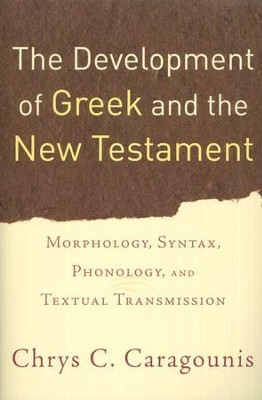
This series of blog posts will revolve around a book written by Chrys Caragounis entitled The Development of Greek and the New Testament: Morphology, Syntax, Phonology, and Textual Transmission (Grand Rapids, Baker Academic, 2006).
I will start on page 316, then pick out certain portions of Caragounis' work to make my focus. On pp. 316-321, Caragounis argues by means of numerous sources that Greek has both tense and aspect (contra Porter). His entire critique of Porter's work is quite strong and direct: he mercilessly castigates Porter's findings.
I'm not going to spend much time on the tense-aspect debate, because it's already been covered many times, including on this blog. Interested parties can see:
https://fosterheologicalreflections.blogspot.com/2015/10/matthew-1619-and-greek-aspect.html
https://fosterheologicalreflections.blogspot.com/2015/11/aspect-and-aktionsart-john-1032-and.html
https://fosterheologicalreflections.blogspot.com/2012/05/ism-time-grammaticalized-in-new.html
I will spend more time on subsequent analyses of Caragounis' book and his major disagreements with Porter.

I will start on page 316, then pick out certain portions of Caragounis' work to make my focus. On pp. 316-321, Caragounis argues by means of numerous sources that Greek has both tense and aspect (contra Porter). His entire critique of Porter's work is quite strong and direct: he mercilessly castigates Porter's findings.
I'm not going to spend much time on the tense-aspect debate, because it's already been covered many times, including on this blog. Interested parties can see:
https://fosterheologicalreflections.blogspot.com/2015/10/matthew-1619-and-greek-aspect.html
https://fosterheologicalreflections.blogspot.com/2015/11/aspect-and-aktionsart-john-1032-and.html
https://fosterheologicalreflections.blogspot.com/2012/05/ism-time-grammaticalized-in-new.html
I will spend more time on subsequent analyses of Caragounis' book and his major disagreements with Porter.
Saturday, July 02, 2016
2 Chronicles 24:17 (LXX) and Proskynesis
2 Chronicles 24:17:
καὶ ἐγένετο μετὰ τὴν τελευτὴν ᾿Ιωδαὲ εἰσῆλθον οἱ ἄρχοντες ᾿Ιούδα καὶ προσεκύνησαν τὸν βασιλέα· τότε ἐπήκουσεν αὐτοῖς ὁ βασιλεύς.
"And it came to pass after the death of Jodae, that the princes of Juda went in, and did obeisance to the king. Then the king hearkened to them" (Brenton LXX).
"And it happened after Iodae's death that the rulers of Ioudas entered and did obeisance to the king. Then the king heeded them" (NETS).
καὶ ἐγένετο μετὰ τὴν τελευτὴν ᾿Ιωδαὲ εἰσῆλθον οἱ ἄρχοντες ᾿Ιούδα καὶ προσεκύνησαν τὸν βασιλέα· τότε ἐπήκουσεν αὐτοῖς ὁ βασιλεύς.
"And it came to pass after the death of Jodae, that the princes of Juda went in, and did obeisance to the king. Then the king hearkened to them" (Brenton LXX).
"And it happened after Iodae's death that the rulers of Ioudas entered and did obeisance to the king. Then the king heeded them" (NETS).
Friday, July 01, 2016
Isaiah 9:6 (Otto Kaiser's OTL Commentary)
(1) Otto Kaiser (OTL) professes that the King (or Messiah) mentioned in Isa. 9:6 is EL GIBBOHR insofar as he is "the representative and viceregent of God on earth, who, as the one endowed with this spirit (cf. 11:1), shares in his nature and his will" (Isaiah 1-12, Page 213).
When Kaiser claims that the Messiah-King shares in "the nature" and "will" of God, his statement should not be construed to mean that he believes the King shares the essence of God (i.e., the divine attributes). To the contrary, the King that Kaiser provides commentary about is fully human. This point is clearly brought out when Kaiser explains that the words "Wonderful Counselor" characterize: "the ruler as a man who, like God, can make extraordinary resolves and then carry them out. Illuminated by Yahweh himself, he needs no counsel from others . . . The second name [Mighty God] stresses his abundance of power, calling men to their God" (213).
Kaiser also contends that Isa. 9:6 possibly shows hints of Egyptian influence on the royal ritual of Israel (a point some have insisted applies to Ps. 45 and Heb. 1). For an interesting discussion of this matter vis-a'-vis Revelation 5:1ff and the coronation of the Lamb, see David Aune's thorough notes in his Word commentary (Revelation 1-5). But whether Isa. 9:6 shows Egyptian influence or not, Kaiser demonstrates by means of parallels why Isa. 9:6 is not necessarily proof for the Deity of Jesus (even though it is clearly Messianic). Please see the Catholic NAB and its handling of this OT passage since the NABRE appears to have changed the footnote found in the older NAB.
(2) Isa. 9:7 indicates that the Messiah would rule by the power of YHWH. A similar point is made at Mic. 5:4, where the Messiah is said to rule in the strength of YHWH. There is abundant proof that Mic. 5:1-4 is what we would today call--a subordinationist delineation of the Messiah.
For Kaiser's commentary, see https://books.google.com/books?id=15a7BwAAQBAJ&printsec=frontcover&dq=isaiah+1-12+kaiser&hl=en&sa=X&ved=0ahUKEwjf6669vsvNAhUF5iYKHSkLD1MQ6AEIHDAA#v=onepage&q=isaiah%201-12%20kaiser&f=false
Tuesday, June 28, 2016
Tertullian on the Joy That Results from Watching People Suffer Eternal Punishment (Spectacles 30)
What a panorama of spectacle on that day! Which sight shall excite my wonder? Which, my laughter? Where shall I rejoice, where exult--as I see so many and so mighty kings, whose ascent to heaven used to be made known by public announcement, now along with Jupiter himself, along with the very witnesses of their ascent, groaning in the depths of darkness? Governors of provinces, too, who persecuted the name of the Lord, melting in flames fiercer than those they themselves kindled in their rage against the Christians braving them with contempt?
Whom else shall I behold? Those wise philosophers blushing before their followers as they burn together, the followers whom they taught that the world is no concern of God's whom they assured that either they had no souls at all or that what souls they had would never return to their former bodies? The poets also, trembling, not before the judgment seat of Rhadamanthus or of Minos, but of Christ whom they did not expect to meet.
Then will the tragic actors be worth hearing, more vocal in their own catastrophe; then the comic actors will be worth watching, more lither of limb in the fire; then the charioteer will be worth seeing, red all over on his fiery wheel; then the athletes will be worth observing, not in their gymnasiums, but thrown about by fire--unless I might not wish to look at them even then but would prefer to turn an insatiable gaze on those who vented their rage on the Lord.
"This is He," I will say, "the son of the carpenter and the harlot, the sabbath-breaker, the Samaritan who had a devil. This is He whom you purchased from Judas, this is He who was struck with reed and fist, defiled with spittle, given gall and vinegar to drink. This is He whom the disciples secretly stole away to spread the story of His resurrection, or whom the gardener removed lest his lettuces be trampled by the throng of curious idlers."
What praetor or consul or quaestor or priest with all his munificence will ever bestow on you the favor of beholding and exulting in such sights? Yet, such scenes as these are in a measure already ours by faith in the vision of the spirit. But what are those things which "eye has not seen nor ear heard and which have not entered into the heart of man"? Things of greater delight, I believe, than circus, both kinds of theater, and any stadium.
Saturday, June 25, 2016
Comments on 1 John 5:20 (Omar)
Omar,
You asked about the prepositions used in 1 John 5:20, and why NWT renders the verse the way it does. The verse reads in WH: οἴδαμεν δὲ ὅτι ὁ υἱὸς τοῦ θεοῦ ἥκει, καὶ δέδωκεν ἡμῖν διάνοιαν ἵνα γινώσκομεν τὸν ἀληθινόν· καί ἐσμεν ἐν τῷ ἀληθινῷ, ἐν τῷ υἱῷ αὐτοῦ Ἰησοῦ Χριστῷ. οὗτός ἐστιν ὁ ἀληθινὸς θεὸς καὶ ζωὴ αἰώνιος.
Others may have some points to add, and I might have more to say as well. But here are some initial comments that might help:
Benson Commentary: and we are in him that is true — In his favour, and in a state of union and fellowship with him; even — This particle is not in the Greek; in — Or rather; through; his Son Jesus Christ — Through whose mediation alone we can have access to, or intercourse with, the Father.
Barnes' Notes on the Bible: And we are in him that is true - That is, we are united to him; we belong to him; we are his friends. This idea is often expressed in the Scriptures by being "in him." It denotes a most intimate union, as if we were one with him - or were a part of him - as the branch is in the vine, John 15:4, John 15:6. The Greek construction is the same as that applied to "the wicked one," 1 John 5:19, (ἐν τῷ ἀληθινᾧ en tō alēthinō.)
Tyndale's NT (1 John 5:20-21):
We know that the son of God is come, and hath given us a mind to know him which is true: and we are in him that is true, through his son Iesu Christ. This same is very God, and eternal life. Babes keep yourselves from images. Amen.
Williams-New Testament in the Language of the People:
"And we know that the Son of God has come, and has given us insight to recognize the True One; and we are in union with the True One through His Son, Jesus Christ. He is the true God and eternal life."
See http://defendingthenwt.blogspot.com/2010/11/translating-in.html
See Thayer's Greek-English Lexicon here: http://biblehub.com/greek/1722.htm
Notice what entry 6b says.
You asked about the prepositions used in 1 John 5:20, and why NWT renders the verse the way it does. The verse reads in WH: οἴδαμεν δὲ ὅτι ὁ υἱὸς τοῦ θεοῦ ἥκει, καὶ δέδωκεν ἡμῖν διάνοιαν ἵνα γινώσκομεν τὸν ἀληθινόν· καί ἐσμεν ἐν τῷ ἀληθινῷ, ἐν τῷ υἱῷ αὐτοῦ Ἰησοῦ Χριστῷ. οὗτός ἐστιν ὁ ἀληθινὸς θεὸς καὶ ζωὴ αἰώνιος.
Others may have some points to add, and I might have more to say as well. But here are some initial comments that might help:
Benson Commentary: and we are in him that is true — In his favour, and in a state of union and fellowship with him; even — This particle is not in the Greek; in — Or rather; through; his Son Jesus Christ — Through whose mediation alone we can have access to, or intercourse with, the Father.
Barnes' Notes on the Bible: And we are in him that is true - That is, we are united to him; we belong to him; we are his friends. This idea is often expressed in the Scriptures by being "in him." It denotes a most intimate union, as if we were one with him - or were a part of him - as the branch is in the vine, John 15:4, John 15:6. The Greek construction is the same as that applied to "the wicked one," 1 John 5:19, (ἐν τῷ ἀληθινᾧ en tō alēthinō.)
Tyndale's NT (1 John 5:20-21):
We know that the son of God is come, and hath given us a mind to know him which is true: and we are in him that is true, through his son Iesu Christ. This same is very God, and eternal life. Babes keep yourselves from images. Amen.
Williams-New Testament in the Language of the People:
"And we know that the Son of God has come, and has given us insight to recognize the True One; and we are in union with the True One through His Son, Jesus Christ. He is the true God and eternal life."
See http://defendingthenwt.blogspot.com/2010/11/translating-in.html
See Thayer's Greek-English Lexicon here: http://biblehub.com/greek/1722.htm
Notice what entry 6b says.
Friday, June 24, 2016
Tripartite Anthropology and Scripture (1 Thessalonians 5:23)
Charles Ryrie (whom I understand to be a dispensationalist) apparently does not interpret 1 Thess. 5:23 in a tripartite manner. He seems to openly rejects a tripartite interpretation of humanity for 1 Thess. 5:23. And he is not alone. David J. Williams writes: "One would be hard pressed to draw a distinction between spirit and soul; and, while it may be easier to distinguish between spirit and body, the biblical notion of the wholeness of our being must be kept in view" (1 and 2 Thessalonians, p. 103).
Simply put, Williams rejects the tripartite interpretation of this verse as does Ryrie. Gen. 2:7 also seems to militate against any tripartite understanding of humanity. So those who believe in soul and body can make some kind of distinction between body, soul, and spirit or they can equate the soul with the human spirit. I've also seen theologians of Christendom define "spirit" as the vital force for humans and animals. But they try to argue that the human spirit differs from the spirit of animals.
Henry Alford on 1 Thessalonians 5:23:
Simply put, Williams rejects the tripartite interpretation of this verse as does Ryrie. Gen. 2:7 also seems to militate against any tripartite understanding of humanity. So those who believe in soul and body can make some kind of distinction between body, soul, and spirit or they can equate the soul with the human spirit. I've also seen theologians of Christendom define "spirit" as the vital force for humans and animals. But they try to argue that the human spirit differs from the spirit of animals.
Henry Alford on 1 Thessalonians 5:23:
τὸ πν. κ. ἡ ψυχ. κ. τὸ σῶμα] τὸ πνεῦμα is the spirit, the highest and distinctive part of man, the immortal and responsible soul, in our common parlance: ἡ ψυχή is the lower or animal soul, containing the passions and desires (αιτία κινήσεως ζωικῆς ζώων, Plato, Deff. p. 411), which we have in common with the brutes, but which in us is ennobled and drawn up by the πνεῦμα. That St. Paul had these distinctions in mind, is plain (against Jowett) from such places as 1 Corinthians 2:14. The spirit, that part whereby we are receptive of the Holy Spirit of God, is, in the unspiritual man, crushed down and subordinated to the animal soul (ψυχή): he therefore is called ψυχικὸς πνεῦμα μὴ ἔχων, Jude 1:19: see also note on 1 Cor. as above.
Wednesday, June 22, 2016
Upcoming Material About Caragounis and Porter
Now that summer is here, my work schedule has changed, and I am able to do other things besides work in the classroom and grade papers. I want to take the next few weeks to closely analyze Chrys Caragounis' critique of Stanley Porter's work regarding aspect. That will be the primary focus of my blog activity for the next 3-4 weeks. So while I'll be blogging about other issues, I just wanted to let readers know what my chief focus will be.
Stanley Porter Reviews Daniel B. Wallace's Book on Sharp's Rule
Porter is harsh on Wallace in certain parts of the review. See http://www.etsjets.org/files/JETS-PDFs/56/56-1/JETS_56-1_93-100_Porter.pdf
Some good points are made about Sharp's Rule.
Some good points are made about Sharp's Rule.
Tuesday, June 21, 2016
Addressing Other Questions Pertaining to Ruach and Christian Materialism
Regarding RUACH: What makes us justified in believing that the import of RUACH in Psalm 146:4; Ecclesiastes 12:7 is different from the import of RUACH in Psalm 104:29-30; Ecclesiastes 3:19-22, especially when Qoheleth writes that man and beast have "one spirit" and the same eventuality? My question is a linguistic rather than a theological one. I believe that we must be as objective as possible about defining words and exegeting texts. Ecclesiastes 3:19-22 is very compelling evidence that man and beast have the same RUACH or vital force. Of course, RUACH has different meanings in other contexts.
The meaning of RUACH is going to depend on the setting of the passage we're examining. Its basic denotations are "spirit, wind or breath." In Ecclesiastes 3:19-22; 12:7 and Psalm 104:29; 146:4, I believe that it denotes "life force." My understanding of "life force" is harmonious with the view presented in Insight on the Scriptures II:1025: the word "life force" refers to that energy or vitality which is active in our body's cells.
Concerning Christian materialism: Not all Christian materialists hold the same beliefs about human uniqueness. From the perspective of science, the way our brains have developed (especially the neocortex) makes us unique in terms of rationality, language, and spirituality. At the present time, I have no good reasons for attributing my spiritual appetite or my rational and sociable nature to anything but neurobiological processes. If there is something else that explains human uniqueness, it seems to go beyond the purview of empirical and naturalistic science. But you will find divergent views of materialism/physicalism among those who consider themselves Christian. And while Witnesses don't technically label themselves as "Christian materialists," I've just found that it's a convenient way to describe what I/we believe.
Finally, it's interesting to think about the role that the human body has qua identity. The Apostle Paul painstakingly outlines a position that says the body raised is not the same corpus as the body that was sown in death (1 Corinthians 15:42-44). While his inspired comments apply to those raised to immortal life in the heavens, based on what we seem to know about the resurrection of Christ and others, those resurrected in the new earth will probably have bodies that look similar to those bodies that were sown. In other words, God will not bring the same (exact) body to life that one had in this world.
The meaning of RUACH is going to depend on the setting of the passage we're examining. Its basic denotations are "spirit, wind or breath." In Ecclesiastes 3:19-22; 12:7 and Psalm 104:29; 146:4, I believe that it denotes "life force." My understanding of "life force" is harmonious with the view presented in Insight on the Scriptures II:1025: the word "life force" refers to that energy or vitality which is active in our body's cells.
Concerning Christian materialism: Not all Christian materialists hold the same beliefs about human uniqueness. From the perspective of science, the way our brains have developed (especially the neocortex) makes us unique in terms of rationality, language, and spirituality. At the present time, I have no good reasons for attributing my spiritual appetite or my rational and sociable nature to anything but neurobiological processes. If there is something else that explains human uniqueness, it seems to go beyond the purview of empirical and naturalistic science. But you will find divergent views of materialism/physicalism among those who consider themselves Christian. And while Witnesses don't technically label themselves as "Christian materialists," I've just found that it's a convenient way to describe what I/we believe.
Finally, it's interesting to think about the role that the human body has qua identity. The Apostle Paul painstakingly outlines a position that says the body raised is not the same corpus as the body that was sown in death (1 Corinthians 15:42-44). While his inspired comments apply to those raised to immortal life in the heavens, based on what we seem to know about the resurrection of Christ and others, those resurrected in the new earth will probably have bodies that look similar to those bodies that were sown. In other words, God will not bring the same (exact) body to life that one had in this world.
Saturday, June 18, 2016
Isaiah, Daniel, and the Dead Sea Scrolls (Patrick Zuckeran)
These quotes originate with Zuckeran:
[SPACE]
To read the entire article, see https://bible.org/article/dead-sea-scrolls
Compare http://biblicalstudies.org.uk/blog/prof-kenneth-kitchen-on-the-aramaic-of-daniel/#.V2XOfaLVvQo
The Dead Sea Scrolls provided further proof that the Old Testament canon existed prior to the third century B.C. Thousands of manuscript fragments from all the Old Testament books except Esther were found predating Christ's birth, and some date as early as the third century B.C. For example, portions from the book of Samuel date that early, and fragments from Daniel date to the second century B.C. Portions from the twelve Minor Prophets date from 150 B.C. to 25 B.C. Since the documents were found to be identical with our Masoretic Text, we can be reasonably sure that our Old Testament is the same one that the Essenes were studying and working from.
One of the most important Dead Sea documents is the Isaiah Scroll. This twenty-four foot long scroll is well preserved and contains the complete book of Isaiah. The scroll is dated 100 B.C. and contains one of the clearest and most detailed prophecies of the Messiah in chapter fifty-three, called the "Suffering Servant." Although some Jewish scholars teach that this refers to Israel, a careful reading shows that this prophecy can only refer to Christ.
[SPACE]
Before the discovery of the scrolls, critical scholars argued that the Aramaic language used in Daniel was from a time no earlier than 167 B.C. during the Maccabean period. Other scholars, such as well-respected archaeologist Kenneth Kitchen, studied Daniel and found that ninety percent of Daniel's Aramaic vocabulary was used in documents from the fifth century B.C. or earlier. The Dead Sea Scrolls revealed that Kitchen's conclusion was well founded. The Aramaic language used in the Dead Sea Scrolls proved to be very different from that found in the book of Daniel. Old Testament scholars have concluded that the Aramaic in Daniel is closer to the form used in the fourth and fifth century B.C. than to the second century B.C.
To read the entire article, see https://bible.org/article/dead-sea-scrolls
Compare http://biblicalstudies.org.uk/blog/prof-kenneth-kitchen-on-the-aramaic-of-daniel/#.V2XOfaLVvQo
A Dialogue on the Condition of the Dead
My interlocutor's statements will appear in quotation marks, and they are in block quotation form. I'll indicate where my responses are.
Edgar: Gen 2:7 does not say that Adam 'became a living spirit.' The Hebrew word, as you know, is NEPHESH. It refers to a human person, an animal, or the life which an animal or human experiences.
RESPONSE: May I suggest that you look at the verse again. Gen 2:7 does not say that Adam *became* a "Neshamah" but that he came to be a NEPHESH ("Adam chay nephesh"). Furthermore, animals are said to *be* creatures or souls. An animal, in other words, does not simply possess a NEPHESH but *is* one (Num 31:26-28). Additionally, Gen 7:22 certainly indicates that animals have NESHAMAH: "All in whose nostrils [was] the breath [NESHAMAH] of life, of all that [was] in the dry [land], died.
RESPONSE: According to Scripture, animals have a NESHAMAH (Gen 7:22; Ps 150:6); RUACH (Eccl 3:19-21) and they are souls (Gen 1:21-24; Rev 16:3).
RESPONSE: The verse does not actually say that "we" are not part of our respective tents. Nor does Gen 2:7 make such a claim. What the first book of the Pentateuch does say, however (in perfect harmony with 2 Cor 5:1), is that the body + the breath of life (NESHAMAH) together constitute the human person (i.e., "we"). The person = the soul, that is, the union of body and NESHAMAH make up the human NEPHESH. Without either element, "we" would not exist as persons.
RESPONSE: The body is [metaphorical] clothing, to be sure. That does not mean that the body is merely a temporary house for the spirit of man. Without my "clothing," I cease to be a "living soul" (NEPHESH) and become an unconscious carcass or corpse (i.e., a dead soul). Eccl 9:5 relates that the dead know nothing. Jesus affirms this teaching in Jn 11:11-14. The dead sleep the sleep of AQANATOS (Ps 13:3) until God calls them forth from Sheol. Interestingly, Paul does not say that he will become incorporeal after death. He envisions being given, though he states it in a conditional way, a new building out of heaven from God, an eternal house in the very heavens of God's presence (2 Cor 5:1-2). Similar to the teaching of Tertullian, Paul believes that the resurrected dead who see God and become like Him will possess spiritual bodies suited to their new heavenly environment (1 Jn 3:1-3).
RESPONSE: Neither the flesh nor the NESHAMAH is "us." It is the unity of BASAR and NESHAMAH that constitutes the human person. Without a brain, there is no human consciousness, mind or spirit. As the psalmist writes, when man's RUACH goes out, he returns to the dust and his thoughts cease (Ps 146:3-4).
Edgar: Gen 2:7 does not say that Adam 'became a living spirit.' The Hebrew word, as you know, is NEPHESH. It refers to a human person, an animal, or the life which an animal or human experiences.
"No, the word is 'Neshamah'. Animals have a nefesh, but they do not have a neshamah."
RESPONSE: May I suggest that you look at the verse again. Gen 2:7 does not say that Adam *became* a "Neshamah" but that he came to be a NEPHESH ("Adam chay nephesh"). Furthermore, animals are said to *be* creatures or souls. An animal, in other words, does not simply possess a NEPHESH but *is* one (Num 31:26-28). Additionally, Gen 7:22 certainly indicates that animals have NESHAMAH: "All in whose nostrils [was] the breath [NESHAMAH] of life, of all that [was] in the dry [land], died.
"The Neshamah, according to Jewish tradition, is that part of the spiritual man that transcends the nefesh (or soul - which even animals have) and the ruach (spirit - which animals don't have) and gets even closer to the essence of who a man is than even the ruach/spirit. Animals have neither a neshamah nor a ruach/spirit, but they do have a nefesh/soul."
RESPONSE: According to Scripture, animals have a NESHAMAH (Gen 7:22; Ps 150:6); RUACH (Eccl 3:19-21) and they are souls (Gen 1:21-24; Rev 16:3).
"2 Cor 5:1 says 'If the earthly tent we live in is destroyed....' 'We' here lives in a 'tent', thus, the 'tent' is not part of 'we'. It also says ...
RESPONSE: The verse does not actually say that "we" are not part of our respective tents. Nor does Gen 2:7 make such a claim. What the first book of the Pentateuch does say, however (in perfect harmony with 2 Cor 5:1), is that the body + the breath of life (NESHAMAH) together constitute the human person (i.e., "we"). The person = the soul, that is, the union of body and NESHAMAH make up the human NEPHESH. Without either element, "we" would not exist as persons.
"'when we are clothed, we will not be found naked' (2 Cor 5:3) [and] 'You clothe me in skin and flesh' (Job 10:11)"
RESPONSE: The body is [metaphorical] clothing, to be sure. That does not mean that the body is merely a temporary house for the spirit of man. Without my "clothing," I cease to be a "living soul" (NEPHESH) and become an unconscious carcass or corpse (i.e., a dead soul). Eccl 9:5 relates that the dead know nothing. Jesus affirms this teaching in Jn 11:11-14. The dead sleep the sleep of AQANATOS (Ps 13:3) until God calls them forth from Sheol. Interestingly, Paul does not say that he will become incorporeal after death. He envisions being given, though he states it in a conditional way, a new building out of heaven from God, an eternal house in the very heavens of God's presence (2 Cor 5:1-2). Similar to the teaching of Tertullian, Paul believes that the resurrected dead who see God and become like Him will possess spiritual bodies suited to their new heavenly environment (1 Jn 3:1-3).
"So our flesh is something we wear - like clothing - but our clothes are not us. Revelation also uses this language. We also find the idea that man is a spiritual being living in a fleshly body promoted in numerous ancient Jewish writings (e.g. Zohar I (on Bereshit), 20b )."
RESPONSE: Neither the flesh nor the NESHAMAH is "us." It is the unity of BASAR and NESHAMAH that constitutes the human person. Without a brain, there is no human consciousness, mind or spirit. As the psalmist writes, when man's RUACH goes out, he returns to the dust and his thoughts cease (Ps 146:3-4).
Is the Lamb of Revelation Vulnerable or Militaristic (Dr. Loren Johns)
Dr. Loren Johns once wrote a piece entitled "The Lamb in the Rhetorical Program of the Apocalypse of John." In this work, building on previous research, he argued that Christ is portrayed as a Lamb in Revelation to depict his vulnerability or unconventional way of conquering his enemies. Johns reads the Apocalypse through Mennonite lenses which supplies a unique interpretation of the Bible's last book, but his reading of the Johannine text is highly implausible to me. Granted, God is said to hate those who love violence (Psalm 11:5) and the Son of God exhorted his followers to avoid living by the sword lest they perish by it (Matthew 26:52). But Revelation descriptively narrates God and the Lamb waging war (call it violently if you wish) against the enemies of YHWH (17:16-17; 19:11-21; 20:1-10). However, I still find Dr. Johns' use of classical rhetoric to be instructive.
See http://www.ambs.edu/ljohns/LambRPAJ.htm
See http://www.ambs.edu/ljohns/LambRPAJ.htm
Thursday, June 16, 2016
Questions Regarding Hylomorphic/Thomistic Souls
Does the hylomorphic soul (as conceived by Aquinas and the Church) contemplate God while subsisting in the intermediate state between death and the resurrection? Would not the activity of contemplation also raise some questions about the post-mortem soul's condition? Finally, I would question whether the soul alone would be enough to preserve a person's numerical identity since the body and soul are believed to be separated at death. Moreover, it still remains a mystery how the body that's reunited with the soul in the resurrection turns out to be numerically identical with the body that existed prior to death. I am aware of Aquinas' explanation for the preservation of numerical identity despite the body's decay (its return to the dust), but his account has been criticized by Kevin Corcoran and other philosophers who interpret gaps in existence as possible grounds for the recreation or reconstitution of something new.
Let's imagine S accidentally makes a whole burnt-offering of his prestigious 2nd-century papyrus fragment from ancient Egypt. Assuming that the fragment is utterly consumed, would we still identify a reconstituted fragment (the same atom for atom) as the numerically identical object which underwent an accidental burning? My point is that dualists and physicalists must take pains to supply a coherent narrative about the resurrected body, whether it's spirit or flesh. Dualists cannot rightly assert that Christian physicalists lack the adequate resources for explaining a bodily resurrection: the former have not supplied a thorough and satisfactory account of the resurrection either.
Let's imagine S accidentally makes a whole burnt-offering of his prestigious 2nd-century papyrus fragment from ancient Egypt. Assuming that the fragment is utterly consumed, would we still identify a reconstituted fragment (the same atom for atom) as the numerically identical object which underwent an accidental burning? My point is that dualists and physicalists must take pains to supply a coherent narrative about the resurrected body, whether it's spirit or flesh. Dualists cannot rightly assert that Christian physicalists lack the adequate resources for explaining a bodily resurrection: the former have not supplied a thorough and satisfactory account of the resurrection either.
Wednesday, June 15, 2016
A Brief Thought on Satan and Free Will
We've discussed the possible referent of 2 Cor. 4:4. I still believe it's Satan, whereas some argue that Jehovah (YHWH) is the god of this age (world). Let's assume that Paul is referring to Satan. The verse states that the god of this world blinds the minds of the unbelievers. I used to wonder how Jehovah could allow Satan to blind someone's mind from the good news about the Christ. How can God punish someone who does not accept the truth, if he allowed Satan to blind their minds?
I've since learned that Satan can only blind the minds of those, who do not love divine truth. Paul writes:
"And for this cause God sendeth them a working of error, that they should believe a lie: that they all might be judged who believed not the truth, but had pleasure in unrighteousness" (2 Thessalonians 2:11-12 ASV).
Jehovah allows the desires of their hearts to be fulfilled, in accordance with their free choice.
I've since learned that Satan can only blind the minds of those, who do not love divine truth. Paul writes:
"And for this cause God sendeth them a working of error, that they should believe a lie: that they all might be judged who believed not the truth, but had pleasure in unrighteousness" (2 Thessalonians 2:11-12 ASV).
Jehovah allows the desires of their hearts to be fulfilled, in accordance with their free choice.
Tuesday, June 14, 2016
Catholic NABRE Footnote on Luke 17:21
[17:21] Among you: the Greek preposition translated as among can also be translated as “within.” In the light of other statements in Luke's gospel about the presence of the kingdom (see Lk 10:9, 11; 11:20) “among” is to be preferred.
Monday, June 13, 2016
Reading List for the Subject of Free Will (From Spring Semester 2014)
PHI 318 (Spring Semester 2014)-List of Readings for the Semester
January 23-28: “Free Will, Praise and Blame” (J. J. C. Smart); “Towards a Reasonable Libertarianism” (David Wiggins) in Watson.
“Compatibilism” (John Martin Fischer) and “Hard Compatibilism” (Derk Pereboom) in Four Views
January 30-February 4: “Are We Free to Break the Laws” (David Lewis); “Alternate Possibilities and Moral Responsibility” (Harry G. Frankfurt), and “Libertarianism and Frankfurt's Attack on the Principle of Alternative Possibilities” (David Widerker) in Watson.
February 6-11: “Revisionism” (Manuel Vargas); “Response to Fischer, Pereboom, and Vargas” (Robert Kane) in Four Views.
February 13-18: “The Impossibility of Moral Responsibility” (Galen Strawson); “Toward a Credible Agent-Causal Account of Free Will” (Randolph Clarke) in Watson.
February 20-27: “Response to Kane, Pereboom, and Vargas” (John Martin Fischer); “Response to Kane, Fischer, and Vargas” (Derk Pereboom); “Response to Kane, Fischer, and Pereboom” (Manuel Vargas) in Four Views.
March 1-6: “Freedom of the Will and the Concept of a Person” (Harry G. Frankfurt); “Free Agency” (Gary Watson); “The Significance of Choice” (T. M. Scanlon) in Watson.
March 7-13: “Sanity and the Metaphysics of Responsibility” (Susan Wolf); “Freedom of Will and Freedom of Action” (Rogers Albritton); “Addiction as Defect of the Will: Some Philosophical Reflections” (R. Jay Wallace) in Watson.
March 14-20: “On the Free Choice of the Will” (Augustine), pages 3-30; Aristotle in Pereboom, 1-4.
March 21-27: “On the Free Choice of the Will” (Augustine), pages 30-72; Stoics in Pereboom, 5-16.
March 28-April 3: “On the Free Choice of the Will” (Augustine), 72-126; Lucretius in Pereboom, 17-18 and Aquinas, pages 34-42 (ibid.).
April 4-10: “On Grace and Free Choice” (Augustine), pages 141-184; Aquinas in Pereboom, pages 43-56.
April 11-17: “On the Gift of Perseverance,” 225-245; Spinoza in Pereboom, pages 57-75.
April 18-24: Hume, pages 76-104; Kant in Pereboom, 105-129.
April 25-May 1: Thomas Reid, 130-138; Ayer in Pereboom, 139-147.
January 23-28: “Free Will, Praise and Blame” (J. J. C. Smart); “Towards a Reasonable Libertarianism” (David Wiggins) in Watson.
“Compatibilism” (John Martin Fischer) and “Hard Compatibilism” (Derk Pereboom) in Four Views
January 30-February 4: “Are We Free to Break the Laws” (David Lewis); “Alternate Possibilities and Moral Responsibility” (Harry G. Frankfurt), and “Libertarianism and Frankfurt's Attack on the Principle of Alternative Possibilities” (David Widerker) in Watson.
February 6-11: “Revisionism” (Manuel Vargas); “Response to Fischer, Pereboom, and Vargas” (Robert Kane) in Four Views.
February 13-18: “The Impossibility of Moral Responsibility” (Galen Strawson); “Toward a Credible Agent-Causal Account of Free Will” (Randolph Clarke) in Watson.
February 20-27: “Response to Kane, Pereboom, and Vargas” (John Martin Fischer); “Response to Kane, Fischer, and Vargas” (Derk Pereboom); “Response to Kane, Fischer, and Pereboom” (Manuel Vargas) in Four Views.
March 1-6: “Freedom of the Will and the Concept of a Person” (Harry G. Frankfurt); “Free Agency” (Gary Watson); “The Significance of Choice” (T. M. Scanlon) in Watson.
March 7-13: “Sanity and the Metaphysics of Responsibility” (Susan Wolf); “Freedom of Will and Freedom of Action” (Rogers Albritton); “Addiction as Defect of the Will: Some Philosophical Reflections” (R. Jay Wallace) in Watson.
March 14-20: “On the Free Choice of the Will” (Augustine), pages 3-30; Aristotle in Pereboom, 1-4.
March 21-27: “On the Free Choice of the Will” (Augustine), pages 30-72; Stoics in Pereboom, 5-16.
March 28-April 3: “On the Free Choice of the Will” (Augustine), 72-126; Lucretius in Pereboom, 17-18 and Aquinas, pages 34-42 (ibid.).
April 4-10: “On Grace and Free Choice” (Augustine), pages 141-184; Aquinas in Pereboom, pages 43-56.
April 11-17: “On the Gift of Perseverance,” 225-245; Spinoza in Pereboom, pages 57-75.
April 18-24: Hume, pages 76-104; Kant in Pereboom, 105-129.
April 25-May 1: Thomas Reid, 130-138; Ayer in Pereboom, 139-147.
Explaining Consciousness By Using (Christian) Physicalism
A number of philosophers argue that consciousness cannot in principle be explained by materialist/physicalist methods. They believe that subjectivity is not amenable to a physicalist explanation.
I self-identify as a Christian materialist, which means that while I believe spirits exist (God, angels, and resurrected spirit beings), I do not believe in immortal souls nor do I think the human sphere contains a "mental" or spiritual component. In other words, I reject the existence of an immortal soul or a res cogitans as Rene Descartes famously expressed matters. It seems that humans are purely physical: we do not have non-material souls or spirits.
Scientific work is just beginning (in earnest) on questions pertaining to consciousness and subjectivity. The neuroscientist Antonio Damasio has written books that possibly attempt to integrate free will and a physicalist account of the self. He and Hanna Damasio (along with many others) have extensively studied the case of Phineas Gage, and what it might tell us about mentality. See Descartes' Error by Antonio Damasio. There's also a book that I'll start reading soon entitled The Neuroscience of Freedom and Creativity: Our Predictive Brain written by Joaquin M. Fuster (Cambridge Press). Joel B. Green has also published works that partly analyze the role of brain activity in our mental life. Admittedly though, much work needs to be done in this area. But I would not agree that science lacks the resources in principle to explain memory (for instance) or pain in physicalist terms, since joint pain could be explained by the overabundance of uric acid or the wearing away of cartilage.
Long-term memory can be explained by the hippocampus or the fight/flight response could be explained by the amygdala. As for free will, Nancey Murphy addresses that question. She demonstrates the possibility that free will could exist even though we might be purely material beings. Physicalists have worked on qualia too, with no definitive result. It's still an open question just what qualia are. Almost every writer that I've read in the philosophy of mind accepts the existence of qualia. However, there's no unanimous consensus respecting how we experience "raw feels" or subjective sensations. Does dualism fully address this question? Not to my knowledge. Dualism offers suggestions for how mentality works, just like Christian physicalism does. Neither approach definitively explains consciousness.
I self-identify as a Christian materialist, which means that while I believe spirits exist (God, angels, and resurrected spirit beings), I do not believe in immortal souls nor do I think the human sphere contains a "mental" or spiritual component. In other words, I reject the existence of an immortal soul or a res cogitans as Rene Descartes famously expressed matters. It seems that humans are purely physical: we do not have non-material souls or spirits.
Scientific work is just beginning (in earnest) on questions pertaining to consciousness and subjectivity. The neuroscientist Antonio Damasio has written books that possibly attempt to integrate free will and a physicalist account of the self. He and Hanna Damasio (along with many others) have extensively studied the case of Phineas Gage, and what it might tell us about mentality. See Descartes' Error by Antonio Damasio. There's also a book that I'll start reading soon entitled The Neuroscience of Freedom and Creativity: Our Predictive Brain written by Joaquin M. Fuster (Cambridge Press). Joel B. Green has also published works that partly analyze the role of brain activity in our mental life. Admittedly though, much work needs to be done in this area. But I would not agree that science lacks the resources in principle to explain memory (for instance) or pain in physicalist terms, since joint pain could be explained by the overabundance of uric acid or the wearing away of cartilage.
Long-term memory can be explained by the hippocampus or the fight/flight response could be explained by the amygdala. As for free will, Nancey Murphy addresses that question. She demonstrates the possibility that free will could exist even though we might be purely material beings. Physicalists have worked on qualia too, with no definitive result. It's still an open question just what qualia are. Almost every writer that I've read in the philosophy of mind accepts the existence of qualia. However, there's no unanimous consensus respecting how we experience "raw feels" or subjective sensations. Does dualism fully address this question? Not to my knowledge. Dualism offers suggestions for how mentality works, just like Christian physicalism does. Neither approach definitively explains consciousness.
Sunday, June 12, 2016
Aquinas Responds to the Question: Did the Godhead of Jesus Die? (FYI)
The grace of God is so great and His love for us is such that we cannot understand what He has done for us. Now, we must believe that, although Christ suffered death, yet His Godhead did not die; it was the human nature in Christ that died. For He did not die as God, but as man.[2]
This will be clear from two examples, one of which is taken from himself. Now, when a man dies, in the separation of the soul from the body the soul does not die but the body or flesh does die. So also in the death of Christ, His Divinity did not die, but His man nature suffered death. But if the Jews did not slay the Divinity of Christ, it would seem that their sin was not any greater than if they killed any ordinary man. In answering this we say that it is as if a king were clothed only in one garment, and if someone befouled this garment, such a one has committed as grave a crime as if he had defiled the king himself. Likewise, although the Jews could not slay God, yet in putting to death the human nature which Christ assumed, they were as severely punished as if they had put the Godhead itself to death. Another example is had from what we said before, viz., that the Son of God is the Word of God, and the Word of God made flesh is like the word of a king written on paper.[3] So if one should tear this royal paper in pieces, it would be considered that he had rent apart the word of the king. Thus, the sin of the Jews was as grievous as if they had slain the Word of God.
See http://jimmyakin.com/the-catechism-of-st-thomas-aquinas-the-fourth-article
This will be clear from two examples, one of which is taken from himself. Now, when a man dies, in the separation of the soul from the body the soul does not die but the body or flesh does die. So also in the death of Christ, His Divinity did not die, but His man nature suffered death. But if the Jews did not slay the Divinity of Christ, it would seem that their sin was not any greater than if they killed any ordinary man. In answering this we say that it is as if a king were clothed only in one garment, and if someone befouled this garment, such a one has committed as grave a crime as if he had defiled the king himself. Likewise, although the Jews could not slay God, yet in putting to death the human nature which Christ assumed, they were as severely punished as if they had put the Godhead itself to death. Another example is had from what we said before, viz., that the Son of God is the Word of God, and the Word of God made flesh is like the word of a king written on paper.[3] So if one should tear this royal paper in pieces, it would be considered that he had rent apart the word of the king. Thus, the sin of the Jews was as grievous as if they had slain the Word of God.
See http://jimmyakin.com/the-catechism-of-st-thomas-aquinas-the-fourth-article
Partial Letter to a Friend Concerning God's Organization
I'm only quoting part of my email in order to keep certain things confidential:
Granted, Jehovah's Witnesses believe they (we) are God's organization and sole channel for [biblical] truth on the earth. However, the brothers recognize that the Catholic Church (for example) is responsible for preserving quite a bit of scripture that has come down to us. What about all of the biblical scholarship that takes place in Christendom? Do we not use and benefit from those things? The churches sometimes also have good observations on how to understand a text or [scriptural] matter. Even Brother Russell acknowledged that Lutherans, Baptists (etc.) know some truth: they are not completely devoid of truth. Please also see the 6/15/1992 WT about the figurative dragnet.
[The Proclaimers book also discusses how C.T. Russell took fragments of the truth from respective groups, then later modified or adjusted those verities.]
Granted, Jehovah's Witnesses believe they (we) are God's organization and sole channel for [biblical] truth on the earth. However, the brothers recognize that the Catholic Church (for example) is responsible for preserving quite a bit of scripture that has come down to us. What about all of the biblical scholarship that takes place in Christendom? Do we not use and benefit from those things? The churches sometimes also have good observations on how to understand a text or [scriptural] matter. Even Brother Russell acknowledged that Lutherans, Baptists (etc.) know some truth: they are not completely devoid of truth. Please also see the 6/15/1992 WT about the figurative dragnet.
[The Proclaimers book also discusses how C.T. Russell took fragments of the truth from respective groups, then later modified or adjusted those verities.]
Solomon Landers' Discussion of Ruth 1:8-9
All credit goes to Brother Landers for these observations. I once asked for his thoughts on Ruth 1:8-9, and this is how he replied:
Well, since everybody else goes lazily with the stale "May [YHWH] grant..." perhaps the brothers wanted to make a more inclusive, vibrant, or "amplified" translation, embracing the various facets of meaning behind the verb *n-t-n*, i,b
The NWT has been accused of many things, but never can it be accused of being "stale." :-)
The verb and its derived forms sustain "a great variety of meanings" according to the Hebrew lexicons, with three broad areas of meaning: 1) give, 2) put or set and 3) make or constitute. TDOT gives the elemental meaning "extend the hand" in order to place an object at a specific place or to give it over to another person. One Jewish etymological source says the basic idea is simply to "give over (something)."
"May Jehovah make a gift to you" of a resting place with a husband is the thought. It's more expressive and contextual (since it would be a gift, indeed) than just "grant," and is a legitimate translation.
[It's interesting that the 2013 revision of the NWT now says: "'May Jehovah grant* that each of you finds security* in the home of your husband.' Then she kissed them, and they wept loudly." The wording "make a gift" now appears in the footnote.-EGF]
Well, since everybody else goes lazily with the stale "May [YHWH] grant..." perhaps the brothers wanted to make a more inclusive, vibrant, or "amplified" translation, embracing the various facets of meaning behind the verb *n-t-n*, i,b
The NWT has been accused of many things, but never can it be accused of being "stale." :-)
The verb and its derived forms sustain "a great variety of meanings" according to the Hebrew lexicons, with three broad areas of meaning: 1) give, 2) put or set and 3) make or constitute. TDOT gives the elemental meaning "extend the hand" in order to place an object at a specific place or to give it over to another person. One Jewish etymological source says the basic idea is simply to "give over (something)."
"May Jehovah make a gift to you" of a resting place with a husband is the thought. It's more expressive and contextual (since it would be a gift, indeed) than just "grant," and is a legitimate translation.
[It's interesting that the 2013 revision of the NWT now says: "'May Jehovah grant* that each of you finds security* in the home of your husband.' Then she kissed them, and they wept loudly." The wording "make a gift" now appears in the footnote.-EGF]
Irenaeus and Novatian on John 17:5
"In the beginning, therefore, did God form Adam, not as if He stood in need of man, but that He might have [some one] upon whom to confer His benefits. For not alone antecedently to Adam, but also before all creation, the Word glorified His Father, remaining in Him; and was Himself glorified by the Father, as He did Himself declare, 'Father, glorify Thou Me with the glory which I had with Thee before the world was'" (Irenaeus, Adversus Haereses 4.14.1).
"If, before the world was, He had glory with God, and maintained His glory with the Father, He existed before the world, for He would not have had the glory unless He Himself had existed before, so as to be able to keep the glory. For no one could possess anything, unless he himself should first be in existence to keep anything. But now Christ has the glory before the foundation of the world; therefore He Himself was before the foundation of the world. For unless He were before the foundation of the world, He could not have glory before the foundation of the world, since He Himself was not in existence. But indeed man could not have glory before the foundation of the world, seeing that he was after the world; but Christ had—therefore He was before the world. Therefore He was not man only, seeing that He was before the world. He is therefore God, because He was before the world, and held His glory before the world. Neither let this be explained by predestination, since this is not so expressed, or let them add this who think so, but woe is denounced to them who add to, even as to those who take away from, that which is written. Therefore that may not be said, which may not be added. And thus, predestination being set aside, seeing it is not so laid down, Christ was in substance before the foundation of the world" (Novatian, De Trinitate 16).
"If, before the world was, He had glory with God, and maintained His glory with the Father, He existed before the world, for He would not have had the glory unless He Himself had existed before, so as to be able to keep the glory. For no one could possess anything, unless he himself should first be in existence to keep anything. But now Christ has the glory before the foundation of the world; therefore He Himself was before the foundation of the world. For unless He were before the foundation of the world, He could not have glory before the foundation of the world, since He Himself was not in existence. But indeed man could not have glory before the foundation of the world, seeing that he was after the world; but Christ had—therefore He was before the world. Therefore He was not man only, seeing that He was before the world. He is therefore God, because He was before the world, and held His glory before the world. Neither let this be explained by predestination, since this is not so expressed, or let them add this who think so, but woe is denounced to them who add to, even as to those who take away from, that which is written. Therefore that may not be said, which may not be added. And thus, predestination being set aside, seeing it is not so laid down, Christ was in substance before the foundation of the world" (Novatian, De Trinitate 16).
Saturday, June 11, 2016
Sons of the Prophets and the Sons of Disobedience (A Continuing Dialogue)
Barnabas: "in 2 Kings 20:35 [really 1 Kings 20:35], 'a certain man of the sons of the prophet' means that the man is a prophet, as the rest of the verse verifies…everything that makes a prophet a prophet is what this man was."
Edgar: Actually, according to BDB, the Hebrew word BEN here (used in the plural) refers to one who is a member in
a guild or certain order. It does not mean that the man possesses every quality that a prophet has or should have. In fact, the NAB translates this verse, "One of the guild prophets was prompted by the LORD to say to his companion . . ."
Barnabas: "Interestingly, one definition entry in my BDB for ben has 'sons (as characterisation, i.e. sons of
injustice [for un-righteous men]…'"
Edgar: This definition does not help your argument at all, considering how you define the term "nature" in relation to Jesus, the Son of God.
Barnabas: "on Ephesians 2:2, I agree that 'the sons of disobedience' means nothing more than 'disobedience
ones' or 'those that are disobedient,' the characteristic of these ones is of a disobedient nature, but you would be stretching the idiom to mean 'disobedient sons,' for the term, as the context shows, is not referring to offspring."
Edgar: The terminology "sons" is most certainly being employed metaphorically in Eph 2:2, just as we find in 1 Thess. 5:5 or Lk 16:8. And since we evidently have an instance of the descriptive genitive in Eph 2:2, why can we not render the construction "disobedient sons"?
Addendum: "in which you once walked, following the course of this world, following the prince of the power of the air, the spirit that is now at work in the sons of disobedience—" (Ephesians 2:2 ESV)
"The disobedient: literally, 'the sons of disobedience,' a Semitism as at Is 30:9" (Footnote for Ephesians 2:2 in NABRE).
Edgar: Actually, according to BDB, the Hebrew word BEN here (used in the plural) refers to one who is a member in
a guild or certain order. It does not mean that the man possesses every quality that a prophet has or should have. In fact, the NAB translates this verse, "One of the guild prophets was prompted by the LORD to say to his companion . . ."
Barnabas: "Interestingly, one definition entry in my BDB for ben has 'sons (as characterisation, i.e. sons of
injustice [for un-righteous men]…'"
Edgar: This definition does not help your argument at all, considering how you define the term "nature" in relation to Jesus, the Son of God.
Barnabas: "on Ephesians 2:2, I agree that 'the sons of disobedience' means nothing more than 'disobedience
ones' or 'those that are disobedient,' the characteristic of these ones is of a disobedient nature, but you would be stretching the idiom to mean 'disobedient sons,' for the term, as the context shows, is not referring to offspring."
Edgar: The terminology "sons" is most certainly being employed metaphorically in Eph 2:2, just as we find in 1 Thess. 5:5 or Lk 16:8. And since we evidently have an instance of the descriptive genitive in Eph 2:2, why can we not render the construction "disobedient sons"?
Addendum: "in which you once walked, following the course of this world, following the prince of the power of the air, the spirit that is now at work in the sons of disobedience—" (Ephesians 2:2 ESV)
"The disobedient: literally, 'the sons of disobedience,' a Semitism as at Is 30:9" (Footnote for Ephesians 2:2 in NABRE).
Jesus and Blasphemy (Luke 22:65)
Luke writes: KAI hETERA POLLA BLASFHMOUNTES ELEGON EIS
AUTON. The NWT renders Lk. 22:65 "And they went on
saying many other things in blasphemy against him."
The NAB states: "they reviled him in saying many
other things against him."
Does this text indicate that Christ is Almighty God?
What about when Stephen the martyr was accused of
"speaking blasphemous sayings against Moses and God" (Acts 6:11?)
Why was Stephen charged with uttering blasphemous speech?
Were these charges merited? Lastly, notice that he spoke not only against
God, but also against Moses. Admittedly, as the
context shows, Moses equals Torah in this case. Yet there
was a sense in which ancient Judaism thought it was
possible to blaspheme representatives of God.
In Isa. 51:7 and Zeph. 2:8, we read of Israel having
blasphemy directed toward her by ungodly men. Are we to
conclude that such actions suggest the nation of
Israel was somehow equal to God? I don't think
any reader of this blog would draw that conclusion.
From this discussion, we learn that it is possible
to blaspheme an entity who is not ontologically
equal to Jehovah, the SUMMUS DEUS.
Theology, History, and Scholarly Objectivity (Philip Walker Butin)
Taken from Revelation, Redemption and Response: Calvin's Trinitarian Understanding of the Divine-Human Relationship, which is authored by P.W. Butin:
"I have no quarrel with the ideal of 'objectivity,'
properly conceived. If Yahweh alone is God, then at
least this fundamental truth obtains in all times and
places, whether or not it is acknowledged by human
beings" (p. 4).
While conceding the importance of objectivity,
"properly conceived," however, Butin adds:
"Within this conviction, however, it is for equally
theological reasons that I personally have no wish to
deny or critically overcome the contextual limitations
of my own historical and cultural standpoint. In my
view, the incarnation of Jesus Christ implies a
corresponding divine affirmation of the historical
particularity and contextuality of the church that is
his body and the individuals who comprise it. Happily,
this theological position comports well with certain
trends in recent general historiography. It is
increasingly acknowledged that historical figures
become significant precisely because of the
investments specific communities or individuals in the
present have in the living legacy they have left to
humankind" (ibid).
See https://books.google.com/books?id=6-fUGSk9pdAC&printsec=frontcover&dq=butin+calvin+trinitarianism&hl=en&sa=X&ved=0ahUKEwjS1YaJoqDNAhXDpx4KHbYKAQIQ6AEIHDAA#v=onepage&q=butin%20calvin%20trinitarianism&f=false
Friday, June 10, 2016
Thursday, June 09, 2016
Mystery and the Trinity
Taken from Kallistos Ware's The Orthodox Way, page 15:
"In the proper religious sense of the term, 'mystery' signifies not only hiddenness but disclosure. The Greek word MUSTHRION is linked with the verb MUEIN, meaning 'to close the eyes or mouth.' The candidate for initiation into certain of the pagan mystery religions was first blindfolded and led through a maze of passages; then suddenly his eyes were uncovered and he saw, displayed all round him, the secret emblems of the cult. So, in the Christian context, we do not mean by a 'mystery' merely that which is baffling and mysterious, an enigma or insoluble problem. A mystery is, on the contrary, something that is revealed for our understanding, but which we never understand exhaustively because it leads into the depth or the darkness of God. The eyes are closed--but they are also opened."
"In the proper religious sense of the term, 'mystery' signifies not only hiddenness but disclosure. The Greek word MUSTHRION is linked with the verb MUEIN, meaning 'to close the eyes or mouth.' The candidate for initiation into certain of the pagan mystery religions was first blindfolded and led through a maze of passages; then suddenly his eyes were uncovered and he saw, displayed all round him, the secret emblems of the cult. So, in the Christian context, we do not mean by a 'mystery' merely that which is baffling and mysterious, an enigma or insoluble problem. A mystery is, on the contrary, something that is revealed for our understanding, but which we never understand exhaustively because it leads into the depth or the darkness of God. The eyes are closed--but they are also opened."
Biblical Use of "Sons" (Plural)
Some Trinitarians try to make a distinction between the plural "sons" that allegedly denotes an "office" or function, and the singular "Son" which allegedly signifies Jesus' "nature." However, the person who offered this suggestion insisted that the "nature" of the sons mentioned in Ephesians 2:2 was being delineated. He then reversed his position and claimed that the plural use only describes an office or function (i.e., it is not ontological).
However, the distinction does not seem to hold water when we actually take the time to look at actual examples of the construction "sons of" in the relevant texts or literature. hUIOI (plural) most certainly does not refer to an office in Matthew 5:9; Luke 20:36; 2 Thessalonians 2:3.
However, the distinction does not seem to hold water when we actually take the time to look at actual examples of the construction "sons of" in the relevant texts or literature. hUIOI (plural) most certainly does not refer to an office in Matthew 5:9; Luke 20:36; 2 Thessalonians 2:3.
Saturday, June 04, 2016
Nancey Murphy on the Transition from Hylomorphism to Atomism
Nancey Murphy explains the shift from hylomorphism to atomism in these words:
"In a world composed of atoms, sensation must result from the impinging of atoms on the sensory membranes, and then from coded information conveyed to the brain and thence to the mind. Ideas in the mind are no longer identical with forms inherent in things, but mere representations produced by a complicated process of transmission, encoding, and decoding. Thus arises modern skepticism with regard to sense perception" (Bodies and Souls, Or Spirited Bodies?, 47).
My comment: On the modern scientific view of the world, which rejects hylomorphism, treeness could be interpreted as a purely natural category: there is no need to invoke Platonic or Aristotelian Forms/forms. Chemically speaking, water is H2O and salt is NaCl. But "saltness" in the Platonic or Aristotelian sense does not exist; neither does waterness. So a natural kind like cathood can be interpreted as a biological class without being understood in terms of ontological structures, abstractions or formal quiddities. Nevertheless, Platonism and Aristotelian hylomorphism continue to subsist, despite the fact that both theories posit the existence of transcendent and absolute Forms/forms.
"In a world composed of atoms, sensation must result from the impinging of atoms on the sensory membranes, and then from coded information conveyed to the brain and thence to the mind. Ideas in the mind are no longer identical with forms inherent in things, but mere representations produced by a complicated process of transmission, encoding, and decoding. Thus arises modern skepticism with regard to sense perception" (Bodies and Souls, Or Spirited Bodies?, 47).
My comment: On the modern scientific view of the world, which rejects hylomorphism, treeness could be interpreted as a purely natural category: there is no need to invoke Platonic or Aristotelian Forms/forms. Chemically speaking, water is H2O and salt is NaCl. But "saltness" in the Platonic or Aristotelian sense does not exist; neither does waterness. So a natural kind like cathood can be interpreted as a biological class without being understood in terms of ontological structures, abstractions or formal quiddities. Nevertheless, Platonism and Aristotelian hylomorphism continue to subsist, despite the fact that both theories posit the existence of transcendent and absolute Forms/forms.
Friday, June 03, 2016
Is Jesus Christ Physically In the Bread and Wine?
John Walvoord writes:
"Calvin held that the Lord's spiritual presence was in the elements but not his physical presence. Zwingli suggested that they were merely symbols and represented the body of Christ. The controversy cannot be settled, but many have concluded that Zwingli was probably right and that the bread and the cup become the body and blood of Christ no more than Jesus became a vine because of His words, 'I am the true vine.' These are figures of speech, although wonderfully eloquent in their meaning" (Matthew: Thy Kingdom Come, 215).
Schlatter adds this pertinent explanation:
"What we have to do with his flesh and blood is not chew and swallow, but recognize in his crucified body and poured out blood the ground of our life, that we hang our faith and hope on that body and blood, and draw from there our thinking and willing" (Das Evangelium nach Johannes. 4th Ed. Erlauterungen zum Neuen Testament, vol. 3, Stuttgart: Calwer, 1928, 116).
"Calvin held that the Lord's spiritual presence was in the elements but not his physical presence. Zwingli suggested that they were merely symbols and represented the body of Christ. The controversy cannot be settled, but many have concluded that Zwingli was probably right and that the bread and the cup become the body and blood of Christ no more than Jesus became a vine because of His words, 'I am the true vine.' These are figures of speech, although wonderfully eloquent in their meaning" (Matthew: Thy Kingdom Come, 215).
Schlatter adds this pertinent explanation:
"What we have to do with his flesh and blood is not chew and swallow, but recognize in his crucified body and poured out blood the ground of our life, that we hang our faith and hope on that body and blood, and draw from there our thinking and willing" (Das Evangelium nach Johannes. 4th Ed. Erlauterungen zum Neuen Testament, vol. 3, Stuttgart: Calwer, 1928, 116).
Thursday, June 02, 2016


Tuesday, May 31, 2016
A Thesis on the Greek Article (Link)
This work is by Ronald Dean Peters, who has since published his work. It constitutes some of the most recent work done on the Greek article, although I've read biting criticisms of the book that's based on his thesis.
See https://macsphere.mcmaster.ca/bitstream/11375/15578/1/Peters%20Ronald.pdf
See https://macsphere.mcmaster.ca/bitstream/11375/15578/1/Peters%20Ronald.pdf
Holy Spirit and Pneuma (Swete on the GNT Usage)
This entry is designed to post the outlines of what Henry Barclay Swete writes (The Holy Spirit in the New Testament) concerning the anarthrous πνεῦμα ἅγιον. You might find his comments worthwhile, although I believe there are some examples that do not bear out his general thesis. His comments can be found on pp. 396-97 of The Holy Spirit.
I will summarize his argument, then provide scriptural references for each claim:
(1) The anarthrous πνεῦμα ἅγιον may be accounted for by the "strong tendency" of NT writers to "drop the article after a preposition." See Matthew 1:18; 3:11; Mark 1:8; Luke 2:25-26; Ephesians 5:18.
(2) An anarthrous construction may also occur when a writer uses the instrumental dative without a preposition. See Romans 8:14; Galatians 5:16, 18. (Wallace, GGBB, 165-166).
(3) Swete believes that when the spirit is described as "a gift or manifestation of the Spirit in its relation to the life of man," the NT employs πνεῦμα ἅγιον. Cf. Acts 2:38. However, compare Acts 10:38.
(4) Ellicott (on Galatians 5:5) wants to treat πνεῦμα ἅγιον as a proper name along the lines of "Lord" and "God." Yet Swete disagrees with this view and examples in Scripture likewise counter Ellicott's suggestion.
I hope this summary is helpful.
I will summarize his argument, then provide scriptural references for each claim:
(1) The anarthrous πνεῦμα ἅγιον may be accounted for by the "strong tendency" of NT writers to "drop the article after a preposition." See Matthew 1:18; 3:11; Mark 1:8; Luke 2:25-26; Ephesians 5:18.
(2) An anarthrous construction may also occur when a writer uses the instrumental dative without a preposition. See Romans 8:14; Galatians 5:16, 18. (Wallace, GGBB, 165-166).
(3) Swete believes that when the spirit is described as "a gift or manifestation of the Spirit in its relation to the life of man," the NT employs πνεῦμα ἅγιον. Cf. Acts 2:38. However, compare Acts 10:38.
(4) Ellicott (on Galatians 5:5) wants to treat πνεῦμα ἅγιον as a proper name along the lines of "Lord" and "God." Yet Swete disagrees with this view and examples in Scripture likewise counter Ellicott's suggestion.
I hope this summary is helpful.
Sunday, May 29, 2016
BDF Greek Grammar on The Article and Proper Names
See Section 260 of BDF here: https://nicksdata.files.wordpress.com/2008/12/bdf-a-greek-grammar-of-the-new-testament-and-other-early-christian-literature.pdf
Regards,
Edgar
Regards,
Edgar
Colossians 2:4, Rabshakeh, and Logic
One thing that strikes me about Rabshakeh (2 Kings 18:26-35) is that he uses tactics similar to Job's three comforters (Job 3). He takes veracious statements and draws unwarranted inferences from them. His arguments are, in a word, irrelevant (another logical fallacy). Rabshakeh could have written a textbook on how not to do logic: he was a sophist, pure and simple. Furthermore, like Job's buddies, such "plausible talk" defamed the name of the only true God by misrepresenting Jehovah's purpose for Judah.
I also checked James D.G. Dunn's commentary on Colossians (NIGTC) to see if he could shed any additional light on πιθανολογία (Colossians 2:4). He observes that πιθανολογία and its cognates signify: "the persuasiveness and plausibility particularly of popular speakers" (133). However, Dunn adds that Plato makes a vital distinction between πιθανολογία and ἀπόδειξις, with the latter word being a terminus technicus in rhetoric that denotes: "a compelling conclusion drawn from accepted premises" (ibid). See Theaetetus 162E; Ethica Nicomachea 1.3.4 and Philo's De Cherubim 9.
πιθανολογία, in contrast to ἀπόδειξις ("demonstration") thus comes to mean "plausible discourse" (Rotherham), "specious arguments" (NJB) or "fine-sounding arguments" (NIV).
I also checked James D.G. Dunn's commentary on Colossians (NIGTC) to see if he could shed any additional light on πιθανολογία (Colossians 2:4). He observes that πιθανολογία and its cognates signify: "the persuasiveness and plausibility particularly of popular speakers" (133). However, Dunn adds that Plato makes a vital distinction between πιθανολογία and ἀπόδειξις, with the latter word being a terminus technicus in rhetoric that denotes: "a compelling conclusion drawn from accepted premises" (ibid). See Theaetetus 162E; Ethica Nicomachea 1.3.4 and Philo's De Cherubim 9.
πιθανολογία, in contrast to ἀπόδειξις ("demonstration") thus comes to mean "plausible discourse" (Rotherham), "specious arguments" (NJB) or "fine-sounding arguments" (NIV).
Saturday, May 28, 2016
Themes in Exodus (Memorial and Feast)
Ex 3:15: "And God saith again unto Moses, 'Thus dost thou say unto the sons of Israel, Jehovah, God of your fathers, God of Abraham, God of Isaac, and God of Jacob, hath sent me unto you; this is My name -- to the age, and this My memorial, to generation -- generation." (YLT)
Ex 12:14: "This day shall be for you a memorial day, and you shall keep it as a feast to the Lord; throughout your generations, as a statute forever, you shall keep it as a feast." (ESV)
Ex 32:5: "And when Aaron saw it, he built an altar before it; and Aaron made proclamation, and said, To morrow is a feast to the LORD." (KJV)
Ex 32:5: "And Aaron seeth, and buildeth an altar before it, and Aaron calleth, and saith, 'A festival to Jehovah -- to-morrow;'" (YLT)
See Exodus 10:9; 13:6, 9; 17:14; 23:15-18; 28: 12, 29; 30:16; 34:18, 22, 25; 39:7.
Ex 12:14: "This day shall be for you a memorial day, and you shall keep it as a feast to the Lord; throughout your generations, as a statute forever, you shall keep it as a feast." (ESV)
Ex 32:5: "And when Aaron saw it, he built an altar before it; and Aaron made proclamation, and said, To morrow is a feast to the LORD." (KJV)
Ex 32:5: "And Aaron seeth, and buildeth an altar before it, and Aaron calleth, and saith, 'A festival to Jehovah -- to-morrow;'" (YLT)
See Exodus 10:9; 13:6, 9; 17:14; 23:15-18; 28: 12, 29; 30:16; 34:18, 22, 25; 39:7.
Friday, May 27, 2016
Translating Boule (Acts 2:23; 4:28)
On the subject of how βουλὴ (boule) should be translated in Acts 2:23; 4:28, please keep in mind that I don't believe "plan" is wrong. It's just that translating the Greek in that fashion is not the optimal choice for these passages. LSJ (which I realize is a classical Greek lexicon) offers these definitions for βουλὴ:
"will, determination, esp. of the gods," "counsel, design," "generally, counsel, advice," and "deliberation" or "decree." But it's clear that context must determine which definition fits best. BDAG does not seem to advocate "plan" either although that lexicon demonstrates that "plan" is within the term's lexical range. However, I would submit that the meaning does not fit the verses in Acts.
The New Linguistic and Exegetical Key to the Greek New Testament (Rogers and Rogers) states that βουλὴ (Acts 2:23) evidently means (has the sense): "purpose, decision, counsel."
The Expositor's Greek Testament:
We could add Joseph Alexander's commentary on Acts where he writes: "The word translated counsel properly means will, as appears both from etymology and usage" (p. 70). compare Job 38:2; 42:3 Isa 5:19; 9:6; 46:10 (LXX).
Finally, Robertson's Word Pictures on Acts 2:23:
"By the determinate counsel and foreknowledge of God (τηι ωρισμενηι βουληι και προγνωσηι του τεου — tēi hōrismenēi boulēi kai prognōsēi tou theou). Instrumental case. Note both purpose (βουλη — boulē) and foreknowledge (προγνωσις — prognōsis) of God and 'determined' (ωρισμενη — hōrismenē perfect passive participle, state of completion). God had willed the death of Jesus (John 3:16) and the death of Judas (Acts 1:16), but that fact did not absolve Judas from his responsibility and guilt (Luke 22:22). He acted as a free moral agent."
"will, determination, esp. of the gods," "counsel, design," "generally, counsel, advice," and "deliberation" or "decree." But it's clear that context must determine which definition fits best. BDAG does not seem to advocate "plan" either although that lexicon demonstrates that "plan" is within the term's lexical range. However, I would submit that the meaning does not fit the verses in Acts.
The New Linguistic and Exegetical Key to the Greek New Testament (Rogers and Rogers) states that βουλὴ (Acts 2:23) evidently means (has the sense): "purpose, decision, counsel."
The Expositor's Greek Testament:
βουλῇ: Wendt compares the Homeric διὸς δʼ ἐτελείετο βουλή. The phrase βουλή τοῦ θ. is used only by St. Luke; once in his Gospel, Acts 7:30, and three times in Acts 13:36; Acts 20:27 (whilst βουλή is used twice in the Gospel, eight times in the Acts, and only three times elsewhere in the N.T., 1 Corinthians 4:5, Ephesians 1:2, Hebrews 6:17), but cf. Wisdom of Solomon 6:4; Wisdom of Solomon 9:13, and often ἡ βουλή κυρίου in LXX.
We could add Joseph Alexander's commentary on Acts where he writes: "The word translated counsel properly means will, as appears both from etymology and usage" (p. 70). compare Job 38:2; 42:3 Isa 5:19; 9:6; 46:10 (LXX).
Finally, Robertson's Word Pictures on Acts 2:23:
"By the determinate counsel and foreknowledge of God (τηι ωρισμενηι βουληι και προγνωσηι του τεου — tēi hōrismenēi boulēi kai prognōsēi tou theou). Instrumental case. Note both purpose (βουλη — boulē) and foreknowledge (προγνωσις — prognōsis) of God and 'determined' (ωρισμενη — hōrismenē perfect passive participle, state of completion). God had willed the death of Jesus (John 3:16) and the death of Judas (Acts 1:16), but that fact did not absolve Judas from his responsibility and guilt (Luke 22:22). He acted as a free moral agent."
Wednesday, May 25, 2016
Ancient House Ecclesiae and The Present Ecclesia
Written 4/8/2009 and slightly edited 5/24/16.
I'm not faulting the house church model, so much as I'm stating that it appears to have been a temporary necessity in the Christian congregation's history. Daniel Harrington writes: "The house church was a necessary but transitional step in the history of the early church." His comments pertain strictly to the first century. So, in the first century, 40-50 Christians might have gathered in one of the city house churches. But I have also read--in Witherington, I believe--that certain households (like Philemon's) could hold 100 people for Christian worship. So the first-century gatherings might not have been confined to 30, 40 or 50 people. And I would say that socio-economic conditions necessitated the early house churches. I tend to agree with Harrington that the house churches should not be romanticized or necessarily viewed as models for today. Now I am not suggesting that small gatherings should be disbanded, but something had to be done with the book study/Bible study arrangement. Sorry to say that socio-economic factors partly necessitated that the GB adjust one of the meetings. Family Worship is another factor. I would submit that a larger gathering is in keeping with the notion of a universal ecclesia, a notion which we encounter in Ephesians.
I'm not faulting the house church model, so much as I'm stating that it appears to have been a temporary necessity in the Christian congregation's history. Daniel Harrington writes: "The house church was a necessary but transitional step in the history of the early church." His comments pertain strictly to the first century. So, in the first century, 40-50 Christians might have gathered in one of the city house churches. But I have also read--in Witherington, I believe--that certain households (like Philemon's) could hold 100 people for Christian worship. So the first-century gatherings might not have been confined to 30, 40 or 50 people. And I would say that socio-economic conditions necessitated the early house churches. I tend to agree with Harrington that the house churches should not be romanticized or necessarily viewed as models for today. Now I am not suggesting that small gatherings should be disbanded, but something had to be done with the book study/Bible study arrangement. Sorry to say that socio-economic factors partly necessitated that the GB adjust one of the meetings. Family Worship is another factor. I would submit that a larger gathering is in keeping with the notion of a universal ecclesia, a notion which we encounter in Ephesians.
Tuesday, May 24, 2016
Thomistic Souls Versus Cartesian Souls
Thomas Aquinas considers the soul to be subsistent, but not in the Cartesian sense. Kevin Corcoran quotes Summa Contra Gentiles II.69 to demonstrate this point: "body and soul are not two actually existing substances; instead, one actually existing substance arises from these two" (See Rethinking Human Nature, 38). So it's the human person (body and soul) that constitutes one thing or two incomplete substances for Aquinas and those who follow in his wake.


Sunday, May 22, 2016
Galatians 2:15-16 (EAN MH)
The basic issue in Gal. 2:15-16 is whether ἐὰν μὴ is adversative
('but') or exceptive ('except' or 'but only'). The NWT treats it as
exceptive and, admittedly, I had never stopped to verify this reading
until someone brought up the question. But I am familiar with the
construction ἐὰν μὴ (εἰ + ἄν) in Attic texts and, with those texts in
mind, I have never thought that the NWT handling of this passage was
problematic:
"We who are Jews by birth, and not sinners from the nations,
recognize that a man is declared righteous, not by works of law,
but only through faith in Jesus Christ. So we have put our faith in Christ Jesus, so that we may be declared righteous by faith in Christ and not by works of law, for no one will be declared righteous by works of law."
However to make sure that my theological presuppositions are not
unduly affecting my reading of this Pauline passage, I checked a few
commentaries on Galatians and here are my findings.
Ernest De Witt Burton (A Critical and Exegetical Commentary on the
Epistle to the Galatians, pp. 120-121) writes that ἐὰν μὴ (Gal.
2:16) "is properly exceptive, not adversative." But what part of the text
does the construction except? Burton explains that it might be
the "preceding statement taken as a whole" or "the principal part of
it," but in the final analysis, he opts for ἐὰν μὴ excepting οὐ δικαιοῦται ἄνθρωπος only. He thus understands Paul to mean that we cannot be justified by works of Law at all. In order to make the English translation intelligible though, Burton suggests the reading "but only."
Ben Witherington III (Grace in Galatia: A Commentary on St Paul's
Letter to the Galatians, pp. 178-179) concurs with Burton. He
supplements Burton's observations, however, by noting that even an
adversative construal of the operative phrase would still rightly
yield the translation "but only." Witherington thinks that ἐὰν μὴ
is unequivocally exceptive, and he argues that this treatment
of the construction makes the best sense of the words in the context of Paul's letter. Even if one opts for the adversative sense here, Witherington insists, we should still understand Paul to mean "but only."
He writes:
"It is hardly believable that Paul would have said to the Galatians that 'works of law' plus faith in Christ could justify. Indeed, it is precisely this sort of combination that he is arguing against in the remainder of his letter!" See page 179 of Witherington's commentary.
On the other hand, Frank J. Matera (Sacra Pagina Series) gives an interesting Catholic perspective. He seems to favor the adversative sense and he of course indicates that one can be justified by works of Law accompanied by faith in Christ. However, this reading might conflict with Paul's letter as a whole and it possibly does not do justice to Paul's well established antithesis between works of the Law and faith. So we have options for translating ἐὰν μὴ in Gal. 2:15-16, but it's also instructive how theology informs one's understanding of Greek syntax.
Friday, May 20, 2016
"My Father" (John 5:18)
Regarding Jn. 5:18, Christ was not making himself equal to God by claiming the Divine One as his Father. Contrariwise, the context shows that Jesus' remarks were egregiously misinterpreted by those listening to him. Such confusion often happens in the Fourth Gospel. The Expositor's GT is correct about the reasoning of the Jews in John 5:
"The Jews found in hO PATHR MOU [Jn 5:17] and the implication in KAGW ERGAZOMAI a claim to some peculiar and exclusive (IDION) sonship on the part of Jesus; that He claimed to be Son of God not in the sense in which other men are, but in a sense which involved equality with God" (1:738).
While the Jews were justified inferring that Christ viewed himself as a/the unique Son of God, they were mistaken to assume that he was thereby claiming ontological equality with his Father:
"Since the discourse that follows [John 5:18] denies the 'Jewish' understanding of the equality of the Father and the Son, is the 'Jewish' charge that Jesus had broken the sabbath to be taken seriously? I suggest that in John's view the 'Jews' are wrong both in their understanding of the equality of the Father and the Son and of Jesus as a sabbath breaker."
See Herold Weiss, "The Sabbath in the Fourth Gospel," Journal of Biblical Literature, Vol. 110, No. 2. (Summer, 1991): 311-321.
Compare James F. McGrath, "A Rebellious Son? Hugo Odeberg and the Interpretation of John 5:18," New Testament Studies 44 (1998): 470-473.
"The Jews found in hO PATHR MOU [Jn 5:17] and the implication in KAGW ERGAZOMAI a claim to some peculiar and exclusive (IDION) sonship on the part of Jesus; that He claimed to be Son of God not in the sense in which other men are, but in a sense which involved equality with God" (1:738).
While the Jews were justified inferring that Christ viewed himself as a/the unique Son of God, they were mistaken to assume that he was thereby claiming ontological equality with his Father:
"Since the discourse that follows [John 5:18] denies the 'Jewish' understanding of the equality of the Father and the Son, is the 'Jewish' charge that Jesus had broken the sabbath to be taken seriously? I suggest that in John's view the 'Jews' are wrong both in their understanding of the equality of the Father and the Son and of Jesus as a sabbath breaker."
See Herold Weiss, "The Sabbath in the Fourth Gospel," Journal of Biblical Literature, Vol. 110, No. 2. (Summer, 1991): 311-321.
Compare James F. McGrath, "A Rebellious Son? Hugo Odeberg and the Interpretation of John 5:18," New Testament Studies 44 (1998): 470-473.
Thursday, May 19, 2016
Leon Morris and John 6:51ff (Remnants of a Dialogue)
"I am the living bread that came down from heaven. If anyone eats of this bread he will live forever. The bread that I will give for the life of the world is My flesh" (John 6:51 HCSB).
Eucharist-"The name given to the Blessed Sacrament of the Altar in its twofold aspect of sacrament and Sacrifice of Mass, and in which Jesus Christ is truly present under the appearances of bread and wine" (Catholic Encyclopedia).
Leon Morris presents some excellent objections to viewing John 6:51ff as eucharistic. He explains: "The objections already urged [against a eucharistic interpretation] remain. The very strength of the language is against it. The eating and drinking spoken of are the means of bringing eternal life (v. 54), and they are absolutely unqualified. Are we to say that the one thing necessary for life is to receive the sacrament? Again, 'flesh' is not commonly used with reference to the sacrament. In every other New Testament passage referring to 'flesh,' the Scriptures use the word 'body'" (John, 376-377).
Morris thus concludes: "I am not contending that there is no application to the sacrament. But I very strongly doubt whether this is the primary meaning. It seems much better to think of the words as meaning first of all the appropriation of Christ" (Morris, Leon. John [The New ICC], 377).
He continues to point out in footnote 122 (on page 377) that other scholars see the terminology "flesh and blood" as applicable to "the demand for faith in [the enfleshed] Christ" and the words may further apply to his death. A suggestion I would also make is that its quite possible the wilderness motif (found in Exodus) is applicable in John 6:51ff too. A symbolic "feeding" and "drinking" would be quite appropriate in that case. For instance, the apostle Paul wrote: "our forefathers were all under the cloud and all passed through the sea and all got baptized into Moses by means of the cloud and of the sea; and all ate the same spiritual food and all drank the same spiritual drink. For they used to drink from the spiritual rock-mass that followed them, and that rock-mass meant the Christ" (1 Cor. 10:1-4). Cf. John 6:31-34, 41-51.
[Betty]
If you will forgive my saying that does, to me at least, seem a eucharistic formula. So I would suggest that the Greek does indicate that the eucharist is under consideration as is confirmed by the question in verse 52. Jesus answer is that truly his flesh and blood are food and drink, and where else is this association found? Only in the eucharist I would suggest.
[Edgar]
I think you're missing a very important point here. Jesus is clearly using metaphorical language here as we see by the words: "I am the living bread that came down from heaven . . . the bread that I shall give is my flesh in behalf of the life of the world" (John 6:51).
Jesus was not literal bread and he was not going to offer up literal or physical bread as he plainly demonstrated by his utterance in 6:51. Notice too that Jesus uses SARX in this account whereas in Matthew 26:26 and other related discourses, he employs SWMA. Jesus' use of SARX in 6:51 undoubtedly points back to John 1:14 where John tells us the Word became flesh (SARX) and dwelled among us. The evidence for a eucharistic interpretation seems to be lacking.
G. R. B. Murray writes in his "Theology in the Fourth Gospel" concerning John 6:51-58:
"The concept of Jesus as the Bread of Life can be related not alone to Jewish thought but to other cultures of the nearer and remoter East. The most remarkable parallel to John 6, however, is found in an utterance of Rabbi Hillel, son of Gamaliel III . . . He astonished his contemporaries by saying, 'there shall be no Messiah for Israel, for they have already eaten him in the days of Hezekiah' " (See Page 98).
Interestingly, as Murray points out, Jewish translations of the Talmud into English render the language for "have eaten" as "enjoy." So John 6:51-58 must be viewed in the proper context to be rightly understood.
I conclude with an observation from Johannine scholar Gerald Borchert:
"The means to life, accordingly, is not eating and drinking communion elements, but believing is the means of inwardly accepting the suffering death of the Passover Lamb who gave his life for the sin of the world" (Borchert, John 1-11, 272).
For additional information, see http://fosterheologicalreflections.blogspot.com/2015/04/john-656-57-eucharist-and-sons-present.html
Eucharist-"The name given to the Blessed Sacrament of the Altar in its twofold aspect of sacrament and Sacrifice of Mass, and in which Jesus Christ is truly present under the appearances of bread and wine" (Catholic Encyclopedia).
Leon Morris presents some excellent objections to viewing John 6:51ff as eucharistic. He explains: "The objections already urged [against a eucharistic interpretation] remain. The very strength of the language is against it. The eating and drinking spoken of are the means of bringing eternal life (v. 54), and they are absolutely unqualified. Are we to say that the one thing necessary for life is to receive the sacrament? Again, 'flesh' is not commonly used with reference to the sacrament. In every other New Testament passage referring to 'flesh,' the Scriptures use the word 'body'" (John, 376-377).
Morris thus concludes: "I am not contending that there is no application to the sacrament. But I very strongly doubt whether this is the primary meaning. It seems much better to think of the words as meaning first of all the appropriation of Christ" (Morris, Leon. John [The New ICC], 377).
He continues to point out in footnote 122 (on page 377) that other scholars see the terminology "flesh and blood" as applicable to "the demand for faith in [the enfleshed] Christ" and the words may further apply to his death. A suggestion I would also make is that its quite possible the wilderness motif (found in Exodus) is applicable in John 6:51ff too. A symbolic "feeding" and "drinking" would be quite appropriate in that case. For instance, the apostle Paul wrote: "our forefathers were all under the cloud and all passed through the sea and all got baptized into Moses by means of the cloud and of the sea; and all ate the same spiritual food and all drank the same spiritual drink. For they used to drink from the spiritual rock-mass that followed them, and that rock-mass meant the Christ" (1 Cor. 10:1-4). Cf. John 6:31-34, 41-51.
[Betty]
If you will forgive my saying that does, to me at least, seem a eucharistic formula. So I would suggest that the Greek does indicate that the eucharist is under consideration as is confirmed by the question in verse 52. Jesus answer is that truly his flesh and blood are food and drink, and where else is this association found? Only in the eucharist I would suggest.
[Edgar]
I think you're missing a very important point here. Jesus is clearly using metaphorical language here as we see by the words: "I am the living bread that came down from heaven . . . the bread that I shall give is my flesh in behalf of the life of the world" (John 6:51).
Jesus was not literal bread and he was not going to offer up literal or physical bread as he plainly demonstrated by his utterance in 6:51. Notice too that Jesus uses SARX in this account whereas in Matthew 26:26 and other related discourses, he employs SWMA. Jesus' use of SARX in 6:51 undoubtedly points back to John 1:14 where John tells us the Word became flesh (SARX) and dwelled among us. The evidence for a eucharistic interpretation seems to be lacking.
G. R. B. Murray writes in his "Theology in the Fourth Gospel" concerning John 6:51-58:
"The concept of Jesus as the Bread of Life can be related not alone to Jewish thought but to other cultures of the nearer and remoter East. The most remarkable parallel to John 6, however, is found in an utterance of Rabbi Hillel, son of Gamaliel III . . . He astonished his contemporaries by saying, 'there shall be no Messiah for Israel, for they have already eaten him in the days of Hezekiah' " (See Page 98).
Interestingly, as Murray points out, Jewish translations of the Talmud into English render the language for "have eaten" as "enjoy." So John 6:51-58 must be viewed in the proper context to be rightly understood.
I conclude with an observation from Johannine scholar Gerald Borchert:
"The means to life, accordingly, is not eating and drinking communion elements, but believing is the means of inwardly accepting the suffering death of the Passover Lamb who gave his life for the sin of the world" (Borchert, John 1-11, 272).
For additional information, see http://fosterheologicalreflections.blogspot.com/2015/04/john-656-57-eucharist-and-sons-present.html
What the Son Knows-Final Part of a Dialogue with Barnabas
[Barnabas]
"and you raise the question, on what is supposedly, the ignorance of Jesus on certain things. Let's first of all understand that Jesus' knowledge was never on a level as our own limited awareness, people seem to just look at what Jesus appears not to know, and ignore what He does know. He knew an individual's undisclosed past (John 1:47; 4:29), and the thoughts of His enemies (Luke 6:8) and friends (Luke 9:47), which is a sole attribute of God (Acts 15:8; 2
Chron. 6:29; 1 Kings 8:38). And Jesus understood the Old Testament Scriptures in an unprecedented manner (Matt 22:29; 26:54-56; Luke 24;27).
[Edgar]
The Son of God certainly knew what was in the heart of humans (Jn 2:25). The question is, how did he know it? Was he omniscient? Alternatively, did God's spirit and his pre-existence as the first creature of God allow him to know the interior life of humans? The Scriptures answer that Jesus of Nazareth was anointed with God's spirit and power. Because of this fact, he was able to go through the land of Palestine doing good (Acts 10:38). The prophet Isaiah (11:1-3) foretold that the Messiah would be filled with "a spirit of wisdom and of understanding, a spirit of counsel and of strength, a spirit of knowledge and of fear of the LORD [YHWH], and his delight shall be the fear of the LORD [YHWH]" (NAB).
[Barnabas]
"in fact Jesus even says this about Himself, "no one knows the Son except the Father. Nor does anyone know the Father except the Son, and the one to whom the Son will reveal Him" (Matt. 11:27). From this passage, both the omniscience and
incomprehensibility of Christ are declared by Himself. He who knows the Father is omniscient, and He who is known only by the Father is incomprehensible, we get glimpse of the divine nature only as Jesus will reveal."
[Edgar]
Again, I think you're reading far too much into this text, rather than extracting meaning from it, as one should do. If the Son fully knowing the Father and vice versa functions as proof of Christ's "omniscience and incomprehensibility," then what about the latter part of the passage? When Jesus reveals the Father to one of his disciples and the enlightened disciple comes to "fully know" the Father and Son, would you say that he/she then becomes omniscient or incomprehensible? Notice that OUDEIS (in Mt 11:27) is qualified by KAI hWi EAN BOULHTAI hO hUIOS APOKALUYAI.
[Barnabas]
"christ omniscience is further expressed in the fact that He hears and answers the prayers of His people (John 14:14). This ability to hear and answer the prayers of His disciples is a claim to omniscience. To be able to hear each prayer of His disciples—offered up to him night and day, day in and day out throughout the centuries—keep each request infallibly related to its petitioner, and answer each one in accordance with the divine mind and will, would require Him to be omniscient!"
[Edgar]
Jn 14:14 neither teaches that we should pray to Christ nor does it prove that he hears prayers. We are instructed to pray to God the Father through the Son in the spirit. Jesus taught us to pray, "Our Father in the heavens, let your name be sanctified" (Mt 6:9 NWT). He did not encourage or exhort his disciples to offer prayers to him. Asking the Father for something in Jesus' name does not mean that we pray to Christ.
[Barnabas]
"but why does it show that Jesus didn't know certain things? Why for example, when His friend Lazarus died He knew about it without being told and set off for Bethany, but when He got there He asked where Lazarus had been laid (John 11)? The answer is quite simple. Just as in Genesis 18:20-21 and 22:12 where it is clear that God chooses to know and not know certain things, Jesus chooses not to know certain thing, that is He chooses not to exercising His omniscience. And so if we were to use the same line of reasoning that you employ that deny Jesus' Deity because it appears He has limited knowledge of certain things, then from Genesis 18:20-21 we can assume that Yahveh has limited knowledge and is not omniscient also."
[Edgar]
The two situations that you mention are not analogous. In the case of YHWH in the OT, we are told in no uncertain terms that He is "perfect in knowledge" (Job 37:16); no explicit statement of this sort is posited with respect to Christ. Furthermore, if your theory corresponded to reality, then one would expect that if the Father knows the day and hour, then the Son, if he is Almighty God, would also know the day and hour, which only the Father knows (Mt 24:36). To argue that the Son can choose not to know what the Father knows--yet they are supposedly hOMOOUSION--implies
that the Son has a different divine consciousness than the Father does, which implies tritheism rather than trinitarianism.
[Barnabas]
"my friend it seems that it is your theology that is getting in your way of understanding the scriptures; for only one that has a poor grasp of the idiom of certain phrases would read into the passage of Rev 3:14 that the subject was created."
[Edgar]
Evidently, BDAG Greek-English Lexicon also is controlled by the editor's theology and he also must have a poor grasp of the idiom in Rev 3:14 since this magisterial source states that the meaning "first created" for ARXH is "linguistically probable" which was upgraded from the older BAGD, which said this meaning is "linguistically possible."
"and you raise the question, on what is supposedly, the ignorance of Jesus on certain things. Let's first of all understand that Jesus' knowledge was never on a level as our own limited awareness, people seem to just look at what Jesus appears not to know, and ignore what He does know. He knew an individual's undisclosed past (John 1:47; 4:29), and the thoughts of His enemies (Luke 6:8) and friends (Luke 9:47), which is a sole attribute of God (Acts 15:8; 2
Chron. 6:29; 1 Kings 8:38). And Jesus understood the Old Testament Scriptures in an unprecedented manner (Matt 22:29; 26:54-56; Luke 24;27).
[Edgar]
The Son of God certainly knew what was in the heart of humans (Jn 2:25). The question is, how did he know it? Was he omniscient? Alternatively, did God's spirit and his pre-existence as the first creature of God allow him to know the interior life of humans? The Scriptures answer that Jesus of Nazareth was anointed with God's spirit and power. Because of this fact, he was able to go through the land of Palestine doing good (Acts 10:38). The prophet Isaiah (11:1-3) foretold that the Messiah would be filled with "a spirit of wisdom and of understanding, a spirit of counsel and of strength, a spirit of knowledge and of fear of the LORD [YHWH], and his delight shall be the fear of the LORD [YHWH]" (NAB).
[Barnabas]
"in fact Jesus even says this about Himself, "no one knows the Son except the Father. Nor does anyone know the Father except the Son, and the one to whom the Son will reveal Him" (Matt. 11:27). From this passage, both the omniscience and
incomprehensibility of Christ are declared by Himself. He who knows the Father is omniscient, and He who is known only by the Father is incomprehensible, we get glimpse of the divine nature only as Jesus will reveal."
[Edgar]
Again, I think you're reading far too much into this text, rather than extracting meaning from it, as one should do. If the Son fully knowing the Father and vice versa functions as proof of Christ's "omniscience and incomprehensibility," then what about the latter part of the passage? When Jesus reveals the Father to one of his disciples and the enlightened disciple comes to "fully know" the Father and Son, would you say that he/she then becomes omniscient or incomprehensible? Notice that OUDEIS (in Mt 11:27) is qualified by KAI hWi EAN BOULHTAI hO hUIOS APOKALUYAI.
[Barnabas]
"christ omniscience is further expressed in the fact that He hears and answers the prayers of His people (John 14:14). This ability to hear and answer the prayers of His disciples is a claim to omniscience. To be able to hear each prayer of His disciples—offered up to him night and day, day in and day out throughout the centuries—keep each request infallibly related to its petitioner, and answer each one in accordance with the divine mind and will, would require Him to be omniscient!"
[Edgar]
Jn 14:14 neither teaches that we should pray to Christ nor does it prove that he hears prayers. We are instructed to pray to God the Father through the Son in the spirit. Jesus taught us to pray, "Our Father in the heavens, let your name be sanctified" (Mt 6:9 NWT). He did not encourage or exhort his disciples to offer prayers to him. Asking the Father for something in Jesus' name does not mean that we pray to Christ.
[Barnabas]
"but why does it show that Jesus didn't know certain things? Why for example, when His friend Lazarus died He knew about it without being told and set off for Bethany, but when He got there He asked where Lazarus had been laid (John 11)? The answer is quite simple. Just as in Genesis 18:20-21 and 22:12 where it is clear that God chooses to know and not know certain things, Jesus chooses not to know certain thing, that is He chooses not to exercising His omniscience. And so if we were to use the same line of reasoning that you employ that deny Jesus' Deity because it appears He has limited knowledge of certain things, then from Genesis 18:20-21 we can assume that Yahveh has limited knowledge and is not omniscient also."
[Edgar]
The two situations that you mention are not analogous. In the case of YHWH in the OT, we are told in no uncertain terms that He is "perfect in knowledge" (Job 37:16); no explicit statement of this sort is posited with respect to Christ. Furthermore, if your theory corresponded to reality, then one would expect that if the Father knows the day and hour, then the Son, if he is Almighty God, would also know the day and hour, which only the Father knows (Mt 24:36). To argue that the Son can choose not to know what the Father knows--yet they are supposedly hOMOOUSION--implies
that the Son has a different divine consciousness than the Father does, which implies tritheism rather than trinitarianism.
[Barnabas]
"my friend it seems that it is your theology that is getting in your way of understanding the scriptures; for only one that has a poor grasp of the idiom of certain phrases would read into the passage of Rev 3:14 that the subject was created."
[Edgar]
Evidently, BDAG Greek-English Lexicon also is controlled by the editor's theology and he also must have a poor grasp of the idiom in Rev 3:14 since this magisterial source states that the meaning "first created" for ARXH is "linguistically probable" which was upgraded from the older BAGD, which said this meaning is "linguistically possible."
Monday, May 16, 2016
Another Response to the Son = "Nature of X" Argument
Interlocutor:
"I gathered my 'data' on the matter from a wide range of sources, over many years, here are a few; New Bible Dictionary (second edition) says, 'Son' is commonly used in Semitic languages to denote membership of a class, as 'son of Israel' for 'Israelite,' 'son of might' for 'valorous.' 'Son of God' in Hebrew means 'God.'"
My Response:
So, are you now saying that one who is called or identified as a "Son of God" is a member of the "class" God?
BDAG states that when hUIOS is followed by the genitive of the thing, it denotes "one who shares in [the thing named] or who is worthy of it [i.e., the thing named in the genitive], or who stands in some other close relation to it, oft[en] made clear by the context; this constr[uction] is prob[ably] a Hebraism in the main . . ." (p. 1025).
One example of this usage provided by BDAG is Lk 16:8: hOI hUIOI TOU AIWNOS TOUTOU. Also, hUIOS POLEWS, both of which refute your [earlier] "possessing the nature of X" suggestion.
Interlocutor:
"Vine's Expository Dictionary says, 'huios primarily signifies the relation of offspring to parent…It is often used metaphorically of prominent moral characteristics…the word `Son' is used sometimes (a) of relationship, sometimes (b) of the expression of charater [sic]."
My Response:
This source, at least, as you quoted it, does not say that a "son" (hUIOS) in the Hebraic idiom "sons of" (followed by the genitive of the thing) necessarily possesses the nature of the thing named (i.e., of X).
Interlocutor:
"niv Bible Dictionary, 'Son… Another very common biblical use of this word is in combination with another word to express something about the individual or individuals described…'Son of perdition' is used of Judas.' Nelson's New Illustrated Bible Dictionary, "The word "son" is also used in a figurative sense in the Bible." Many good theological dictionaries and word books will also explain it for you.>>
My Response:
First, I own and have consulted "many good theological dictionaries and word books," Barnabas. Second, what you have cited here does not support your previous assertion about "son" referring to one "possessing the nature of X." Are we to believe that Jesus meant Judas possessed the nature of destruction, after his defection from the Son of God (Jn 17:12). Rather, was not Jesus pointing out that Judas was given to destruction or intimately related to it, as suggested by BDAG and Zerwick?
Interlocutor:
"Friend, an angel is NEVER defined as "a son of God" like you say (see Hebrews 1:5), they are termed thusly in the plural only. It is interesting that when used with reference to creatures, whether men or angels, the phrase is always in the plural (sons of God), the singular with the definite article is only used of Jesus. To equate the Sonship of Jesus with the plural used elsewhere would be to deny the plain truth of the Bible."
My Response:
Who is "equating the Sonship of Jesus with the plural used elsewhere," my friend? I have not seen anyone here doing that. Besides, your argument that the plural usage "sons of God" somehow differs in meaning from the singular "son of God" is just wrong-headed from a logical or lexical semantic standpoint.
Interlocutor:
jesus is more than one of God's chosen people, more than one of the heavenly messengers, more than one who rules on God's behalf on earth. Even a casual reading of the verses where Jesus is called the Son of God will show the difference in both quality and extent from the other uses in the plural, read them and see. When applied to Jesus it is a title of nature, the plural form is of office.
My Response:
(1) I agree that Jesus is the unique Son of God. No argument there.
(2) It seems that you've now changed the direction of your argument, now wanting to make a distinction between the plural denoting one's "office" and the singular "son" denoting Jesus' "nature," whereas previously you said that the "nature" of the sons mentioned in Eph 2:2 was being delineated. Have you thus adjusted your understanding of the plural "sons of" construction?
(3) Your distinction does not seem to hold water when we actually take the time to look at real examples of the construction "sons of" in the relevant texts or literature. hUIOI most certainly does not refer to an office in Lk 20:36 or in Mt 5:9 or in 2 Thess 2:3.
Interlocutor:
"in 2 Kings 20:35 [1 Kings 20:35], "a certain man of the sons of the prophet" means that the man is a prophet, as the rest of the verse verifies…everything that makes a prophet a prophet is what this man was."
My Response:
"Actually, according to BDB, the Hebrew word BEN here (used in the plural) refers to one who is a member in a guild or certain order. It does not mean that the man possesses every quality that a prophet has or should have. In fact, the NAB translates this verse, "One of the guild prophets was prompted by the LORD to say to his companion . . ."
Interlocutor:
"Interestingly, one definition entry in my BDB for ben has "sons (as characterisation, i.e. sons of injustice [for un-righteous men]…"
My Response:
This definition does not help your argument at all, considering how you define the term "nature" in relation to Jesus, the Son of God.
Interlocutor:
"on Ephesians 2:2, I agree that 'the sons of disobedience' means nothing more than 'disobedience ones' or 'those that are disobedient,' the characteristic of these ones is of a disobedient nature, but you would be stretching the idiom to mean 'disobedient sons,' for the term, as the context shows, is not referring to offspring.>>
My Response:
The terminology "sons" is most certainly being employed metaphorically in Eph 2:2, just as we find in 1 Thess. 5:5 or Lk 16:8. And since we evidently have an instance of the descriptive genitive in Eph 2:2, why can we not render the construction "disobedient sons"? [The Greek word is also hUIOI in Eph. 2:2 which would most naturally be rendered "sons" contra my interlocutor's suggestion. See ASV and Darby's translation.]
My Interlocutor:
"jesus used the term 'Son of man' for Himself to indicated that He was Himself human, lets remember how He carefully guarded His identity that He was the Messiah (Matt 16:20; Luke 4:41), so it would be quite contrary for Him to go about, using the term Son of man in that sense you claim when you say that that was the way Christ 'primarily made use of the title or formula.'"
My Response:
There are places in the Gospels, which if we accept them as historical texts, seem to verify Jesus' use of the title "Son of Man" as a way to identify him as the Messiah (Jn 5:26-27). Let us assume that he did not utilize this expression as a title. Does this mean that he was merely indicating that he was human by his use of these words? Not necessarily, since Geza Vermes and E.P. Sanders (among others) have pointed out that Christ could have been availing himself of an Aramaic idiom, "that man," which was really a circumlocution for the first-person singular pronoun, "I." I consider this as a good possibility in light of the findings made by both Vermes and Sanders. But see BDAG under the entry hUIOS.
Addendum: While I no longer think the explanation of Vermes or Sanders is likely, although it's possible, the overall position advanced in this dialogue remains the same.
"I gathered my 'data' on the matter from a wide range of sources, over many years, here are a few; New Bible Dictionary (second edition) says, 'Son' is commonly used in Semitic languages to denote membership of a class, as 'son of Israel' for 'Israelite,' 'son of might' for 'valorous.' 'Son of God' in Hebrew means 'God.'"
My Response:
So, are you now saying that one who is called or identified as a "Son of God" is a member of the "class" God?
BDAG states that when hUIOS is followed by the genitive of the thing, it denotes "one who shares in [the thing named] or who is worthy of it [i.e., the thing named in the genitive], or who stands in some other close relation to it, oft[en] made clear by the context; this constr[uction] is prob[ably] a Hebraism in the main . . ." (p. 1025).
One example of this usage provided by BDAG is Lk 16:8: hOI hUIOI TOU AIWNOS TOUTOU. Also, hUIOS POLEWS, both of which refute your [earlier] "possessing the nature of X" suggestion.
Interlocutor:
"Vine's Expository Dictionary says, 'huios primarily signifies the relation of offspring to parent…It is often used metaphorically of prominent moral characteristics…the word `Son' is used sometimes (a) of relationship, sometimes (b) of the expression of charater [sic]."
My Response:
This source, at least, as you quoted it, does not say that a "son" (hUIOS) in the Hebraic idiom "sons of" (followed by the genitive of the thing) necessarily possesses the nature of the thing named (i.e., of X).
Interlocutor:
"niv Bible Dictionary, 'Son… Another very common biblical use of this word is in combination with another word to express something about the individual or individuals described…'Son of perdition' is used of Judas.' Nelson's New Illustrated Bible Dictionary, "The word "son" is also used in a figurative sense in the Bible." Many good theological dictionaries and word books will also explain it for you.>>
My Response:
First, I own and have consulted "many good theological dictionaries and word books," Barnabas. Second, what you have cited here does not support your previous assertion about "son" referring to one "possessing the nature of X." Are we to believe that Jesus meant Judas possessed the nature of destruction, after his defection from the Son of God (Jn 17:12). Rather, was not Jesus pointing out that Judas was given to destruction or intimately related to it, as suggested by BDAG and Zerwick?
Interlocutor:
"Friend, an angel is NEVER defined as "a son of God" like you say (see Hebrews 1:5), they are termed thusly in the plural only. It is interesting that when used with reference to creatures, whether men or angels, the phrase is always in the plural (sons of God), the singular with the definite article is only used of Jesus. To equate the Sonship of Jesus with the plural used elsewhere would be to deny the plain truth of the Bible."
My Response:
Who is "equating the Sonship of Jesus with the plural used elsewhere," my friend? I have not seen anyone here doing that. Besides, your argument that the plural usage "sons of God" somehow differs in meaning from the singular "son of God" is just wrong-headed from a logical or lexical semantic standpoint.
Interlocutor:
jesus is more than one of God's chosen people, more than one of the heavenly messengers, more than one who rules on God's behalf on earth. Even a casual reading of the verses where Jesus is called the Son of God will show the difference in both quality and extent from the other uses in the plural, read them and see. When applied to Jesus it is a title of nature, the plural form is of office.
My Response:
(1) I agree that Jesus is the unique Son of God. No argument there.
(2) It seems that you've now changed the direction of your argument, now wanting to make a distinction between the plural denoting one's "office" and the singular "son" denoting Jesus' "nature," whereas previously you said that the "nature" of the sons mentioned in Eph 2:2 was being delineated. Have you thus adjusted your understanding of the plural "sons of" construction?
(3) Your distinction does not seem to hold water when we actually take the time to look at real examples of the construction "sons of" in the relevant texts or literature. hUIOI most certainly does not refer to an office in Lk 20:36 or in Mt 5:9 or in 2 Thess 2:3.
Interlocutor:
"in 2 Kings 20:35 [1 Kings 20:35], "a certain man of the sons of the prophet" means that the man is a prophet, as the rest of the verse verifies…everything that makes a prophet a prophet is what this man was."
My Response:
"Actually, according to BDB, the Hebrew word BEN here (used in the plural) refers to one who is a member in a guild or certain order. It does not mean that the man possesses every quality that a prophet has or should have. In fact, the NAB translates this verse, "One of the guild prophets was prompted by the LORD to say to his companion . . ."
Interlocutor:
"Interestingly, one definition entry in my BDB for ben has "sons (as characterisation, i.e. sons of injustice [for un-righteous men]…"
My Response:
This definition does not help your argument at all, considering how you define the term "nature" in relation to Jesus, the Son of God.
Interlocutor:
"on Ephesians 2:2, I agree that 'the sons of disobedience' means nothing more than 'disobedience ones' or 'those that are disobedient,' the characteristic of these ones is of a disobedient nature, but you would be stretching the idiom to mean 'disobedient sons,' for the term, as the context shows, is not referring to offspring.>>
My Response:
The terminology "sons" is most certainly being employed metaphorically in Eph 2:2, just as we find in 1 Thess. 5:5 or Lk 16:8. And since we evidently have an instance of the descriptive genitive in Eph 2:2, why can we not render the construction "disobedient sons"? [The Greek word is also hUIOI in Eph. 2:2 which would most naturally be rendered "sons" contra my interlocutor's suggestion. See ASV and Darby's translation.]
My Interlocutor:
"jesus used the term 'Son of man' for Himself to indicated that He was Himself human, lets remember how He carefully guarded His identity that He was the Messiah (Matt 16:20; Luke 4:41), so it would be quite contrary for Him to go about, using the term Son of man in that sense you claim when you say that that was the way Christ 'primarily made use of the title or formula.'"
My Response:
There are places in the Gospels, which if we accept them as historical texts, seem to verify Jesus' use of the title "Son of Man" as a way to identify him as the Messiah (Jn 5:26-27). Let us assume that he did not utilize this expression as a title. Does this mean that he was merely indicating that he was human by his use of these words? Not necessarily, since Geza Vermes and E.P. Sanders (among others) have pointed out that Christ could have been availing himself of an Aramaic idiom, "that man," which was really a circumlocution for the first-person singular pronoun, "I." I consider this as a good possibility in light of the findings made by both Vermes and Sanders. But see BDAG under the entry hUIOS.
Addendum: While I no longer think the explanation of Vermes or Sanders is likely, although it's possible, the overall position advanced in this dialogue remains the same.
Friday, May 13, 2016


Hebrews 1:4 (ONOMA)
In Heb. 1:4, it's possible that the "name" (ONOMA) refers to the increased privileges of the resurrected and elevated Messiah. Isa. 9:6 prophesied that the Messiah's name would be 'Wonderful Counselor, Mighty God, Eternal Father, and Prince of Peace." Interestingly, the prophet writes that all of these titles or descriptions constitute one name. The "name" mentioned by the writer of Hebrews is pretty much co-extensive with the description listed in Isa. 9:6.
Cf. Rev. 19:11-13.
George Buchanan also writes (in the Anchor Bible commentary on Hebrews) that "since his [Christ's] inheritance was associated with his sonship, which name he inherited, he was evidently made Son, heir, apostle, and high priest (1:2; 3:1; 5:10) all at once" (Buchanan, Hebrews, 9).
Daniel Wallace lists the phrase KREITTWN GENOMENOS TWN AGGELWN as a genitive of comparison and in addition to this construction in the passage, the datival form of hOSOS (hOSWi) indicates that Jesus became better than the angels since he inherited ('to the degree that he inherited') a name superior to their name. See the entry for hOSOS in BAGD 586.
Paul Ellingworth calls attention to the fact that ONOMA is anarthrous here and its reference is vague. He suggests that the name (ONOMA) in this context might be "Son," but he suggests that it might also refer to the exaltation of the "eternal Son" (The Epistle to the Hebrews, 106). At any rate, one should not place too much emphasis on the anarthrousness of ONOMA (see BDF 254.2).
For 1:4, the RSV reads: "having become as much superior to angels as the name he has inherited is more excellent than theirs."
Cf. Rev. 19:11-13.
George Buchanan also writes (in the Anchor Bible commentary on Hebrews) that "since his [Christ's] inheritance was associated with his sonship, which name he inherited, he was evidently made Son, heir, apostle, and high priest (1:2; 3:1; 5:10) all at once" (Buchanan, Hebrews, 9).
Daniel Wallace lists the phrase KREITTWN GENOMENOS TWN AGGELWN as a genitive of comparison and in addition to this construction in the passage, the datival form of hOSOS (hOSWi) indicates that Jesus became better than the angels since he inherited ('to the degree that he inherited') a name superior to their name. See the entry for hOSOS in BAGD 586.
Paul Ellingworth calls attention to the fact that ONOMA is anarthrous here and its reference is vague. He suggests that the name (ONOMA) in this context might be "Son," but he suggests that it might also refer to the exaltation of the "eternal Son" (The Epistle to the Hebrews, 106). At any rate, one should not place too much emphasis on the anarthrousness of ONOMA (see BDF 254.2).
For 1:4, the RSV reads: "having become as much superior to angels as the name he has inherited is more excellent than theirs."
Thursday, May 12, 2016
Blasphemy in the First Century CE (Darrell Bock)
What exactly constituted blasphemy in the first
century has been a cause of much debate among NT
scholars. One of the most thorough and helpful studies
I've read on this subject is Darrell Bock's Blasphemy
and Exaltation in Judaism: The Charge against Jesus in
Mark 14:53-65.
Bock reports that one form of blasphemy (according
to m Sanh 6.4; 7.5) was improperly using the divine name (YHWH)
or pronouncing it at all(p. 234). But other acts
constituting blasphemy were acts of idolatry and
wanton disrespect for God and His chosen
representatives. With this historical data in mind,
Bock explains:
"Jesus' blasphemy [in Mk 14:53-65] operated at two
levels. 1) There was a claim to possess comprehensive
authority from the side of God. Though Judaism might
contemplate such a posiiton for a few, the teacher
from Galilee was not among the luminaries for whom
such a role might be considered. As a result, his
remark would have been seen as a self-claim, that was
an affront to God's presence. 2) He also attacked the
leadership, by implicitly claiming to be their future
judge (or by claiming a vindication by him). This
would be seen as a violation of Exod 22:27, where
God's leaders are not to be cursed" (p. 236).
Admittedly, Bock seems to think that the claims of
Christ in the Gospel of Mark differed from other
exalted figures of Judaism since Mark records that the Son
of Man would come "seated at the right hand of power
and coming with the clouds of heaven." Nevertheless, I
believe his discussion illustrates that the charge of
blasphemy was not as narrow as some imply.
Wednesday, May 11, 2016
Isaiah 53 As a Test Case for Isaiah DSS (Hebrew Steams)
See http://www.hebrew-streams.org/works/qumran/isaiah-53-qumran.pdf
Murray J. Harris and Colossians 1:16 (Quote from An "Exegetical Guide" FYI)
This quote falls within the fair use law, and I by no means endorse all of what he writes, but I find the quote informative:
He adds:
Harris, Murray J. (2010-06-01). Colossians and Philemon (Exegetical Guide to the Greek New Testament) (Kindle Locations 1701-1703). B&H Publishing Group. Kindle Edition.
Harris, Murray J. (2010-06-01). Colossians and Philemon (Exegetical Guide to the Greek New Testament) (Kindle Location 1687). B&H Publishing Group. Kindle Edition.
Harris, Murray J. (2010-06-01). Colossians and Philemon (Exegetical Guide to the Greek New Testament) (Kindle Locations 1680-1687). B&H Publishing Group. Kindle Edition.
Harris, Murray J. (2010-06-01). Colossians and Philemon (Exegetical Guide to the Greek New Testament) (Kindle Locations 1676-1680). B&H Publishing Group. Kindle Edition.
εἴτε θρόνοι εἴτε κυριότητες εἴτε ἀρχαὶ εἴτε ἐξουσίαι “Things invisible” are now defined in a typical but not exhaustive list (“ everything . . . including . . . , CEV; “invisible orders . . . such as . . . ,” Cassirer) of four classes of supernatural powers or spiritual beings, each class being introduced by the particle εἴτε, used here as a copulative (cf. T 333). By metonymy θρόνοι (“ the enthroned,” BDAG 460c) are probably angelic occupants of heavenly thrones, although Wilson (141) suggests “all the powers of heaven, both good and evil,” while κυριότητες (nom. pl. of κυριότης, -ητος, ἡ, “ruling power/ force, dominion”; cf. BDAG 579b), ἀρχαί (“rulers,” NRSV, HCSB, ESV; Wilson 123), and ἐξουσίαι (“ authorities,” NASB ², HCSB, ESV; Dunn 83) are supernatural potentates who exercise (respectively) “dominion,” “rule,” and “authority” in heavenly realms. Wilson, however, finds a twofold chiastic sequence here so that thrones and dominions belong to the invisible heavenly realm, while rulers and powers belong to the visible earthly realm (140). See further Turner, Words 28–32, 115–16, 348–49, 448–49; For Further Study 27, “Principalities and Powers in Paul (2:10, 15).”
He adds:
Thus “the whole universe” (REB) (τὰ πάντα, a synonym for πᾶσα κτίσις, v. 15 [Barth-Blanke 199]) has an ongoing relationship to Christ. ̓́ Εκτισται is thus a prelude to συνέστηκεν (see comments on v. 17b).
Harris, Murray J. (2010-06-01). Colossians and Philemon (Exegetical Guide to the Greek New Testament) (Kindle Locations 1701-1703). B&H Publishing Group. Kindle Edition.
Harris, Murray J. (2010-06-01). Colossians and Philemon (Exegetical Guide to the Greek New Testament) (Kindle Location 1687). B&H Publishing Group. Kindle Edition.
Harris, Murray J. (2010-06-01). Colossians and Philemon (Exegetical Guide to the Greek New Testament) (Kindle Locations 1680-1687). B&H Publishing Group. Kindle Edition.
Harris, Murray J. (2010-06-01). Colossians and Philemon (Exegetical Guide to the Greek New Testament) (Kindle Locations 1676-1680). B&H Publishing Group. Kindle Edition.
Subscribe to:
Posts (Atom)